

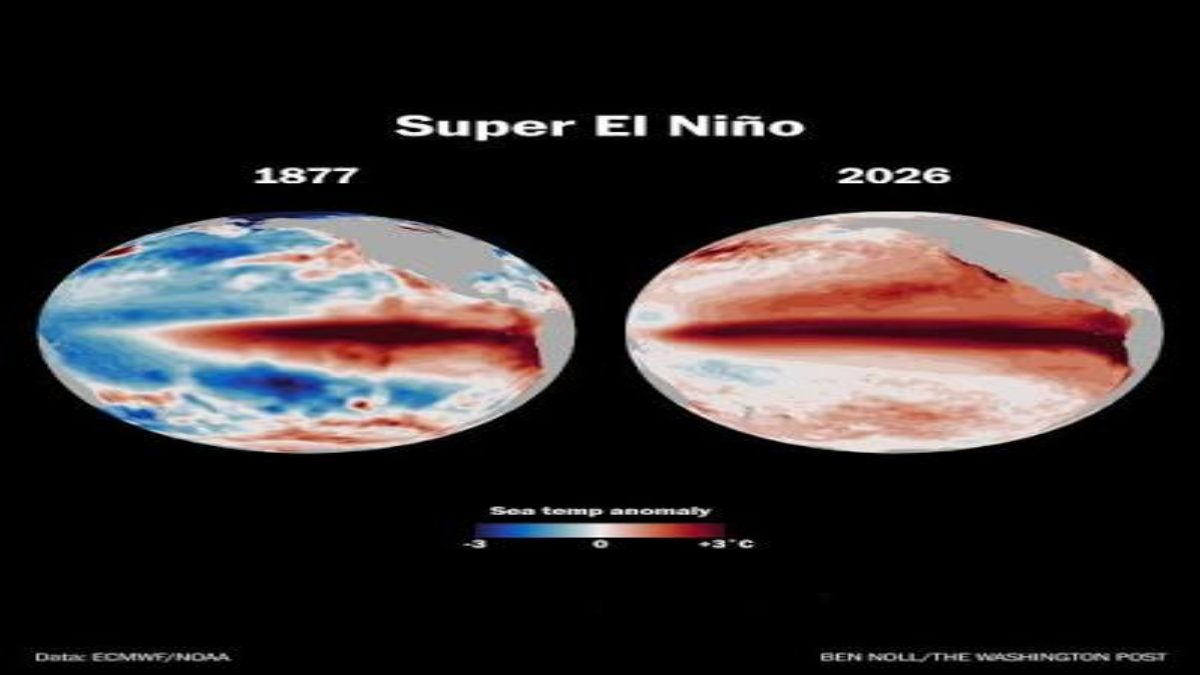
New Delhi, June 22, 2026 — Advanced space technology has given scientists an unprecedented, front-row seat to a colossal climate shift unfolding deep beneath the ocean surface. Satellite data from the international Sentinel-6 Michael Freilich spacecraft has detected an massive wave of hidden heat surging across the equatorial Pacific Ocean. The findings indicate that a powerful climate pattern is intensifying rapidly, drawing stark comparisons to the historic 1997 “Godzilla El Niño” that caused widespread global weather chaos.
As the planet enters mid-2026, major meteorological agencies — including the World Meteorological Organization (WMO) and the National Oceanic and Atmospheric Administration (NOAA) — have officially confirmed the activation of El Niño conditions. However, it is the sheer depth and volume of the underlying heat reservoir, mapped from hundreds of miles above Earth, that has climate scientists raising urgent flags about the extreme weather events looming for the latter half of the year.
The Invisible Fingerprint: How Satellites Track the Surge
Traditional weather tracking relies heavily on sea surface temperature (SST) measurements collected by floating marine buoys and ships. While useful, surface temperatures only tell part of the story. A thin layer of sun-baked surface water might register as exceptionally warm without possessing the thermal mass required to alter global weather systems.
To map the true extent of the phenomenon, the Sentinel-6 satellite utilizes radar altimetry to track subtle changes in sea surface height. Because water naturally expands as it absorbs heat, a higher ocean elevation is a direct fingerprint of a deep reservoir of stored energy below.
The latest satellite visualizations reveal vast, glowing bands across the central and eastern Pacific where sea levels are more than 5.9 inches (15 centimeters) higher than long-term averages. This massive hump of elevated water is being propelled eastward toward South America by enormous underwater pulses known as Kelvin waves.
These subterranean waves form when the standard equatorial trade winds, which normally blow from east to west, weaken or completely reverse direction. With the wind barriers down, the immense pool of warm water that typically stacks up near Indonesia and Australia behaves like a sloshing bathtub, sliding rapidly toward the coastlines of the Americas.
The Return of the “Godzilla” Phenomenon
The phrase “Godzilla El Niño” was first coined during the historic 1997–1998 event, which remains one of the strongest ocean-warming cycles ever documented in modern human history. That particular cycle triggered catastrophic mudslides in California, severe droughts and wildfires across Indonesia and Australia, and crop failures that impacted global food supplies for years.
NASA Jet Propulsion Laboratory (JPL) researchers analyzing the current space observations note that the structural profile of the current Kelvin waves closely mirrors the early development phases recorded in June 1997. If the current trajectory and wind patterns persist, the Relative Oceanic Niño Index (RONI) could push past a critical threshold, officially classifying this as a “very strong” or “super” El Niño event.
Global Disruptions: What to Expect Globally
The shifting of this immense body of warm water fundamentally alters the circulation of energy, air currents, and moisture throughout the global atmosphere. The downstream impacts behave like falling dominoes, bringing extreme moisture to some regions while stripping it away from others.
In regions like South Asia, the timing of this oceanic surge is causing intense concern. The India Meteorological Department (IMD) has been closely monitoring how this development interacts with other climate variables, such as the Indian Ocean Dipole. A weaker or erratic monsoon season could severely compromise groundwater reserves and impact agricultural output in areas already vulnerable to changing weather baselines.
The Climate Change Multiplier
What sets this event apart from historical occurrences is the baseline environmental state. The emerging El Niño is not developing in a vacuum; it is layering directly on top of a multi-decade global warming trend driven by human industrial activities.
Because a warmer atmosphere holds significantly more moisture and energy, the typical impacts associated with an ocean-warming cycle are magnified. Scientists warn that the combined force of anthropogenic warming and a natural “super El Niño” creates a volatile climate tandem. It increases the probability of record-shattering global average temperatures, making it highly likely that the subsequent year will set new global temperature benchmarks.
While modern agricultural practices, precision satellite forecasting, and disaster risk management frameworks have advanced significantly since the 1990s, the scale of the incoming heat pulse will test global infrastructure. Governments and humanitarian agencies are being urged to utilize these early space-based warnings to implement proactive water management strategies, reinforce coastal defenses, and secure food supply chains ahead of the peak intensity.
This video provides an excellent visual breakdown of the atmospheric shifts and global temperature concerns associated with this extreme climate pattern: Godzilla El Niño Forecast and Climate Impacts