

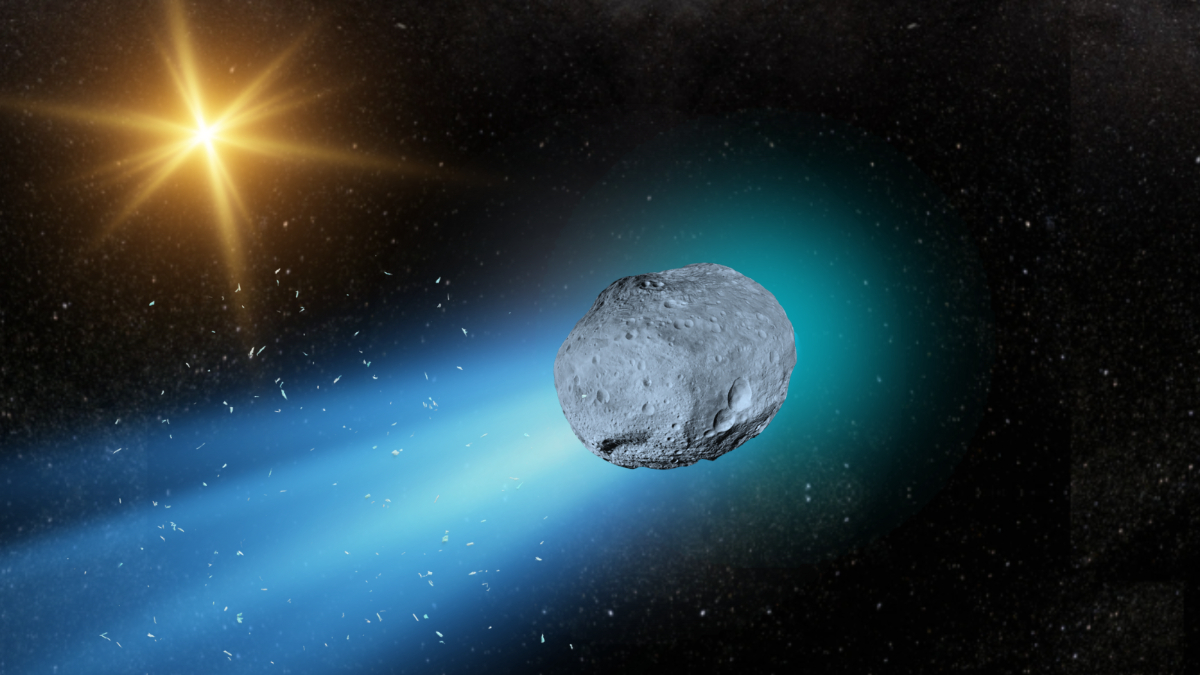
New Delhi, December 17, 2025: A rare messenger from the deep cosmos is making its final “hurrah” in our solar system this week. Comet 3I/ATLAS, only the third interstellar object ever confirmed to visit our celestial neighborhood, is currently at its closest point to Earth before it vanishes back into the darkness of interstellar space forever.
Discovered on July 1, 2025, by the ATLAS (Asteroid Terrestrial-impact Last Alert System) telescope in Chile, the comet has spent the last few months under the intense gaze of every major observatory, from the Hubble Space Telescope to the James Webb Space Telescope (JWST).
A Record-Breaking “Anti-Tail”
As of mid-December 2025, astronomers have reported a startling phenomenon: massive “anti-tail” pointing directly toward the Sun. While many comets have tails that stream away from the Sun due to solar wind, 3I/ATLAS has developed a sunward-facing plume of dust and gas stretching over 500,000 kilometers—a distance greater than that between the Earth and the Moon.
This “anti-tail” has sparked intense scientific debate. While some researchers, including Harvard’s Avi Loeb, have noted “anomalies” in how the tail behaves, most astronomers believe it is a result of the comet’s unique rotation and the way it sheds prehistoric ice as it warms up.
Where is it now?
If you are hoping to see a giant streak across the sky, you might need some help. Despite the excitement, 3I/ATLAS remains a target primarily for backyard astronomers with telescopes.
- Closest Approach: Friday, December 19, 2025.
- Distance: Approximately 1.8 astronomical units (270 million km)—nearly twice the distance between the Earth and the Sun.
- Visibility: It is currently moving through the constellations Virgo and Leo. It appears as a faint, greenish smudge (caused by diatomic carbon) and is visible in the early morning and late evening skies.
Why 3I/ATLAS is Different
Unlike “home-grown” comets like Halley’s, which orbit our Sun for millions of years, 3I/ATLAS is a traveler. It entered our system on a hyperbolic path at a staggering speed of 153,000 mph.
| Feature | 3I/ATLAS (2025) | 2I/Borisov (2019) | 1I/ʻOumuamua (2017) |
| Origin | Likely the Galactic Center | Distant Star System | Unknown |
| Composition | Carbon dioxide, Water, Nickel | Water ice, Carbon monoxide | Rocky/Metallic |
| Size | 0.44 to 5.6 km | ~0.5 km | ~0.4 km |
By studying the chemicals released from 3I/ATLAS, scientists are essentially getting a “sample” of a star system that might be billions of years older than our own. “It’s a golden opportunity,” says Paul Chodas of NASA’s Center for Near Earth Object Studies. “It’s like receiving a postcard from the other side of the galaxy.”
The Final Departure
After this week’s close pass, the comet will head toward Jupiter, passing within 33 million miles of the gas giant in March 2026. By the mid-2030s, it will cross the edge of our solar system and return to the void. Because of its extreme speed, the Sun’s gravity cannot hold it; it is a true one-time visitor on a journey that will last for billions of years.