

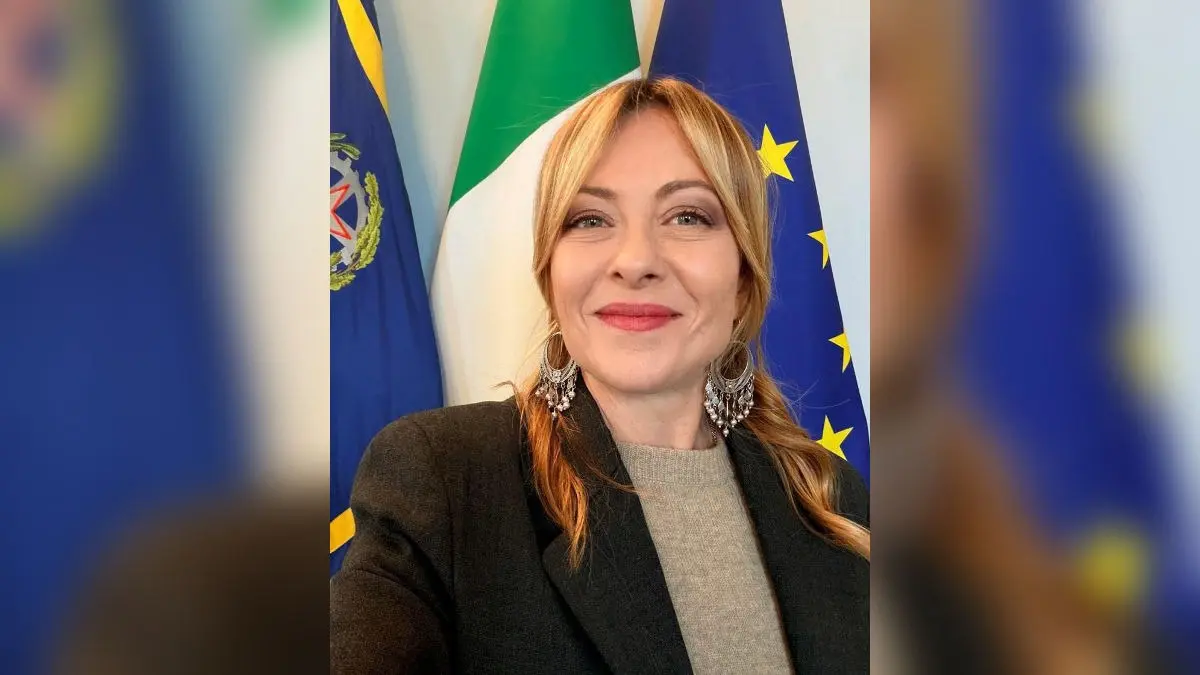
New Delhi, April 25, 2026: In the fast-paced, often serious world of international diplomacy, it is rare for a fashion choice to steal the spotlight from policy statements. Yet, this is exactly what happened this week when Italian Prime Minister Giorgia Meloni shared a selfie that sent Indian social media into a whirlwind of excitement.
In a moment that perfectly illustrates the power of modern digital culture, the Italian leader’s choice of accessories—a pair of traditional, intricately designed Indian jhumkas—transformed a standard political update into one of the most talked-about viral sensations of 2026.
The Viral Snapshot: A Blend of Power and Tradition
On April 24, 2026, Prime Minister Meloni posted a photo on her social media channels. The image featured her in a sharply tailored, professional ensemble: a charcoal blazer layered over a crisp, beige knit top. It was a classic “power look” that one would expect from a head of state.
However, it was the detail beneath the ears that caught the world’s eye. Dangling gracefully were unmistakably Indian jhumkas—ornate, bell-shaped earrings, complete with delicate ghungroo (small metallic beads) detailing.
The accompanying caption was intense, focusing on themes of political integrity, national sovereignty, and resilience against external propaganda. Yet, the internet, with its selective focus and love for the unexpected, largely ignored the heavy political discourse. Instead, the comment sections were flooded with a wave of warmth, surprise, and pride from Indian users.
More Than Just Jewellery: The Cultural Weight of the Jhumka
To understand why this specific fashion choice caused such a stir, one must understand the cultural significance of the jhumka in India.
The jhumka is not merely an accessory; it is a cultural icon. With roots stretching back centuries, the design has been a staple of Indian craftsmanship, transcending state borders and generations. From the ornate, heavy gold designs of South Indian temple jewellery to the delicate, silver, bohemian styles popular in the North, the jhumka is worn at everything from intimate family gatherings to grand, festive weddings.
When a global leader—who has no direct cultural connection to the subcontinent—chooses to wear such a deeply symbolic piece of Indian heritage, it resonates differently. For many Indian netizens, seeing Meloni wear jhumkas felt like a quiet acknowledgement of India’s growing global cultural footprint. It validated the “desi aesthetic” as something that doesn’t just belong in traditional settings but can sit seamlessly alongside Western, professional power-dressing.
The “Melodi” Effect and Fashion Diplomacy
This isn’t the first time Giorgia Meloni has captured the attention of the Indian digital audience. The Italian Prime Minister has cultivated a warm, collaborative relationship with India on the diplomatic stage, often referred to light-heartedly by social media users as the “Melodi” dynamic (a playful portmanteau of Meloni and Modi).
In today’s globalized world, leaders are increasingly using “soft diplomacy”—the subtle use of culture, fashion, and social media to foster goodwill. By donning these earrings, whether as a deliberate nod to her Indian counterparts or simply because she admired the craftsmanship, Meloni created an instant, humanizing connection with millions of people. It turned a rigid political figure into a relatable cultural icon, proving that even a small, silver accessory can bridge gaps that formal treaties sometimes cannot.
The Conversation: Appreciation vs. Appropriation
The viral moment also brought a more nuanced debate to the surface. As the image circulated, it ignited a broader conversation about the global perception of Indian fashion.
In recent months, the internet has been highly sensitive to “cultural appropriation,” particularly when international luxury fashion houses have showcased designs strikingly similar to traditional Indian crafts—often without providing proper credit to the artisans or acknowledging the origins. The backlash against such instances has been fierce, with users demanding that credit be given where it is due.
However, Meloni’s “jhumka moment” was met with largely positive sentiment. Why the difference? Many commentators noted that there was a level of respect in the styling. It wasn’t an exaggerated “costume” look, but a subtle, elegant integration into her personal style. For many, this distinction is key: it wasn’t about “borrowing” culture for a trend, but rather participating in a cross-cultural exchange. It sparked a discussion on how international figures can engage with Indian heritage in a way that feels authentic and respectful.
The Internet’s Verdict: A New Fashion Icon?
The response on platforms like X (formerly Twitter) and Instagram was electric. Memes appeared within hours, with users playfully editing Bollywood music tracks over her photos or comparing her look to the “power-dressing” seen in Indian cinema.
Some comments were purely celebratory:
- “Earrings from India? That’s such a lovely touch!”
- “The jhumkas have officially gone global.”
- “A truly unexpected but iconic fashion moment.”
Others saw it as a testament to the fact that Indian heritage is now a permanent fixture in the global zeitgeist. From high-fashion runways in Paris to the quiet offices of the Italian Prime Minister, the jhumka has traveled further than many expected.
Final Reflections: The Power of the Small Gesture
As the buzz settles, the incident remains a fascinating case study in how the internet processes fame, culture, and politics. In an era where political news is often divisive and grim, Meloni’s jhumka post provided a moment of lighthearted unity.
It serves as a reminder that the world is more interconnected than ever. When a leader chooses to wear a piece of jewellery that speaks to the identity of another nation, it sends a message—intentional or not—of closeness and appreciation.
Perhaps the real lesson here is the enduring appeal of the jhumka itself. Timeless, elegant, and deeply rooted in tradition, it proved once again that it can hold its own on any stage, in any country, and in any conversation—even one about global politics.
Giorgia Meloni may have started her day intending to make a political statement, but she ended it by becoming a symbol of a rising, culturally influential India, one pair of earrings at a time.