

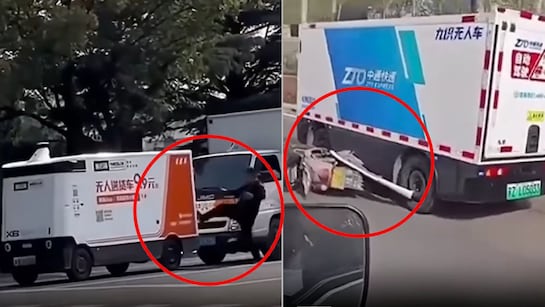
New Delhi, January 14, 2026: The rapid deployment of self-driving courier vans in China has recently come under intense scrutiny following the release of several viral videos. While these autonomous vehicles were originally intended to serve as highly efficient logistical solutions, they are now being described by many as a growing urban menace. Footage circulating across platforms like X and Xiaohongshu shows these unmanned units navigating city streets with a startling lack of situational awareness. Instead of streamlining the delivery process, the technology appears to be struggling with the complexities of real-world traffic and infrastructure.
A Trail of Infrastructure Damage
Significant concern is being raised regarding the physical impact of these vans on public and private property. In one widely shared clip, an autonomous delivery vehicle is seen plowing directly through a patch of freshly poured concrete, completely ignoring the efforts of construction workers to divert it. Other videos depict the vans aggressively mounting high curbs, crashing into barriers, and even continuing to drive with a motorcycle wedged beneath their wheels. It is argued by local residents that the “stubborn” programming of these vehicles, which often prioritizes fixed-route completion over obstacle avoidance, is creating a trail of destruction in its wake.
Also Read: The Mustafizur Rahman AI Hoax
Public Safety and Traffic Disruption
The threat to road safety has become a focal point of the ongoing debate. It is observed that these vans often operate at speeds or in manners that are unpredictable to human drivers and pedestrians. Several incidents have been recorded where self-driving units have barreled down highway shoulders or moved erratically through narrow, potholed back alleys. The lack of an on-board human operator means that immediate intervention during a malfunction is impossible, leading to prolonged traffic jams and hazardous conditions. These “autonomous terrors” have been likened to a real-life version of a chaotic video game, sparking a mix of humor and genuine fear among onlookers.
Reevaluating the Autonomous Push
In light of these viral “menace” videos, the aggressive timeline for autonomous vehicle integration is being questioned by both the public and regulators. While major courier companies have deployed thousands of these units to handle “last-mile” deliveries, the technology’s inability to handle unpredictable human environments is now glaringly obvious. The tragic loss of life in a recent high-speed autonomous car crash has already forced authorities to slow down certain approval processes. It is suggested that until AI can reliably navigate potholes, rogue bikers, and construction zones, the dream of a seamless driverless future may remain a distant and dangerous reality.