

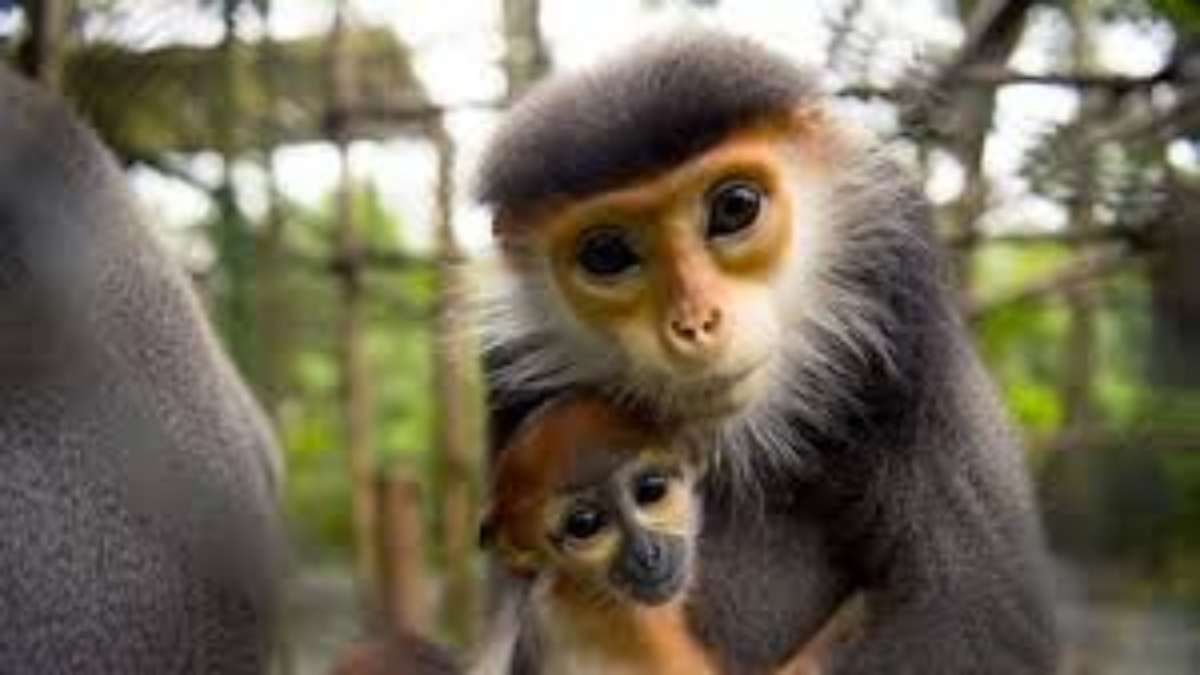
New Delhi, June 18, 2026: A tiny primate with a pair of massive, glassy eyes, a wonderfully clumsy first step, and a colorful coat is taking the internet by storm. Meet Mi, a critically endangered baby red-shanked douc langur who has officially made her public debut at the Yokohama Zoological Gardens Zoorasia in Japan. Born earlier this year, this little bundle of joy spent her first few months completely secluded under the protective care of her parents, Hoa and Moi. Now, she is drawing record-breaking crowds and reminding the world of the fragile beauty of her species.
The name “Mi” was chosen through a public vote by zoo visitors, who selected it from a list of options. It is derived from a Vietnamese word meaning “beautiful,” a fitting tribute to both her heritage and her striking appearance. As a species native to the dense rainforest canopies of Southeast Asia—primarily Vietnam and Laos—the red-shanked douc langur is widely celebrated as the “world’s most beautiful monkey.”
A Living, Breathing Masterpiece
Looking at baby Mi, it is easy to see why her species has earned such high praise. While adult red-shanked doucs look almost as if they are wearing an elaborate, colorful costume—complete with deep red “stockings” on their legs, white forearms, black hands, and a bright golden-orange face frame—baby Mi is a miniature version of this striking palette.
Her most captivating feature is undoubtedly her eyes. Disproportionately large for her tiny face, her dark, round eyes give her a perpetually curious and innocent expression that instantly melts hearts. Her fur is incredibly soft and transitions into a beautiful mix of gray, white, and subtle hints of the vibrant colors she will fully develop as she matures.
According to her keepers at Zoorasia, Mi’s daily routine is a mix of playful exploration and frequent naps. In her first few months, she rarely detached herself from her mother, Hoa. However, as the weeks have passed, she has started showing a wonderful streak of independence. Visitors frequently catch glimpses of her confidently balancing across logs on her own, testing her reflexes, and venturing a few feet away from her parents—though she quickly scrambles back to her mother’s arms the moment she feels unsure.
Understanding the Red-Shanked Douc Langur
To truly appreciate how special Mi’s debut is, it helps to understand what makes her species unique. These gentle primates are specialized arboreal creatures, meaning they spend almost their entire lives high up in the forest canopy. They rarely ever descend to the ground, choosing instead to travel through the treetops by leaping from branch to branch with incredible agility.
Because their diet consists almost entirely of leaves, their digestive systems are highly complex. They possess a multi-chambered stomach, similar to that of a cow, which relies on specific bacteria to ferment and break down the tough, fibrous plant material. This makes caring for them in captivity exceptionally difficult, as keepers must source specific types of fresh leaves to replicate their wild diet and prevent fatal digestive issues.
A Bittersweet Spotlight: The Fight Against Extinction
While Mi’s viral fame brings smiles to millions, her story carries a heavy and urgent message. The red-shanked douc langur is currently listed as Critically Endangered by the International Union for Conservation of Nature (IUCN). In the wild, their populations have experienced a catastrophic decline over the last few decades.
The primary threat to their survival is habitat loss. Rapid agricultural expansion, logging, and infrastructure development have fragmented the dense Southeast Asian rainforests they call home. When the canopy is destroyed, these monkeys lose not only their nesting sites but also their highly specific food sources.
Furthermore, their striking beauty makes them a prime target for illegal wildlife poachers. Adults are frequently hunted for the illegal pet trade, or for use in traditional medicine. Because these primates are so socially close-knit, poachers often shoot the mothers just to capture the clinging infants. Sadly, due to their specialized dietary needs, the vast majority of smuggled douc langur babies die within weeks of capture.
Hope for the Future
The successful birth and public debut of Mi at Yokohama Zoological Gardens Zoorasia represents a major victory for international conservation efforts. Zoos participating in managed breeding programs play a critical role in creating a genetic safety net for species facing total extinction in the wild.
Every milestone Mi reaches—whether it is tasting her first solid leaf, successfully completing a tricky jump, or simply looking out at the crowds with her famous, wide-eyed gaze—is a step forward for her species. Zoo officials hope that the global affection for Mi will translate into real-world action, inspiring people to support rainforest preservation and combat the illegal wildlife trade. For now, little Mi remains blissful unaware of her status as an ambassador for her species, content with exploring her habitat under the watchful, loving eyes of her family.