

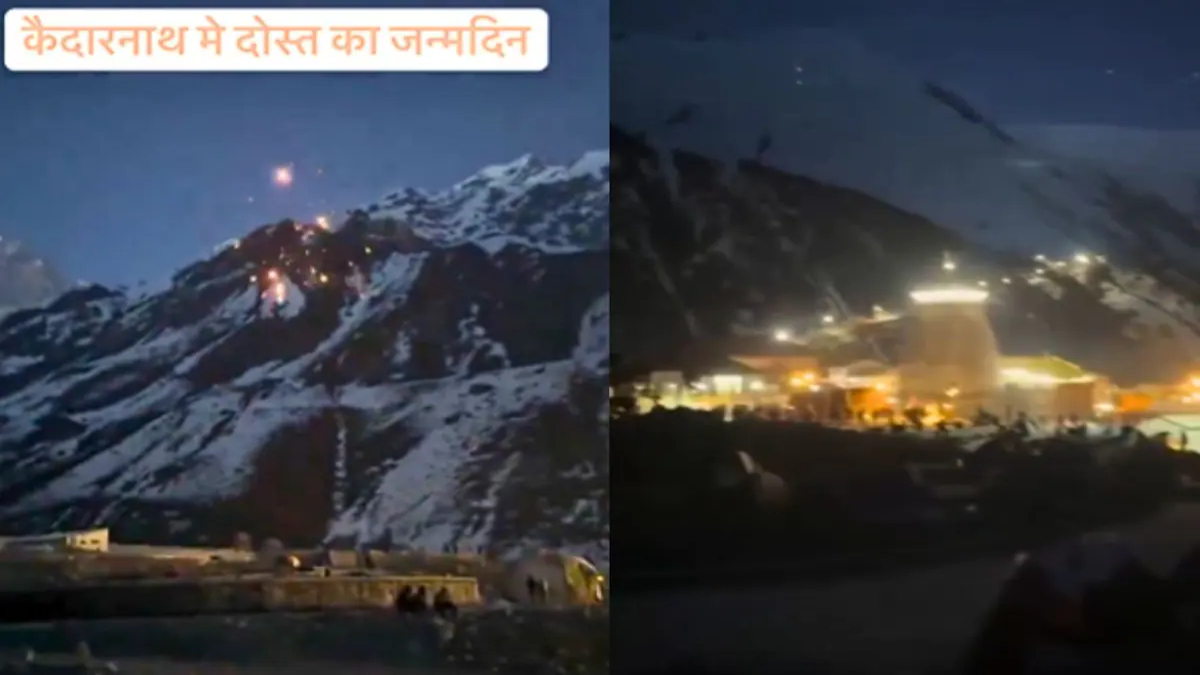
New Delhi, May 2, 2026 — The sanctity of one of India’s most revered pilgrimage sites has been thrust into the center of a national debate following a viral video showing tourists bursting firecrackers to celebrate a birthday within the premises of the Kedarnath Temple. The incident, which occurred just days after the commencement of the Char Dham Yatra, has sparked massive public outrage, leading to immediate police intervention and a stern warning from authorities regarding the conduct of pilgrims at holy sites.
The Incident and Police Action
The controversy began earlier this week when a video surfaced on social media platforms, showing a group of individuals celebrating a birthday near the hallowed Kedarnath shrine. In the footage, the tourists are seen lighting firecrackers, clearly audible and visible, amidst the sacred environment where thousands of devotees gather to seek spiritual solace.
The Rudraprayag Police, acting swiftly upon the circulation of the video, registered a formal FIR at the Kotwali Sonprayag police station. The case has been filed against the individuals involved, including the owner of an Instagram handle identified as ‘Sumit-Ke-Blog’, under Section 353(3) of the Bharatiya Nyaya Sanhita (BNS). This section specifically addresses acts of public mischief and the violation of sanctity within a place of worship.
“The reel appears to have been recorded during the initial days of the shrine’s opening,” said Sub-inspector Ravindra Singh Rawat, in-charge of the Rudraprayag Social Media Monitoring Cell. “An investigation is underway to identify and apprehend all individuals involved in this act, which has deeply hurt the religious sentiments of pilgrims and devotees.”
A Growing Trend of “Reel Culture”
This incident is not an isolated event but rather part of a worrying pattern that has emerged during the 2026 Char Dham Yatra. Since the portals of the temple opened on April 22, police have been grappling with a rising tide of improper behavior by visitors more interested in creating social media content than in religious observance.
Reports indicate that nearly half a dozen similar cases have been registered within the first week of the pilgrimage alone. Other infractions include:
- Political Demonstrations: Visitors waving political party flags within the temple vicinity.
- Restricted Zone Breaches: Vloggers and tourists venturing into restricted, fragile glacier zones to film content, ignoring boundary ropes and safety warnings.
- Disruptive Conduct: General unruly behavior that hinders the smooth management of the heavy footfall of devotees.
Local residents and shrine officials have expressed profound disappointment. Ashish Gairola, a local resident, lamented the shift in visitor behavior: “The things happening this time are unprecedented. People are breaching the sanctity of such a pious place. It feels as though more people are coming for social media likes and comments rather than to experience the spirituality of Kedarnath.”
The Impact on Pilgrimage and Administration
The Kedarnath Yatra is a monumental administrative effort, requiring massive coordination to manage crowds, ensure safety, and maintain the fragile Himalayan ecology. The local economy, which relies heavily on the success of the pilgrimage, is now concerned that such controversies could tarnish the reputation of the Yatra.
For the police, managing these incidents is not only a matter of law but a drain on critical resources. An officer deployed at the site noted, “Dealing with such conduct consumes time and manpower that should be dedicated to assisting elderly pilgrims and ensuring the safety of the massive crowds we see daily.”
The Badrinath-Kedarnath Temple Committee (BKTC) has issued a renewed appeal to all visitors. Senior priest and committee member, Vineet Posti, emphasized that the administration is continuously requesting devotees to behave in a dignified manner that aligns with the religious significance of the Dham.
Law, Ecology, and Religious Sensitivity
The incident also highlights the intersection of law, environment, and tradition. Uttarakhand’s topography is ecologically sensitive, and the noise and chemical pollution from firecrackers pose risks to local wildlife and the environment. Beyond the environmental impact, the act of bursting crackers in a site of profound religious silence and devotion is viewed as a direct affront to the sentiments of the millions who travel great distances to pray there.
State authorities have now tightened social media monitoring, with the state cyber crime unit actively tracking handles that violate norms. Nilesh Anand Bharne, IG (STF) and the state cyber crime unit, stated, “Our dedicated social media monitoring team is identifying such handles and accounts to take necessary legal action. FIRs have already been registered, and more action will follow wherever required.”
Conclusion: A Call for Responsibility
As the Char Dham Yatra continues, the incident serves as a stark reminder of the responsibilities that accompany tourism in sacred spaces. While the digital age encourages capturing memories, there is a growing consensus that such documentation must not come at the cost of public decorum, environmental safety, or the religious sanctity of India’s cultural heritage.
The police action in this case is intended as a deterrent, signaling that the “reel culture” will not be permitted to overshadow the devotion that defines the Kedarnath experience. As the season progresses, authorities are hopeful that increased vigilance and public awareness will restore the peace and reverence that the Kedarnath Dham rightfully demands.