

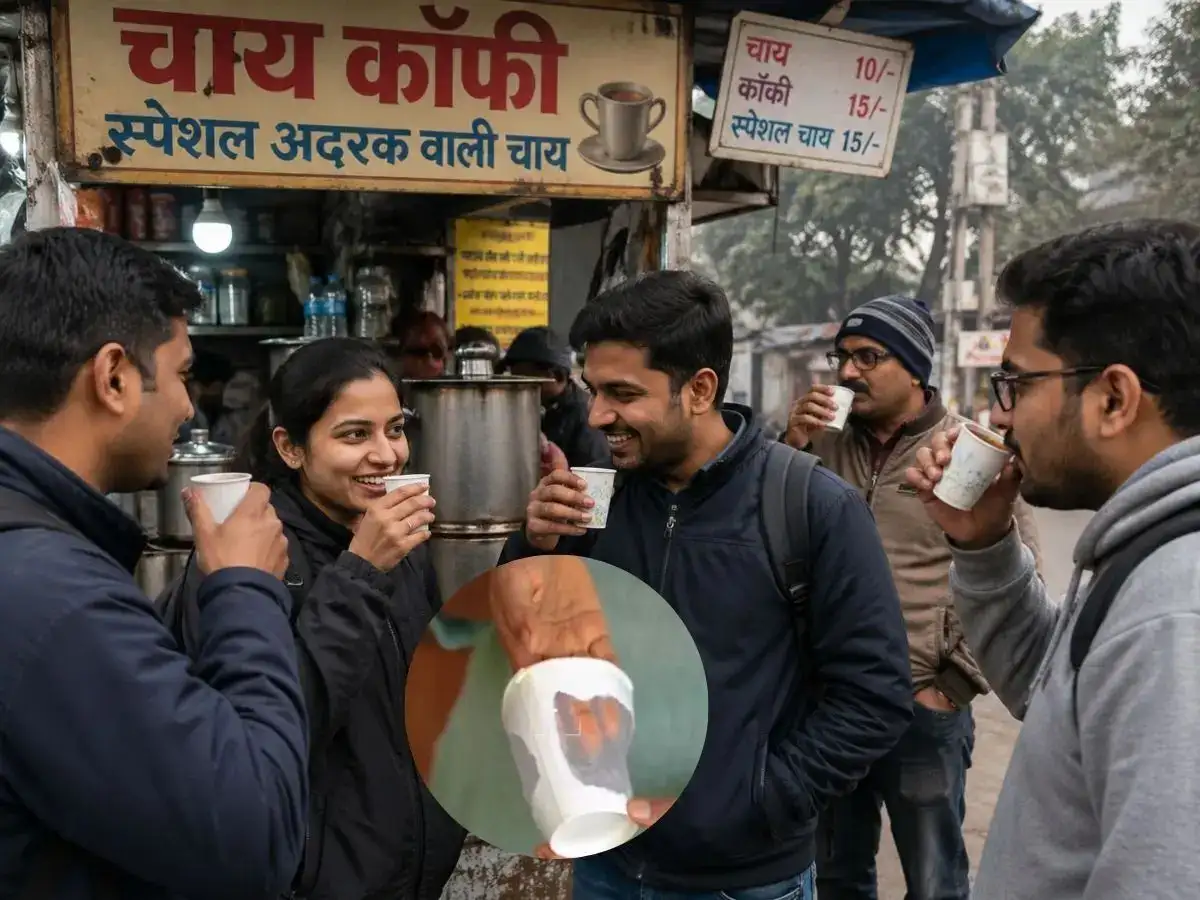
New Delhi, April 25, 2026: A startling revelation regarding everyday coffee and tea habits has taken social media by storm today, April 25, 2026. A viral video circulating on platforms like X and Instagram is challenging the long-held belief that paper cups are a safer, eco-friendly alternative to plastic. The “truth” behind the demonstration, which has amassed millions of views, reveals that what appears to be a simple paper container is often observed to be lined with a hidden layer of polyethylene plastic to prevent leaks and maintain structural integrity when filled with hot liquid.
The interaction was observed to have been captured by a content creator who demonstrated the “peel test,” showing a thin, transparent plastic film separating from the paper shell. In the viral clips, it is claimed that pouring hot beverages at temperatures of $85\text{–}90^{\circ}\text{C}$ into these cups for just 15 minutes can release approximately 25,000 microplastic particles into a single 100 ml drink. This “microplastic tea” has been described by health advocates as a silent contributor to long-term physical issues, as these invisible fragments are ingested with every sip.
More Than Just Microplastics: The Chemical Leaching Concern
The reaction from the digital community has been one of shock and immediate concern, with many users tagging food safety authorities for stricter regulations. It is argued by researchers cited in the video that beyond microplastics, the heat-induced breakdown of the plastic lining may release trace amounts of heavy metals such as lead, chromium, and cadmium. On various wellness forums, the footage has been shared alongside warnings about endocrine disruptors like BPA, prompting a surge in the hashtag #PaperCupReality as users rethink their daily office and street-side chai rituals.
The impact of the video has prompted a wider discussion about the “greenwashing” of disposable products. It is noted by environmentalists that the very plastic lining that keeps the cup from leaking also makes it nearly impossible to recycle in standard facilities. The passive role of the consumer—who often chooses paper believing it to be the “cleaner” option—has been cited as a primary target for this awareness campaign, which suggests that the most sustainable and healthy choice is to carry a personal stainless steel or glass container.
Also Read: K. Kavitha Launches ‘Telangana Rashtra Sena’, Targets BRS Leadership in Major Political Shake-up
A Simple Switch: Reclaiming Health with Reusable Alternatives
Following the viral spread of the “Reality Check” clip, many popular cafe chains and hospital cafeterias have come under scrutiny for their continued reliance on lined paper cups. It is reported that the video concludes with a practical solution: a shift back to traditional materials like steel, ceramic, or glass. The passive wait for the industry to develop truly biodegradable, plastic-free coatings is being bypassed by a growing movement of individuals who are now seen carrying their own flasks to avoid the “hidden plastic” altogether.
As of the afternoon of April 25, 2026, the “Paper Cup vs. Plastic” debate remains a top trending topic in the health and environmental categories. While the convenience of disposables is hard to match, the digital record of the plastic film peeling away serves as a permanent testimony to the hidden costs of modern convenience. For now, the story stands as a digital reminder: the safest cup is the one you bring yourself, ensuring that the only thing you consume is the drink you actually ordered.