

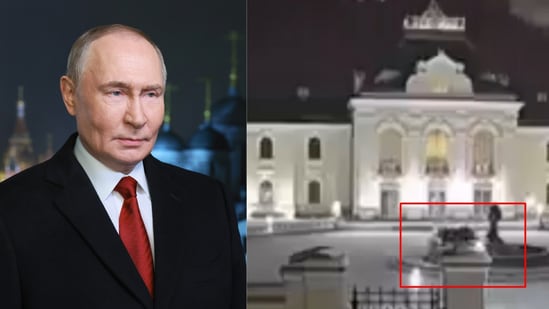
New Delhi, January 1, 2026: A wave of international alarm was triggered on December 31, 2025, after a chilling video began circulating on social media, purportedly showing a massive drone attack on Russian President Vladimir Putin’s residence. The 15-second clip, which features multiple drones striking a heavily guarded compound, has amassed millions of views across X and Telegram. However, as the world transitions into January 2026, the authenticity of this footage has been called into serious question by intelligence agencies and digital forensics experts alike.
AI Deception and the “Viral” Smoke Screen
The viral video showing the actual impact on the residence has been confirmed as a sophisticated AI-generated fabrication. Detailed fact-checks by digital experts and platform safety teams revealed that the footage contains several visual anomalies, such as inconsistent lighting and unrealistic physics during the explosions. It was noted that while the clip appeared highly realistic to the untrained eye, it was designed specifically to capitalize on current geopolitical tensions. On January 1, 2026, social media platforms began labeling the footage as “AI Generated” to prevent further public panic.
Also Read: The Viral Moments That Defined India in 2025
The Kremlin’s Official Claims vs. Intelligence Reports
While the viral “strike” video is a fake, the Kremlin has been observed doubling down on allegations of a real-world attempt. On December 31, the Russian Defense Ministry released its own night-time footage of what it claimed were fragments of a Chaklun-V drone downed near Putin’s residence in the Novgorod region. Russian officials alleged that 91 drones were intercepted during a “mass launch” by Ukraine. However, these claims were met with extreme skepticism by the CIA and US National Security officials, who stated on Thursday that no evidence exists to suggest that Putin or his residences were ever targeted.
Ukraine’s Firm Rebuttal and Diplomatic Fallout
The allegations have been described by Ukrainian President Volodymyr Zelenskyy as a “complete fabrication” and a “typical Russian lie.” It was argued by Kyiv that the story was manufactured by Moscow to derail ongoing peace negotiations and to justify intensified strikes on Ukrainian cities, including the capital. The timing of the “attack” was highlighted as particularly suspicious, occurring just as diplomatic efforts between Ukraine and the Trump administration were reaching a delicate phase. Ukraine’s Foreign Ministry dismissed the Russian “debris video” as laughable, noting the two-day delay in producing such meager evidence.
Navigating a New Era of Information Warfare
As 2026 begins, this incident serves as a stark reminder of the complexities of information warfare in the age of generative AI. While the Russian government used the incident to “harden its negotiating position,” international observers have been urged to rely on verified intelligence rather than viral clips. The “Putin drone attack” saga highlights how manufactured digital content can influence real-world leaders, as evidenced by initial expressions of concern from global figures before the footage was debunked. For now, the consensus remains that no such strike occurred, and the viral video was merely a digital illusion.