
Home Blog Page 186

Sonam Bajwa Sets Fitness Goals with Viral ‘Impromptu’ Post-Workout Dance

0

New Delhi, February 24, 2026: Punjabi cinema’s reigning queen, Sonam Bajwa, has once again captured the internet’s heart, but this time it wasn’t for a high-glamour red carpet look or a gripping film teaser. Taking to her social media, the actress shared a candid, high-energy video of her “impromptu cool down” session following a grueling workout, proving that fitness can—and should—be fun.

Known for her disciplined lifestyle and envy-inducing physique, Bajwa’s latest post offers a refreshing glimpse into her personality beyond the silver screen.

Redefining the ‘Cool Down’

While most fitness enthusiasts stick to static stretching and deep breathing after a gym session, Sonam decided to take a more rhythmic approach. In the video, dressed in sleek athletic wear, the actress is seen breaking into a spontaneous dance routine.

With a radiant, post-workout glow and messy hair, she embraced the endorphin rush, captioned the post: “An impromptu cool down because why not?” The clip quickly went viral, garnering hundreds of thousands of likes within hours. Fans and fellow celebrities flocked to the comments section to praise her energy, with many noting that her “natural vibe” is what makes her stand out in the crowded space of fitness influencers.

Why This resonates with Fans

Sonam Bajwa has built a massive following not just through her acting prowess in hits like Carry on Jatta and Godday Godday Chaa, but through her relatability. By sharing a video that is unpolished and joyful, she sends a powerful message to her followers:

  • Fitness isn’t a chore: It’s a celebration of what the body can do.
  • Authenticity wins: In an era of curated “perfection,” a sweaty, dancing-like-nobody’s-watching video feels like a breath of fresh air.
  • Mental Well-being: Highlighting the “fun” side of exercise encourages a healthier relationship with physical movement.

A Style Icon Even at the Gym

Even in a casual gym setting, Sonam’s style remains impeccable. Sporting a coordinated monochrome gym set, she effortlessly blended functionality with fashion. Her minimal-effort, maximum-impact look has already sparked a wave of “gym-wear inspo” posts across Pinterest and Instagram.

What’s Next for Sonam?

On the professional front, Sonam continues to be one of the most sought-after names in the Punjabi film industry and is increasingly making waves in pan-Indian circles. While her fans eagerly await her next cinematic outing, these snippets of her daily life keep the engagement levels skyrocketing.

As the video continues to trend, one thing is clear: Sonam Bajwa knows exactly how to keep her audience entertained, whether she’s delivering a dramatic monologue or just dancing away the post-workout fatigue.
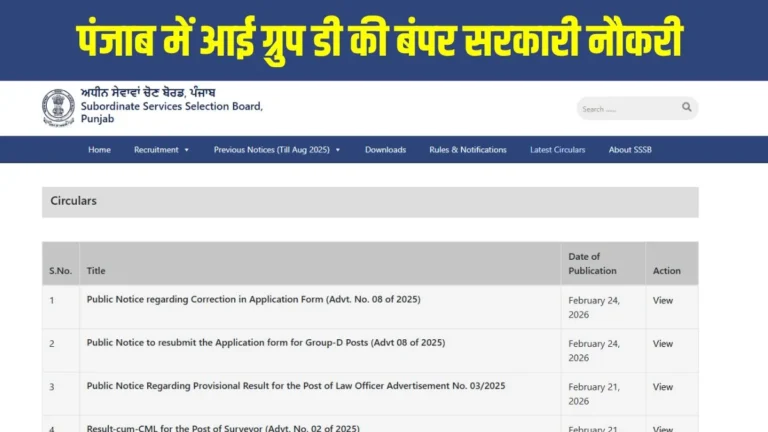
PSSSB Group D Recruitment 2026: Apply Online from February 27

0

New Delhi, February 24, 2026: The Punjab Subordinate Services Selection Board (PSSSB) has officially released the recruitment notification for various Group D positions across several government departments. According to the short notice issued under Advertisement No. 04/2026, the online application window is scheduled to open on February 27, 2026.

This recruitment drive provides a significant opportunity for job seekers in Punjab looking for stable government employment. While the short notice has confirmed the timeline, the board is expected to release the post-wise vacancy breakdown and the detailed PDF notification on the official website shortly.

PSSSB Group D Recruitment 2026: Key Highlights

ParticularsDetails
Recruiting BodyPunjab Subordinate Services Selection Board (PSSSB)
Post NamesSewadar, Chowkidar, Mali, Peon, Sweeper, etc.
Advertisement No.04/2026
Job LocationPunjab
Application ModeOnline
Official Website[suspicious link removed]

Important Dates to Remember

Candidates should keep a close watch on the following schedule to ensure they do not miss the registration deadlines:

  • Release of Short Notification: February 23, 2026
  • Commencement of Online Applications: February 27, 2026
  • Last Date to Apply Online: March 20, 2026 (up to 5:00 PM)
  • Last Date for Fee Payment: March 20, 2026
  • Exam Date: To be announced

Eligibility Criteria

To be eligible for the PSSSB Group D vacancies, applicants must meet the following basic requirements:

  1. Educational Qualification: Candidates must have passed Class 10 (Matriculation) from a recognized board.
  2. Language Requirement: It is mandatory for applicants to have passed Punjabi as a subject at the matriculation level.
  3. Age Limit (as of Jan 1, 2026):
    • Minimum Age: 18 years
    • Maximum Age (General): 37 years
    • Note: Age relaxation will be provided to SC, BC, and other reserved categories as per Punjab Government rules.

Application Fee Structure

The application fee varies based on the candidate’s category:

  • General / Freedom Fighters: ₹1,000
  • SC / BC / EWS (Punjab): ₹250
  • Ex-Servicemen & Dependents: ₹200
  • Physically Handicapped (PwD): ₹500

Selection Process

The PSSSB will select candidates based on a multi-stage process designed to test basic aptitude and language proficiency:

  • Written Examination: An objective-type (MCQ) test.
  • Document Verification: Successful candidates from the merit list will be called for original document checking.
  • Medical Examination: A final fitness check before the formal appointment.

How to Apply for PSSSB Group D 2026

Once the link is activated on February 27, eligible candidates can follow these steps:

  1. Visit the official portal at sssb.punjab.gov.in.
  2. Click on the “Applications” tab on the homepage.
  3. Find the link for Advertisement No. 04/2026 (Group D Recruitment).
  4. Complete the One-Time Registration (OTR) to generate your credentials.
  5. Fill out the application form with personal and educational details.
  6. Upload scanned copies of your photograph, signature, and 10th-grade mark sheet.
  7. Pay the application fee and submit the form.
  8. Download and print the confirmation page for future reference.

Note to Aspirants: The number of vacancies for the 2026 cycle is expected to be substantial, following a previous recruitment (Advt 08/2025) that saw a total of 406 posts. Candidates are advised to read the detailed notification carefully before applying.

JEE Main 2026 Paper 2 Result: NTA to Declare B.Arch and B.Planning Scores Soon

0

New Delhi | February 24, 2026: Thousands of architecture and planning aspirants are on the edge of their seats as the National Testing Agency (NTA) is expected to announce the JEE Main 2026 Session 1 Paper 2 results imminently. Following the release of the Paper 1 (B.E./B.Tech) results on February 16, the focus has shifted to the candidates who appeared for the B.Arch (Paper 2A) and B.Planning (Paper 2B) examinations on January 29, 2026.

According to the latest updates from the official portal, the final answer keys for Paper 2 have already been processed. Historically, the NTA declares the Paper 2 results within a few days of the engineering paper results, often citing the extra time required for the manual evaluation of the drawing sketches in the B.Arch segment.

Key Highlights of the JEE Main Session 1 Result

As the countdown begins, here is a summary of the current status and upcoming events:

  • Official Website: jeemain.nta.nic.in
  • Final Answer Key: Released; NTA reportedly dropped six questions, and candidates will receive bonus marks for these as per the marking scheme.
  • Result Format: Results will be available as NTA scores (percentiles) rather than raw marks to ensure a level playing field across different shifts.
  • Session 2 Registration: The window for Session 2 registration closes tomorrow, February 25, 2026, making it vital for students to check their scores and decide on a second attempt.

How to Check JEE Main 2026 Paper 2 Results

Once the link is activated, candidates can follow these steps to download their scorecards:

  1. Visit the Official Portal: Navigate to the NTA JEE Main website at jeemain.nta.nic.in.
  2. Locate the Link: Click on the notification titled “Result/Scorecard for JEE (Main) 2026 Session 1 Paper 2.”
  3. Enter Credentials: Provide your Application Number and Date of Birth (or Password).
  4. Security Pin: Input the case-sensitive CAPTCHA displayed on the screen.
  5. Download & Print: View your percentile scores and download the PDF. It is highly recommended to keep multiple physical copies for the JoSAA/CSAB 2026 counseling process.

Understanding the Normalization Process

Since the drawing test (Part III of B.Arch) is conducted in a pen-and-paper format, it undergoes a rigorous manual grading process. The scores are then normalized with the computer-based Mathematics and Aptitude sections.

Note: In the event of a tie in Paper 2, the NTA uses a specific hierarchy for resolution: higher marks in Mathematics, followed by the Aptitude Test, then the Drawing Test, and finally, the candidate with the fewer negative responses is ranked higher.

What’s Next for Aspirants?

With the Paper 2 result out soon, candidates will have a clearer picture of their standing for admission into prestigious institutions like the School of Planning and Architecture (SPAs) and various NITs.

For those looking to improve their performance, the Session 2 examination is scheduled to take place between April 2 and April 9, 2026. The correction window for Session 2 applications will also open briefly from February 27 to February 28, 2026.

Viral “Train Cooler” Hack Sparks Safety Debate

0

New Delhi, February 24, 2026: It was only a matter of time before “summer survival hacks” met the reality of railway safety protocols. The video of a passenger hooking up a full-sized desert cooler inside a non-AC sleeper coach has certainly set the internet—and the Indian Railways’ safety departments—on fire.

While we can all empathize with the sweltering heat of a cross-country train journey, this particular “innovation” sits right at the intersection of clever and dangerous.

The Core Issues: Why It’s Not Just “Cooling Off”

The debate isn’t just about someone being extra; it’s about the technical and legal risks involved in modifying a public transport environment.

  • Electrical Overload: Train coaches have specific voltage and load capacities. Plugging in a high-wattage appliance like a cooler can lead to short circuits, potentially causing a fire in a moving vehicle—a nightmare scenario for emergency services.
  • Safety Hazards: An unsecured, water-filled heavy metal box is essentially a projectile if the train brakes suddenly. Furthermore, water spillage near electrical points in a vibrating carriage is a recipe for disaster.
  • Legal Ramifications: Under the Railways Act, unauthorized use of electricity or carrying bulky items that obstruct passengers is a punishable offense. It can lead to heavy fines or even imprisonment.

Public Reaction: Two Sides of the Coin

The viral debate has split social media into two very distinct camps:

The “Jugaad” SupportersThe Safety Advocates
Argue that extreme heat makes non-AC travel unbearable and “inhumane.”Point out that one person’s comfort shouldn’t risk the lives of 70+ others in the coach.
View it as a creative solution to a systemic problem (lack of affordable cooling).Highlight the risk of fire and the precedent it sets for others to bring heaters or stoves.

The Official Stance

Indian Railways generally maintains a zero-tolerance policy toward such modifications. Officials often remind passengers that coach sockets are designed for low-power devices like mobile phones and laptops, not heavy machinery.

It’s a classic case of “just because you can, doesn’t mean you should.” The heat is a real problem, but turning a sleeper coach into a makeshift laboratory for electrical experiments usually ends with a visit from the RPF (Railway Protection Force).

Indian Navy SSC Officer Recruitment 2026: Registration Window Closes Today for 260 Posts

0

New Delhi | February 24, 2026: The Indian Navy is set to close the online application window for the Short Service Commission (SSC) Officer recruitment for the January 2027 course today, February 24, 2026. Eligible unmarried men and women who aspire to serve in the prestigious naval forces must complete their registration by the end of the day to avoid last-minute technical glitches.

This recruitment drive aims to fill a total of 260 vacancies across various branches, including Executive, Education, and Technical wings. Interested candidates can apply directly through the official recruitment portal.

Vacancy Breakup: Branch-wise Details

The 260 available positions are distributed across several specialized cadres. The Executive branch holds the largest share of vacancies this cycle.

BranchCadre/EntryVacancies
ExecutiveGeneral Service (GS/X) / Hydro76
Pilot25
Naval Air Operations Officer (NAOO)20
Air Traffic Controller (ATC)18
Logistics10
TechnicalEngineering Branch (General Service)42
Electrical Branch (General Service)38
Submarine Technical (Engineering/Electrical)16
EducationEducation Officer15

Eligibility Criteria at a Glance

To maintain the high standards of the Indian Navy, candidates must meet specific academic and age requirements:

  • Educational Qualification: Most entries require a BE/B.Tech degree in any discipline or specific engineering streams with a minimum of 60% marks. For the Education branch, candidates with M.Sc, M.A, or M.Tech in relevant subjects are eligible.
  • Special Requirements: For Pilot, ATC, and NAOO entries, candidates must have secured at least 60% aggregate marks in Class 10 and 12, with a minimum of 60% in English.
  • Age Limit: While it varies slightly by branch, the general age bracket for applicants is those born between January 2, 2002, and July 1, 2007 (both dates inclusive).

Selection Process

The Indian Navy follows a rigorous multi-stage selection process:

  1. Shortlisting: Applications are shortlisted based on the normalized marks obtained in the qualifying degree.
  2. SSB Interview: Shortlisted candidates will be called for the Services Selection Board (SSB) interview process.
  3. Medical Examination: Candidates who clear the SSB will undergo a comprehensive medical fitness test as per naval standards.
  4. Merit List: Final selection is based on SSB marks and medical fitness, subject to the number of vacancies.

How to Apply: Step-by-Step Guide

Candidates have until 11:59 PM tonight to submit their forms. There is no application fee for this recruitment.

  • Step 1: Visit the official website [suspicious link removed].
  • Step 2: Click on the “Register” tab if you are a new user, or “Login” if already registered.
  • Step 3: Fill in the personal, educational, and communication details accurately.
  • Step 4: Upload scanned copies of the required documents (Degree certificates, Marksheets, Passport photo, and Signature).
  • Step 5: Review the application carefully and click “Submit.”
  • Step 6: Download and print a copy of the application for future reference.

Note: Ensure all uploaded documents are legible. The Indian Navy warns that multiple applications from the same candidate may lead to disqualification.

Veteran Actor Dalip Tahil Survives Rafting Mishap in Rishikesh

0

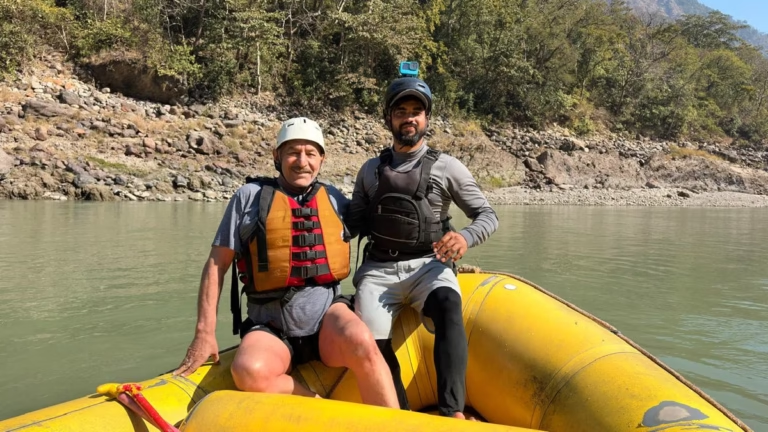
New Delhi, February 24, 2026: The scenic rapids of the Ganges in Rishikesh became the backdrop for a dramatic real-life scene this week when veteran Bollywood actor Dalip Tahil experienced a harrowing capsizing incident. The 73-year-old actor, known for his iconic roles in films like Baazigar and Qayamat Se Qayamat Tak, was enjoying a white-water rafting session when his raft hit a turbulent stretch and flipped, tossing him into the icy waters.

The Incident: A Close Call on the Rapids

Tahil was reportedly navigating a challenging section of the river with a group of friends and professional guides. Despite the safety precautions in place, the unpredictable force of the Ganga proved too much for the raft, leading to an immediate overturn.

Eyewitnesses noted that the actor remained remarkably calm despite the shock of being submerged. Safety kayakers and guides on the scene acted swiftly, pulling the actor from the water and ensuring he reached the riverbank safely. Fortunately, Tahil escaped the incident without any major injuries, though the physical toll of the cold water and the impact was evident.

“Puraane Paapi”: A Moment of Wit Amidst the Chaos

In true veteran fashion, Tahil didn’t let the scare dampen his spirits. Following the rescue, a video surfaced showing the actor reflecting on the experience with his trademark dry wit.

Referencing the river’s spiritual significance—and perhaps his own long career playing sophisticated villains—Tahil joked:

“Ganga ne is puraane paapi ko pehchaan liya” (The Ganges recognized this old sinner).

The comment, a playful nod to the Hindu belief that a dip in the holy river washes away one’s sins, quickly went viral. Fans have praised the actor for his resilience and his ability to find humor in a potentially life-threatening situation.

Safety First: The Risks of Adventure Sports

While the incident ended on a lighthearted note, it serves as a reminder of the inherent risks involved in adventure sports, particularly for seniors. Authorities in Rishikesh continue to emphasize:

  • Mandatory Life Jackets: Even for strong swimmers, the current is unforgiving.
  • Professional Guides: Always raft with certified operators who have rescue protocols.
  • Health Checks: High-adrenaline sports can place significant strain on the heart and respiratory system.

A Legacy of Resilience

Dalip Tahil has been a staple of Indian cinema and theater for over four decades. From playing the stern father to the calculating antagonist, his versatility is well-known. This recent “adventure” in Rishikesh only adds to the legend of an actor who remains active, adventurous, and full of life even in his 70s.

Fans and colleagues from the film industry have taken to social media to express their relief at his safety, with many echoing that his “villainous” charm on screen is clearly matched by a tough-as-nails spirit in real life.

UPSC CSE 2026: Application Deadline and Major Reforms

0

New Delhi, February 24, 2026 — The Union Public Service Commission (UPSC) is set to close the registration window for the Civil Services Examination (CSE) 2026 at 6:00 PM today. With 933 vacancies up for grabs across prestigious services like the IAS, IPS, and IFS, the 2026 cycle stands out not just for the competition, but for a suite of “high-tech” reforms and stricter service rules designed to modernize the recruitment process.

Aspirants who have not yet completed their forms are advised to log on to the official portals, upsc.gov.in or upsconline.nic.in, immediately to avoid last-minute server congestion.

Key Highlights of UPSC CSE 2026

The 2026 notification has introduced several shifts in how candidates apply and how their eligibility is maintained throughout the exam cycle.

FeatureDetails
Total Vacancies933 (Includes 33 for PwBD)
Last Date to ApplyFebruary 24, 2026 (by 18:00 hrs)
Correction Window3 days (opening after Feb 24)
Prelims Exam DateMay 24, 2026 (Sunday)
Mains Exam DateAugust 21, 2026 (Friday onwards)

Major Reforms Introduced in 2026

The UPSC has implemented significant technological and administrative changes this year to ensure transparency and prevent “seat blocking.”

1. Enhanced Security: Live Photo & Face Authentication

In a major tech-overhaul, the application process now requires a Mandatory Live Photo Capture. Gone are the days of uploading old studio photos; candidates must now use a webcam or mobile camera to capture their likeness in real-time. Furthermore, the Commission has introduced Face Authentication at exam venues to curb impersonation.

2. The Four-Stage Application System

The online portal has been restructured into four distinct modules:

  • Universal Registration Number (URN): A permanent ID for all future UPSC exams.
  • Common Application Form (CAF): General details.
  • Triple Signature Upload: Candidates must now upload three signatures for cross-verification.
  • Exam-Specific Module: Where candidates select their center and pay the fee.

3. Stricter Rules for Serving Officers

To prevent candidates from repeatedly holding multiple top-tier seats, the 2026 rules are more rigid:

  • IAS & IFS Restriction: Candidates already appointed to the Indian Administrative Service (IAS) or Indian Foreign Service (IFS) are not eligible to appear for CSE 2026.
  • The “One-Time Improvement” Rule: IPS or Group ‘A’ officers are allowed one improvement attempt (CSE 2027) only if they take a formal training exemption. Beyond this, they must resign to appear again in 2028 or later.

Eligibility and Application Fee

The basic eligibility remains a graduate degree from a recognized university. The age limit is calculated as of August 1, 2026, with the general bracket being 21 to 32 years (relaxable for OBC, SC, ST, and PwBD categories).

Note on Fees: A nominal fee of ₹100 is applicable for General/OBC/EWS male candidates. Female candidates and those from SC/ST/PwBD categories are exempted from the fee.

What Happens After Today?

Once the application window closes at 6:00 PM, the Commission will provide a 3-day correction window for candidates to rectify errors in their forms. However, certain fields like the URN profile may have limited editing options.

The Preliminary Examination, consisting of GS Paper I and the qualifying CSAT Paper II, will take place on May 24, 2026. Candidates qualifying this stage will be eligible for the Main Examination starting August 21, 2026.

Kerala HC Questions ‘The Kerala Story 2’ Certification

0

New Delhi, February 24, 2026: The Kerala High Court on Tuesday raised serious concerns regarding the portrayal of the state in the upcoming film The Kerala Story 2: Goes Beyond. While hearing a batch of petitions seeking a stay on the film’s release, the court questioned the Central Board of Film Certification (CBFC) on how a “U/A” certificate was granted to a project that potentially misrepresents the social fabric of Kerala.

Justice Bechu Kurian Thomas, presiding over the matter, emphasized that Kerala is a state where people of all faiths coexist in “total harmony.” The court’s oral observations highlighted a growing judicial unease with the film’s title and its alleged potential to incite communal passions.

The Core of the Controversy

The sequel to the 2023 hit The Kerala Story has been at the center of a fresh legal and political storm since its trailer was unveiled earlier this month. The petitioners, including a resident from Kannur, argued that the film’s promotional material depicts incidents of forced religious conversion and extremist recruitment as if they are occurring “all over the state.”

The court noted that while the filmmakers claim the story is “inspired by true events,” the inclusion of “Kerala” in the title—despite the narrative allegedly spanning multiple other states—could lead to the unfair stigmatization of the region.

“Kerala lives in total harmony. But you have portrayed that this is happening all over Kerala. There is a wrong indication and it can also incite passion,” Justice Thomas remarked during the proceedings. The judge further noted that the apprehensions of the people of Kerala “cannot be ignored” when the state’s name is being used so prominently in the title.

Legal Challenges and CBFC Scrutiny

The petitions challenge the CBFC’s decision to grant a U/A 16+ rating to the film. Under Section 5B of the Cinematograph Act, 1952, the Censor Board is mandated to ensure that films do not threaten public order, decency, or incite the commission of any offense. The petitioners contend that the board failed to apply these statutory safeguards, particularly concerning the film’s teaser, which ends with the slogan: “Ab sahenge nahi, ladenge” (We will not tolerate it anymore, we will fight).

Lawyers for the petitioners argued that such a tagline could be interpreted as a call for retaliatory action, posing a “real and imminent” threat to law and order.

In a significant turn during the hearing, the court was informed that the film’s teaser had not actually been cleared by the CBFC. Following this revelation, the producers agreed to remove the teaser from all digital platforms.

Comparison with the 2023 Original

The first installment of The Kerala Story faced similar hurdles in 2023. At that time, the Supreme Court of India had directed the filmmakers to include a disclaimer stating that the film was a fictionalized account and that there was no authentic data to support its original claim that 32,000 women had joined ISIS.

The High Court observed on Tuesday that the “presumption of validity” that comes with a CBFC certificate is not absolute and can be rebutted if the content of the film is found to incite communal disharmony.

What’s Next?

To make an informed decision on whether to stay the release, the Kerala High Court has asked the Union Government and the filmmakers to arrange a private screening for the bench. The court intends to examine the film’s content directly to determine if the “microscopic” disclaimers are sufficient to balance artistic freedom with social responsibility.

The Kerala Story 2: Goes Beyond, directed by Kamakhya Narayan Singh and produced by Vipul Amrutlal Shah, is currently scheduled for a nationwide theatrical release on February 27. The High Court is expected to pass further orders following the special screening.

Miracle at Sea: All 7 Rescued in Andaman Helicopter Crash

0

New Delhi, February 24, 2026: In a dramatic turn of events on Tuesday morning, all seven people on board a Pawan Hans helicopter were miraculously rescued after the aircraft ditched into the sea near Mayabunder. The incident, which occurred around 9:30 AM, triggered a swift emergency response from local authorities and the Indian Coast Guard, preventing what could have been a major tragedy.

The Incident: A Race Against Time

The helicopter, operated by the state-owned Pawan Hans Ltd, was performing a routine inter-island service. It departed from Sri Vijaya Puram (formerly Port Blair) at approximately 8:45 AM, heading toward the northern districts.

According to officials, the aircraft was on its final approach to the Mayabunder airstrip when it encountered a suspected technical snag. Forced to make a split-second decision, the pilot executed a controlled “ditching” (emergency water landing) roughly 300 meters short of the runway.

Survivors and Rescue Efforts

The aircraft was carrying five passengers and two crew members at the time of the crash. The passengers have been identified as:

  • Rajita Devi and her infant, Kamal Ch. Das
  • Sipra Saha
  • Nambi Amma
  • (Additional male passenger)

Following the impact, rescue teams including the Indian Coast Guard and local emergency services reached the site within minutes. All seven occupants were successfully pulled from the water and transported to Dr. Rajendra Prasad Hospital in Mayabunder for observation.

“All seven people on board, including the pilot, are safe. We are currently ensuring they receive necessary medical care, and efforts are underway to move them back to Sri Vijaya Puram for further assessment,” stated Nitesh Rawat, Director of Civil Aviation.

Safety Scrutiny and Investigation

The incident has raised immediate concerns regarding aviation safety in the region, particularly as it follows a fatal air ambulance crash in Jharkhand just 24 hours prior.

The Directorate General of Civil Aviation (DGCA) has initiated a formal inquiry into the crash. While the pilot’s skillful maneuver in landing on water is being credited for saving lives, investigators will focus on the maintenance history of the aircraft and the specific nature of the technical failure.

Key Facts of the Incident:

  • Time of Crash: 09:30 AM (approx.)
  • Location: 300 meters from Mayabunder runway.
  • Carrier: Pawan Hans (inter-island service).
  • Casualties: None; all seven rescued.

Connecting the Islands

Pawan Hans serves as a lifeline for the Andaman and Nicobar archipelago, providing essential connectivity to remote islands where fixed-wing aircraft cannot operate. While this incident ended safely, it underscores the challenges of operating in maritime environments and the critical importance of rigorous maintenance protocols for island transport.

Faith Over Family: Son Rejects Long-Lost Mother

0

New Delhi, February 24, 2026: In a poignant incident that has sparked intense debate over the intersections of faith, family, and time, a 55-year-old woman’s return to her ancestral home after 25 years ended in heartbreak. The reunion, decades in the making, was cut short not by a lack of memory, but by a shift in religious identity.

The woman, identified as Sunita (name changed), arrived in her village on the outskirts of Varanasi this week, hoping to reconnect with the son she had not seen since he was a young child. However, the emotional homecoming turned cold when her son, now a 29-year-old devout Hindu, refused to let her cross the threshold upon learning of her conversion to Christianity.

A Quarter-Century of Silence

The details of Sunita’s departure 25 years ago remain blurred by time and conflicting family narratives. According to local sources, Sunita left the household following a series of personal hardships and domestic disputes. She eventually moved to a different state, where she found solace and support within a Christian community, eventually adopting the faith as her own.

For over two decades, there was little to no contact between Sunita and her biological family. Her son, Rajesh (name changed), was raised by his paternal grandparents in a strictly traditional environment.

The Encounter: “Sorry Mom, You Are a Christian”

Witnesses state that the confrontation took place in the courtyard of the family home. Neighbors who gathered to see the “long-lost mother” described a scene that shifted rapidly from curiosity to tension.

When Sunita revealed her new identity and her life as a practicing Christian, Rajesh’s demeanor reportedly shifted. According to local reports, his refusal was blunt:

“I have spent my life performing rituals for a mother I thought was dead or gone. Now you return, but you are not the mother I remember. Our faiths cannot coexist under this roof. Sorry mom, you are a Christian now.”

Despite Sunita’s pleas that her love for her son remained unchanged by her theology, the door remained closed.

The Societal Divide

The incident has highlighted the growing chasm in communal and familial dynamics regarding religious conversion in rural India. While some villagers expressed sympathy for the mother, citing that “a mother’s bond should transcend religion,” others stood by the son, arguing that his devotion to his ancestral traditions and the “Dharma” of the household justified his stance.

Key Points of Contention:

  • The Length of Absence: Many argue that 25 years is too long a gap to bridge, regardless of religion.
  • Identity vs. Lineage: The conflict between a person’s right to choose their faith and a family’s desire to maintain traditional lineage.
  • The Emotional Toll: The psychological impact on both the mother, seeking redemption, and the son, who felt abandoned.

Current Status

Sunita is reportedly staying with a local acquaintance while she decides her next course of action. Local community leaders have attempted to mediate the situation, but Rajesh remains steadfast in his decision, citing his commitment to his religious practices and the “sanctity” of his home.

As of now, no legal complaints have been filed, as the matter is being treated as a private family dispute. However, the story continues to resonate across social media, prompting a wider conversation about whether blood is indeed thicker than the waters of baptism or the fires of tradition.