

New Delhi, June 3, 2026: At its annual Build developer conference, Microsoft officially declared the dawn of a new era in personal computing, shifting its strategy from traditional software applications to autonomous, “agent-first” hardware. Moving beyond basic chatbots, the tech giant showcased a future where users no longer open apps or click through menus, but instead rely on dedicated AI agents capable of carrying out complex tasks independently across the cloud and local devices.
Beyond the App Store: The Shift to AI Agents
For decades, the standard computing model has revolved around operating systems running individual, siloed applications. Microsoft CEO Satya Nadella made it clear that this era is winding down. “The next platform shift is from apps to agents—from software you open to intelligence you invoke,” Nadella announced during his keynote address, detailing how the company aims to rebuild computing from the ground up.
Rather than relying on a single all-knowing assistant, Microsoft envisions an open ecosystem where specialized AI agents collaborate. To make this possible, the company is integrating OpenClaw—a popular open-source software package that coordinates teams of AI bots—directly into the Windows environment. This allows businesses to securely deploy AI workers to manage data, handle routine operations, and execute workflows without risking sensitive corporate information.
Introducing Project Solara: Hardware Built for AI
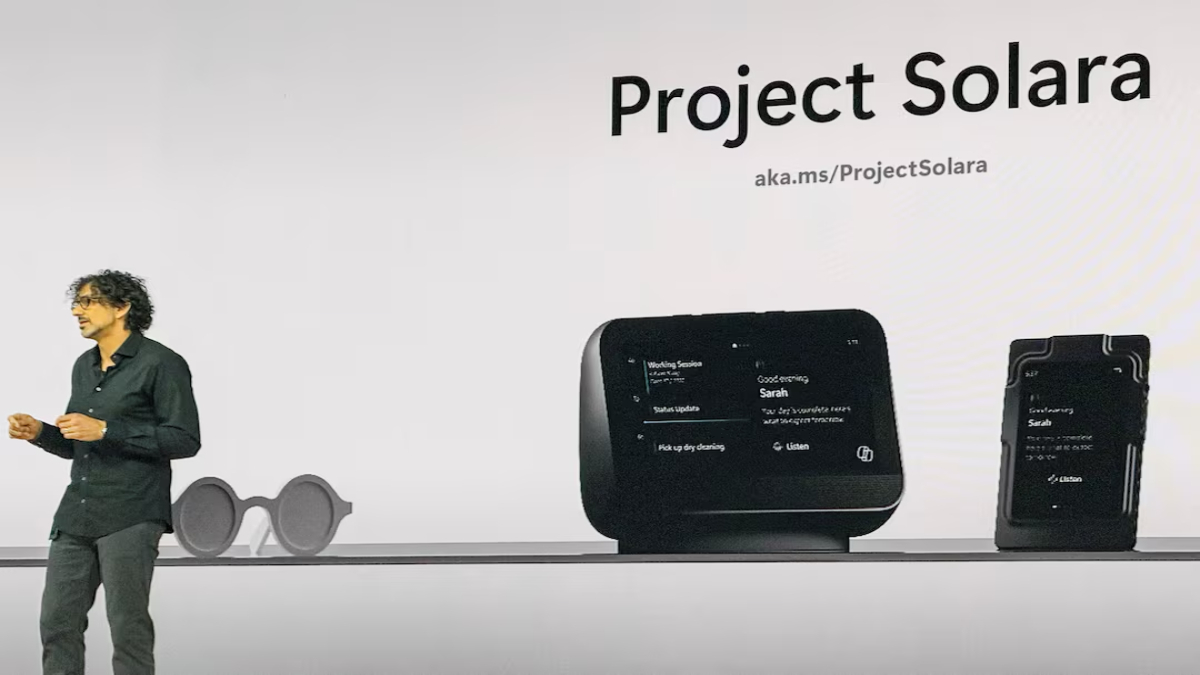
The most surprising announcement of the conference was Project Solara, an Android-based, chip-to-cloud platform built specifically to support these intelligent agents. Developed using the Microsoft Device Ecosystem Platform (MDEP) and powered by processors from Qualcomm and MediaTek, Project Solara steps completely away from traditional phone or PC interfaces.
Instead of hosting standard mobile applications, Solara devices act as physical vessels for autonomous AI. Microsoft showcased several innovative form factors, including:
- The Smart Badge: A device about the size of a standard employee ID card, equipped with a touchscreen, a fingerprint reader, and full wireless connectivity. It is designed for hands-free environments, such as a clinic where an agent can listen to and automatically document a nurse’s patient visit.
- The Smart Display: A compact desktop unit reminiscent of a smart speaker with a built-in screen, meant to serve as an interactive control hub for workplace productivity.
A key technical breakthrough of Project Solara is what Microsoft terms “just-in-time UI.” Because these devices lack fixed application screens, the AI agent dynamically generates a user interface on the fly based on the size of the screen, voice prompts, or camera inputs. This means developers do not have to rewrite code for every different shape of hardware; the AI alters its own visual layout to fit the device perfectly.
Heavy-Duty Hardware: The Surface RTX Spark Dev Box
While compact gadgets stole the spotlight, Microsoft also answered the call for heavy-duty, localized computational power by unveiling the Surface RTX Spark Dev Box. Described by Nadella as a developer’s “dream machine,” this compact, high-performance desktop unit is loaded with Nvidia’s advanced RTX Spark silicon.
The Dev Box is uniquely engineered to run massive AI models directly on the machine itself. During live demonstrations, executives showed the device smoothly running a localized AI model packed with 120 billion parameters. Typically, models of this complexity require massive server farms to run, but the specialized architecture allows developers to train, test, and run heavy agent workflows locally without relying on data centers.
Next-Generation Software: Scout and MAI-Thinking
On the software front, Microsoft took aim at competitors like OpenAI, Google, and Anthropic by introducing its own family of in-house AI models. Chief among these is MAI-Thinking-1, the company’s premier “reasoning model.” A specialized variant called MAI-Code-1-Flash was introduced specifically to support the growing trend of “vibe coding,” allowing developers to build functional websites and software backends using simple natural language instructions.
Microsoft also launched an “always-on” AI assistant called Scout. Integrated directly into Microsoft’s Copilot framework, Scout runs continuously in the background to proactively manage schedules, draft emails, and gather relevant notes before meetings even begin, functioning like a human chief of staff.
Accelerating the Future: Quantum Computing and Beyond
To prove that its AI strategy is already yielding scientific results, Microsoft concluded its hardware announcements by detailing Majorana 2, its newest topological quantum computing chip. Developed using Microsoft Discovery—an agentic AI platform designed for scientific research—the development team used AI bots to automate chip measurements and analyze decades of data.
Thanks to the rapid iterations provided by these AI research agents, Microsoft successfully utilized a new lead-based material stack that resulted in a 1,000-fold improvement in qubit reliability over its predecessor. The breakthrough has allowed Microsoft to cut its development timeline in half, confidently announcing plans to launch a commercially scalable quantum computer by 2029.
The underlying theme of Build was clear: Microsoft is moving aggressively to control every single layer of the AI ecosystem—from the physical microchips and local desktop hardware to the operating systems and the cloud-connected models that power them. By removing the barriers of traditional apps and giving AI agents a physical presence in the real world, the tech giant is betting everything on a more seamless, ambient future for technology.