

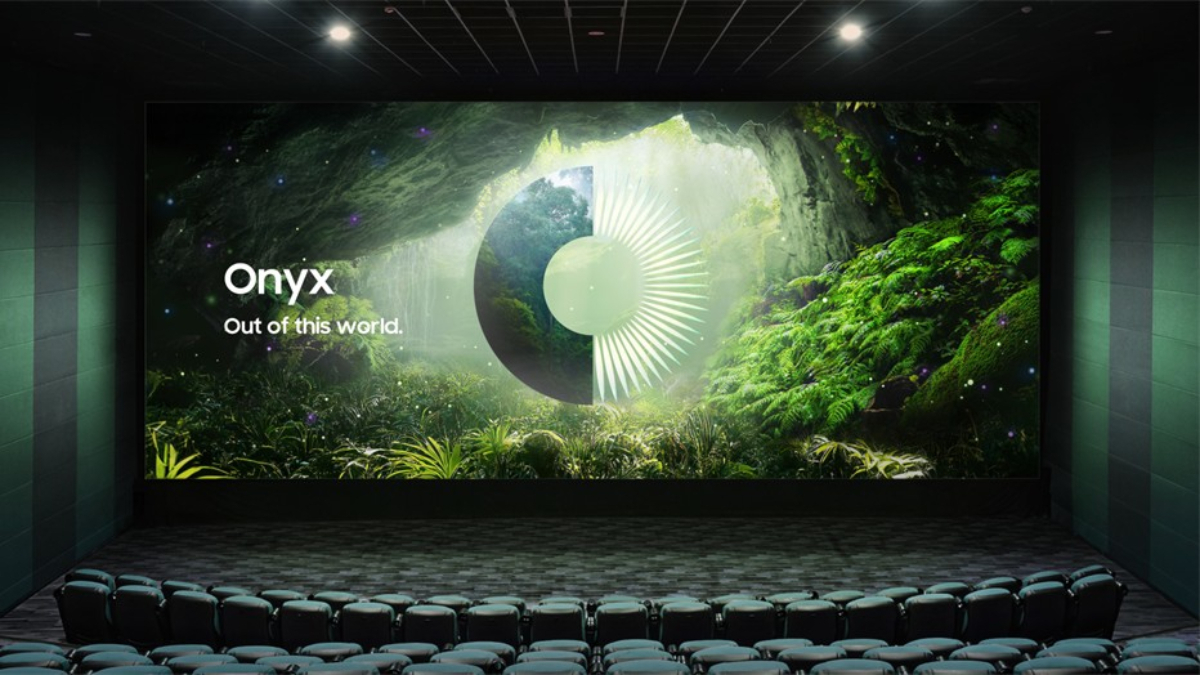
New Delhi, April 20, 2026 — The future of the big-screen experience has officially arrived. At CinemaCon 2026, the world’s largest gathering for the motion picture theater industry, Samsung Electronics unveiled its latest leap in visual technology: a massive 14-meter (46-foot) standard-size Onyx Cinema LED display. Designed specifically for Premium Large Format (PLF) auditoriums, this new model is set to redefine how audiences experience blockbuster filmmaking, bridging the gap between home-viewing convenience and the unparalleled immersion of the theater.
As cinemas globally seek to distinguish themselves in an era of fierce competition for audience attention, Samsung’s latest innovation arrives at a critical juncture. By pushing the boundaries of screen size, brightness, and color accuracy, Samsung is betting that the premium theatrical experience will continue to thrive by offering something that home screens simply cannot replicate.
A New Standard for Premium Large Format (PLF)
For years, the cinema industry has been defined by projection technology. However, as the demand for “Premium Large Format” auditoriums grows, traditional projection has faced limitations regarding ambient light, contrast, and brightness. Samsung’s Onyx Cinema LED platform has been challenging this status quo since its debut in 2017, and the new 14-meter model is the most significant expansion of that vision to date.
“People go to premium theaters for something they cannot recreate at home,” says Hyoung Jae Kim, Executive Vice President of the Visual Display (VD) Business at Samsung Electronics. “That raises the bar for every part of the auditorium, starting with the screen. Samsung’s new 14-meter Onyx gives exhibitors a way to bring the premium experience to larger auditoriums, helping turn moviegoing into a destination again.”
Also Read: OnePlus Nord CE6 Series India Launch Date Announced
Engineering Excellence: Beyond the Pixels
The new 14-meter Onyx model is not merely a “bigger screen”; it is a precision-engineered solution designed for high-end theatrical environments. Samsung has introduced several key technical advancements to maintain, and even elevate, image quality at this larger scale.
- Optimized Pixel Density: The display utilizes a 3.3mm pixel pitch. This specific tuning is crucial, ensuring that images remain sharp, consistent, and free of artifacts, even when viewed up close in a massive auditorium.
- Flexible Scalability: Perhaps the most game-changing feature for theater operators is the screen’s modular design. The 14-meter standard configuration can be scaled up to 20 meters (66 feet) by adding individual LED cabinets to the sides and bottom. This flexibility allows exhibitors to customize their screen size to fit their specific theater footprint without compromising the visual integrity of the presentation.
- Unmatched Visual Fidelity: The display supports 4K resolution at 120Hz, providing exceptionally smooth motion for high-frame-rate content and fast-paced action sequences.
- HDR and Brightness: Leveraging Samsung’s signature HDR technology, the screen reaches a peak brightness of up to 300 nits—approximately six times brighter than the conventional standards currently found in most projection-based cinema halls. This high brightness, combined with an infinite contrast ratio, allows for true “black levels,” resulting in deep, rich imagery that makes shadow details pop in ways traditional projection cannot manage.
Transforming the Theater Experience
The implications of this technology go beyond just better image quality. Because Onyx displays are self-emissive—meaning the screen produces its own light—they eliminate the ambient light restrictions of conventional projectors.
In a traditional projection theater, the room must be kept dark to ensure the image doesn’t wash out. With an Onyx display, the image maintains its vibrancy regardless of the lighting conditions. This opens up entirely new revenue streams for theater owners, including:
- Alternative Programming: Exhibitors can host live sports broadcasts, high-stakes gaming tournaments, corporate presentations, and even concert screenings during daylight hours or with partial house lighting, without sacrificing visual quality.
- Space Optimization: Because the LED screen does not require the same depth and projection booth configuration as traditional systems, it allows for more efficient use of theater space, potentially enabling new seating layouts that offer better sightlines for the audience.
Global Momentum: From Morocco to Georgia
The launch of the 14-meter model follows a period of rapid global adoption for the Onyx platform. The industry has been taking note, with major exhibitors integrating these screens into flagship locations worldwide.
Recent high-profile installations highlight the versatility of the Onyx lineup. In Rabat, Morocco, the Pathé Dar Essalam complex—designed to be a luxury flagship destination—has launched with 12 Onyx screens across its auditoriums. By utilizing a mix of 5-meter, 10-meter, and 6.4-meter custom configurations, Pathé has cemented its position as the largest operator of Samsung cinema LED screens in Europe.
Similarly, in the United States, Trilith Cinemas in Fayetteville, Georgia, became the first theater in the nation to install the latest generation of Onyx screens in December 2025. Situated in one of the country’s most active production hubs, the theater serves as a showcase for how modern technology can match the visual detail and creative intent of the filmmakers who produced the content.
The Future of “Destination” Cinema
As the industry navigates a changing landscape where home entertainment systems become increasingly sophisticated, the theatrical experience must offer a distinct value proposition to remain relevant. Samsung’s announcement at CinemaCon 2026 is a clear signal that the company believes that value lies in scale, quality, and the “wow factor.”
By providing theater owners with the tools to build truly premium, immersive environments, Samsung is doing more than selling hardware; it is helping to craft the future of the moviegoing ritual. As more exhibitors transition to LED-based projection, audiences can look forward to a new era of clarity, color, and immersion that reaffirms why, even in a digital-first world, the big screen remains the ultimate way to experience a story.