

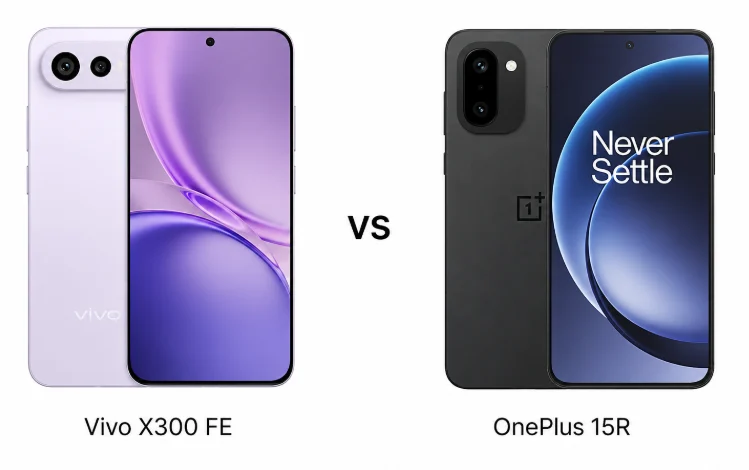
New Delhi, May 30, 2026: The premium smartphone landscape of 2026 has evolved into a fascinating battleground. No longer are buyers forced to spend top-tier flagship money to get elite performance, massive batteries, and stunning displays. This shift is perfectly exemplified by two of the most talked-about devices of the year: the Vivo X300 FE and the OnePlus 15R.
While Vivo launched its X300 FE (Fan Edition) as a compact, photography-forward power player priced at ₹79,999, OnePlus took a drastically different approach with the 15R. Positioned as a performance and endurance juggernaut, the OnePlus 15R enters the ring with a much more aggressive starting price of ₹54,999. If you are standing in a retail store or scrolling through e-commerce platforms trying to decide where to invest your hard-earned money, this comprehensive comparison will help you choose the perfect device for your needs.
Design and Display: A Matter of Size and Philosophy
The immediate difference you will notice when holding these two devices is their physical footprint. Vivo has fully embraced the compact flagship trend with the X300 FE. It sports a modest 6.31-inch AMOLED display and weighs a remarkably light 190 grams. This makes it an absolute joy for one-handed usage, slipping easily into any pocket. Vivo didn’t skimp on materials either, giving the device a premium glass and glass-fiber build with a robust IP68/IP69 water and dust resistance rating. The screen itself is a beautiful 1.5K LTPO panel, meaning it can dynamically adjust its refresh rate up to 120Hz to preserve battery life while maintaining perfect fluid motion.
The OnePlus 15R goes in the exact opposite direction. Built for those who believe bigger is better, it features a massive 6.83-inch AMOLED display. It is a heavier phone at 218 grams, which gives it a substantial, commanding feel in the hand. OnePlus has geared this screen directly toward gamers and multimedia consumers by equipping it with a blistering 165Hz maximum refresh rate. Visually, fast-paced games look smoother on the 15R than almost any other phone on the market. However, it is worth noting that OnePlus chose a standard LTPS display over an LTPO panel for the 15R. While it looks breathtakingly sharp and bright, it cannot scale down its refresh rate as aggressively as the Vivo when displaying static text.
Performance and Software: The Battle of Chipsets
Under the hood, both manufacturers have packed cutting-edge 3nm silicon, but they have placed their bets on different chip suppliers. The Vivo X300 FE is powered by MediaTek’s new flagship Dimensity 9500 processor, coupled with 12GB or 16GB of LPDDR5X Ultra RAM. Vivo’s tuning focuses heavily on sustained, daily efficiency and conservative thermal management. In day-to-day tasks—like jumping between work apps, editing short videos, and scrolling through social feeds—the X300 FE is butter-smooth and rarely gets warm.
On the other side, the OnePlus 15R targets pure, unadulterated power. It runs on Qualcomm’s Snapdragon 8 Gen 5 mobile platform, utilizing the hyper-fast Oryon CPU architecture. OnePlus has paired this chip with up to 16GB of RAM and massive vapor-chamber cooling. If your primary goal is high-end mobile gaming—running heavy titles at maxed-out graphic settings for hours on end—the OnePlus 15R is the undisputed king in this price bracket. It maintains peak frame rates with cooler chassis temperatures than the Vivo, making it a dream device for enthusiast gamers.
On the software front, both devices run on Android 16 out of the box. Vivo utilizes its highly visual and customizable OriginOS 6, which offers deep widget integration and slick animations. OnePlus counters with OxygenOS 16, keeping its signature clean, bloat-free, and hyper-fast aesthetic. Choosing between the two comes down to whether you prefer Vivo’s feature-rich customization or OnePlus’s streamlined, lightweight interface.
Cameras: Zeiss Optics vs. Everyday Practicality
If photography dictates your smartphone purchasing decisions, the scale tips dramatically toward Vivo. The X300 FE inherits Vivo’s legendary camera-first DNA, co-engineered with Zeiss optics. It sports a mind-boggling 200MP primary sensor with a gimbal-style optical image stabilization (OIS) system, a 50MP ultrawide camera, and a dedicated 50MP Sony LYT-602 telephoto lens capable of 3x optical zoom. The photographic output is stunning. Photos captured on the X300 FE boast magnificent dynamic range, incredible detail retention, and natural colors. Furthermore, the Zeiss Multifocal Portrait mode makes it arguably the best phone of 2026 for taking pictures of people, handling low-light edge detection with DSLR-like accuracy.
The OnePlus 15R treats cameras as an important utility rather than a headline feature. It dials back to a more conservative dual-camera array featuring a 50MP main shooter and an 8MP ultra-wide lens, leaving out a dedicated telephoto zoom lens. The main 50MP sensor does an excellent job in daylight, delivering sharp, social-media-ready images with good contrast. It can also shoot high-quality 4K video at up to 120fps. However, when it comes to long-range zoom shots, ultra-wide clarity, and advanced night photography, the OnePlus 15R simply cannot match the versatile, pro-grade optics of the Vivo X300 FE.
Battery Life and Charging: Giant vs. Standard
Battery endurance is an area where 2026 smartphones have made massive leaps forward, primarily due to silicon-carbon battery technology. Despite its small, compact chassis, Vivo managed to fit a 6,040mAh battery inside the X300 FE. It easily powers through a standard workday and supports incredibly fast 90W wired charging alongside convenient 40W wireless charging.
Yet, because the OnePlus 15R is physically larger, it leverages its spacious interior to house a truly monumental 7,400mAh battery. The battery life on the 15R is nothing short of legendary. Even under heavy gaming workloads, data tethering, and maximum brightness, the OnePlus 15R refuses to die, easily delivering a two-day battery life for moderate users. When you do eventually run out of juice, the box includes an 80W SuperVOOC fast charger to get you back up and running in under an hour. The only major feature missing here is wireless charging, which OnePlus omitted to keep the price down.
The Verdict: Which One Fits Your Pocket?
Ultimately, the choice between the Vivo X300 FE and the OnePlus 15R boils down to your budget and what you value most in a daily companion.
Buy the Vivo X300 FE if: You want a true, uncompromising premium experience in a pocket-friendly size. If mobile photography is your absolute passion, the Zeiss-tuned 200MP camera system, superior portrait modes, and versatile optical zoom easily justify the higher ₹79,999 price tag. Add in the convenience of wireless charging and premium IP69 protection, and you have a complete luxury package.
Buy the OnePlus 15R if: You want the absolute best value for your money. At ₹54,999, it undercuts the Vivo by a massive margin while offering a vastly superior 165Hz display for gaming, a class-leading 7,400mAh battery that seems to last forever, and raw Snapdragon 8 Gen 5 performance. If you can live without a telephoto zoom lens and wireless charging, the OnePlus 15R is the smartest financial purchase of 2026.