

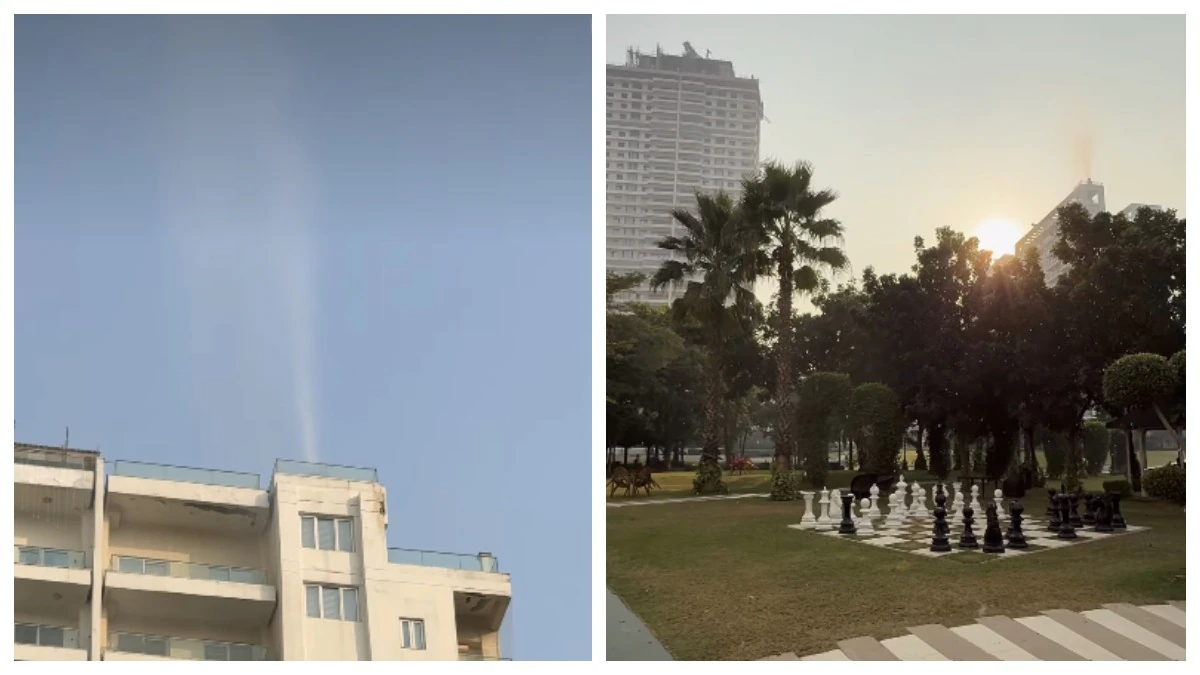
New Delhi, December 27, 2025: A creative and proactive approach to the worsening air quality in the National Capital Region was witnessed this week when a housing society in Gurgaon took matters into its own hands. In a viral video shared on December 27, 2025, a residential complex in Sector 67 was observed using its high-rise firefighting infrastructure to create “artificial rain.” This localized attempt to suppress dust and pollutants has been described by environmentalists as a desperate yet commendable grassroots effort to tackle the persistent smog.
The Mechanism of Private Smog Mitigation
The footage revealed the society’s maintenance staff using powerful water sprinklers and terrace-mounted nozzles to wash away toxic particles from the air. By creating a fine mist that mimics rainfall, the suspended particulate matter (PM2.5 and PM10) was observed being forced to the ground, momentarily clearing the visible haze around the apartment blocks. It was noted by residents that the initiative was launched after the local Air Quality Index (AQI) crossed the “severe” threshold of 450, making even brief outdoor activities hazardous for children and the elderly.
Also Read: Rekha’s Heartwarming Meeting with Amitabh Bachchan’s Grandson
A Viral Sensation Amidst Breathless Days
The video quickly gained traction across social media platforms, amassing millions of views as citizens across North India struggled with the winter pollution peak. The footage was accompanied by a caption highlighting that while government-scale cloud seeding remains a distant dream, smaller communities are forced to innovate for their own survival. This “do-it-yourself” environmentalism was observed being both praised for its ingenuity and lamented as a symbol of the failure of larger urban planning and pollution control measures.
Effectiveness and Water Conservation Concerns
While the visual impact of the artificial rain was significant, the move has triggered a complex debate regarding its long-term viability and environmental cost. It was argued by some experts that while localized misting provides temporary relief, it does not address the root causes of pollution like crop burning or construction dust. Concerns were also raised regarding the consumption of water during a season when resources are often stretched. However, the society management clarified that recycled water from their Sewage Treatment Plant (STP) was utilized, ensuring a sustainable cycle for the operation.
Demands for Structural Change
As the year 2025 draws to a close, the Gurgaon video remains a vivid reminder of the lengths to which citizens will go to secure the right to breathe clean air. It is being suggested by urban activists that such initiatives should be integrated into the standard operating procedures of large townships during peak pollution months. This viral moment has served as a powerful call to action for authorities to expedite larger-scale solutions, as the reliance on private “rain-making” highlights a growing disparity in the quality of life across the region.