

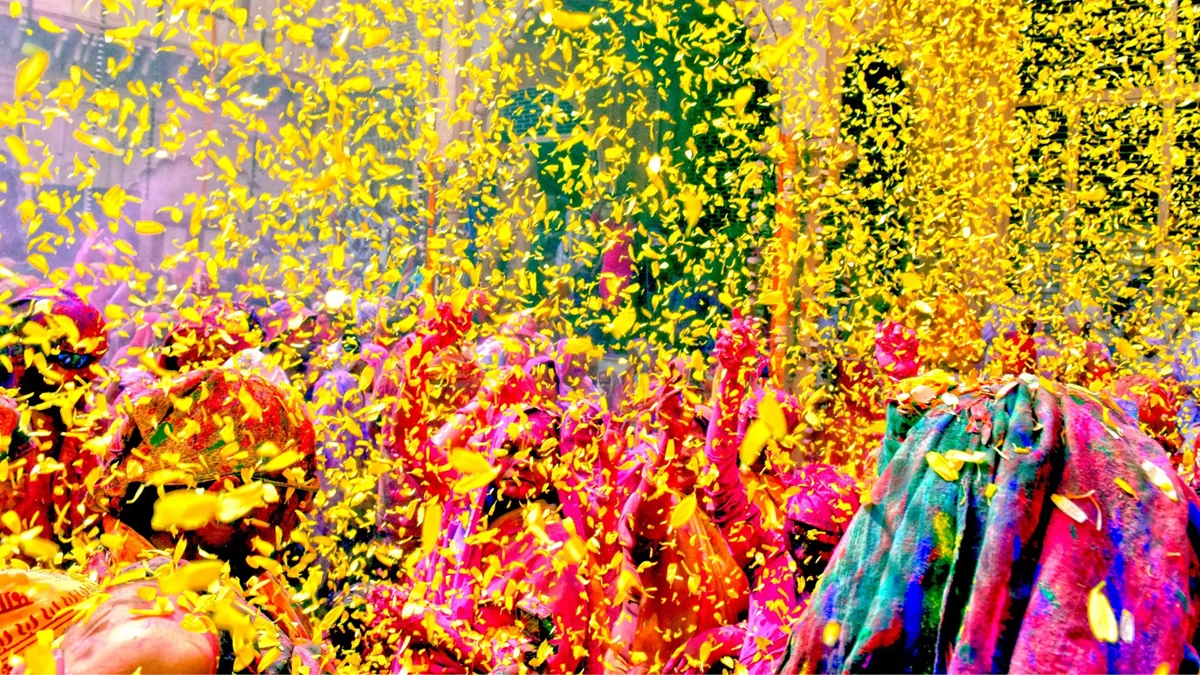
February 28, 2026: The narrow, ancient lanes of Vrindavan transformed into a sea of devotion and floral fragrance today as the world-famous Phoolon ki Holi (Holi of Flowers) officially commenced. Marking one of the most ethereal segments of the 40-day Braj Rangotsav, the celebration saw tens of thousands of devotees and international tourists converge at the historic Banke Bihari Temple and other prominent shrines to witness petals raining from the heavens.
The atmosphere in the holy town was electric, characterized by the rhythmic chanting of “Radhe Radhe” and the vibrant echoes of traditional Hori songs. Unlike the typical Holi played with synthetic powders and water, this unique ritual uses quintessentially organic materials, primarily rose, marigold, and chrysanthemums, symbolizing the pure, divine love between Radha and Krishna.
A Divine Spectacle at Banke Bihari
The epicenter of the festivities remained the Banke Bihari Temple. As the temple doors opened for the morning darshan, priests began showering heaps of fresh flower petals onto the ecstatic crowd from the raised platforms. For many, catching a single petal is considered a divine blessing.
- Duration: The floral shower typically lasts for a brief but intense window of 30 to 60 minutes.
- Significance: Local legends suggest that Lord Krishna played Holi with flowers to please Radha, emphasizing tenderness and affection over the “mischief” associated with later color celebrations.
Tight Security and Crowd Management
With the 2026 Holi season expected to break previous footfall records, the Mathura-Vrindavan district administration has implemented a multi-tier security plan.
- Drone Surveillance: Authorities are using high-definition drones to monitor crowd density in the congested lanes leading to the temple.
- One-Way Entry: A strict one-way route has been enforced for devotees to prevent stampede-like situations.
- Heavy Deployment: Over 2,000 police personnel, including paramilitary forces and “civil-dress” officers, have been stationed across Vrindavan to ensure the safety of women and foreign nationals.
- Emergency Medics: Mobile medical units and ambulances are on standby at major intersections like Holi Gate and Chaitanya Vihar.
The Braj Holi Calendar: What’s Next?
Phoolon ki Holi serves as the spiritual gateway to the more intense celebrations ahead. Having already witnessed the Laddu Holi in Barsana and Lathmar Holi in Nandgaon earlier this week, the festivities are now moving toward their peak.
| Date | Event | Location |
| March 1, 2026 | Widow’s Holi | Gopinath Temple, Vrindavan |
| March 2, 2026 | Chhadi Mar Holi | Gokul |
| March 3, 2026 | Holika Dahan | Throughout Braj Region |
| March 4, 2026 | Dhulandi (Main Holi) | Mathura & Vrindavan |
Traveler Advisory
For those planning to visit in the coming days, local authorities advise arriving at temples at least three hours before the scheduled Aarti. Given the heavy barricading, walking is the most reliable mode of transport within the town limits. Visitors are also encouraged to keep their mobile phones and cameras in waterproof protectors, as the transition from flowers to Gulal (colored powder) begins almost immediately after today’s events.
The “Phoolon ki Holi” is not just a festival; it is a sensory immersion into India’s rich cultural tapestry—one that remains as vibrant and welcoming in 2026 as it has been for centuries.