

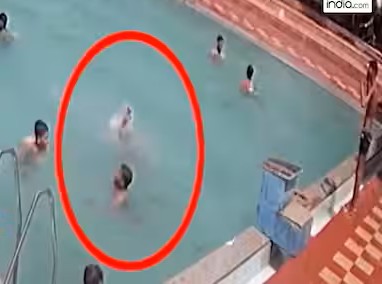
New Delhi, March 30, 2026: A chilling video has resurfaced on social media platforms, serving as a grim reminder that drowning rarely looks like the dramatic splashing often depicted in movies. The footage, which has left viewers in a state of shock, shows a man in a crowded swimming pool struggling for several minutes while bystanders continue to swim and play nearby. Tragically, it is observed that those around him believed he was simply performing acrobatics or holding his breath as a “stunt,” unaware that a life was being lost just inches away.
The “truth” behind the “Instinctive Drowning Response” is that a person who is actually drowning is physiologically unable to call for help. As seen in the viral clip, the individual does not wave or shout; instead, the body’s primary focus is redirected entirely to gasping for air. This leads to a rhythmic, upright movement in the water where the head tilts back and the mouth sinks and reappears, a motion that can be easily misinterpreted by untrained observers as “bobbing” or playful gymnastics.
The Illusion of Safety in a Crowd
The most disturbing aspect of the video is the number of people present who failed to recognize the emergency. It is noted by safety experts that “supervision by proximity” is often a false sense of security. Because the man was not splashing violently, he did not trigger the survival instincts of the other swimmers. This phenomenon, where a person drowns in plain sight of others, highlights the critical need for constant vigilance and the presence of professional lifeguards who are trained to spot these silent “vertical” struggles.
The reaction from the digital community has been a mixture of heartbreak and a demand for better public education on water safety. It is argued by many that “drowning is silent” should be a mandatory lesson in every school and community center. Several netizens shared personal stories of near-misses where they were rescued only because someone noticed their “quiet” struggle. The passive nature of the crowd in the video serves as a powerful case study for why one should never assume someone is “just playing” if they appear to be struggling to keep their mouth above water.
Also Read: India’s Cooking Gas Crisis Eases as Two More LPG Tankers Safely Cross Strait of Hormuz
Recognizing the Signs: What to Look For
To prevent such tragedies, it is advised to look for specific physical markers rather than listening for noise. These include hair over the forehead or eyes, glassy or closed eyes, and the inability to use the legs for treading water. If a person is seen in an upright position in the water without any supportive kick, it must be treated as a potential emergency. As demonstrated in the viral footage, every second counts, and the difference between a “stunt” and a “tragedy” can be a matter of moments.
As of March 30, 2026, the video continues to be used as a vital training tool by lifeguard associations worldwide. It serves as a stark reminder that while the pool is a place for joy and “kalabaji” (acrobatics), it can turn into a silent trap for the unwary. For now, the “Swimming Pool Drowning” video stands as a digital memorial and a warning: if you see someone who looks like they are struggling to breathe, do not wait for a shout—take action immediately.