

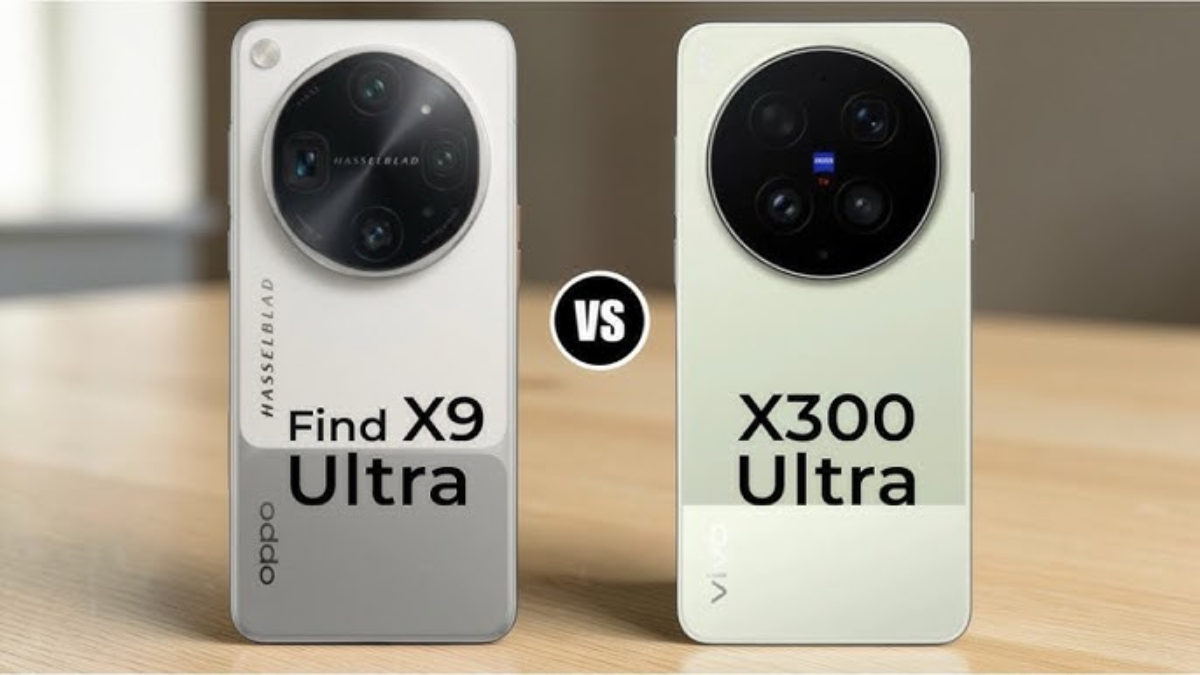
New Delhi, April 10, 2026: The premium smartphone market in 2026 is witnessing a titanic clash between two photography powerhouses: the OPPO Find X9 Ultra and the Vivo X300 Ultra. Both brands have moved beyond standard flagship territory, integrating hardware that rivals professional mirrorless cameras.
While OPPO focuses on a versatile quad-camera array with dual-periscope lenses, Vivo is betting big on high-resolution sensors and its legendary Zeiss partnership. Here is a detailed comparison of their camera specifications and hardware advantages.
OPPO Find X9 Ultra: The Versatility King
OPPO has doubled down on its “dual-periscope” strategy, aiming to provide lossless quality across a massive focal range. The Find X9 Ultra is designed for the user who wants “everything, everywhere.”
- Primary Sensor: Features the massive 200MP Sony LYTIA 901 (1-inch type equivalent). This sensor is engineered for extreme light intake and natural depth of field, making it a low-light beast.
- Dual Periscope Setup:
- 70mm (3x Optical): A 200MP OmniVision periscope lens for high-resolution portraits and medium-range shots.
- 230mm (10x Optical): A 50MP Samsung ISOCELL periscope lens for extreme long-range photography, capable of reaching up to 120x digital zoom.
- Ultra-Wide: A 50MP Samsung S5KJN5 sensor with a 15mm focal length, optimized for macro shots and expansive landscapes.
- Unique Feature: Hasselblad Color Calibration and a rumored built-in teleconverter system that allows the software to crop into the 200MP telephoto sensor without losing significant detail, effectively creating “digital-optical” intermediate steps.
Vivo X300 Ultra: The Resolution Monster
Vivo’s “Ultra” lineup has a reputation for being the “Professional Cinema” choice. The X300 Ultra continues this by emphasizing sensor size and cinematic video capabilities.
- Primary Sensor: Employs a 200MP Sony LYT-901 (or IMX90E variant depending on the region) with an f/1.85 aperture. Vivo’s custom “Blueprint” imaging chip works alongside this to process HDR data at record speeds.
- Telephoto Dominance: A second 200MP Samsung HPB periscope lens (3.7x optical zoom). By using a 200MP sensor for the zoom lens, Vivo allows for incredible “in-sensor zoom” capabilities, theoretically delivering 10x-quality crops from a 3.7x lens.
- Ultra-Wide: A 50MP Sony sensor with an f/2.0 aperture and 14mm focal length, offering a slightly wider field of view than the OPPO.
- Unique Feature: Zeiss T Coating* and the APO (Apochromatic) Lens design. This hardware-level correction significantly reduces chromatic aberration (color fringing) in high-contrast scenes, a common issue in smartphone zoom.
Hardware Comparison Table
| Feature | OPPO Find X9 Ultra | Vivo X300 Ultra |
| Main Camera | 200MP (Sony LYT-901) | 200MP (Sony LYT-901) |
| Telephoto 1 | 200MP Periscope (3x) | 200MP Periscope (3.7x) |
| Telephoto 2 | 50MP Periscope (10x) | N/A (Uses In-Sensor Crop) |
| Ultra-Wide | 50MP (Samsung JN5) | 50MP (Sony) |
| Optics Partner | Hasselblad | Zeiss |
| Video Capability | 4K @ 120fps Dolby Vision | 8K @ 30fps / 4K @ 120fps LOG |
| Front Camera | 50MP | 50MP with Autofocus |
Who Has the Hardware Advantage?
The Case for OPPO:
OPPO holds the advantage in optical reach. By including a dedicated 10x optical lens, the Find X9 Ultra will almost certainly produce cleaner images at extreme distances (20x-50x) compared to Vivo’s digital cropping. If you are a wildlife or sports enthusiast, OPPO’s quad-camera versatility is superior.
The Case for Vivo:
Vivo holds the advantage in image purity and video. The Zeiss APO lens and T* coating provide a “cleaner” look with fewer optical artifacts. Additionally, the X300 Ultra’s ability to shoot 4K/120fps LOG video on all three rear cameras makes it a more powerful tool for professional videographers and color graders.
Final Verdict
- Choose the OPPO Find X9 Ultra if you want the most versatile zoom range on the market and prefer the natural, warm color science of Hasselblad.
- Choose the Vivo X300 Ultra if you prioritize cinematic video, specialized macro photography (telemacro), and the ultra-sharp, flare-resistant optics provided by Zeiss.