

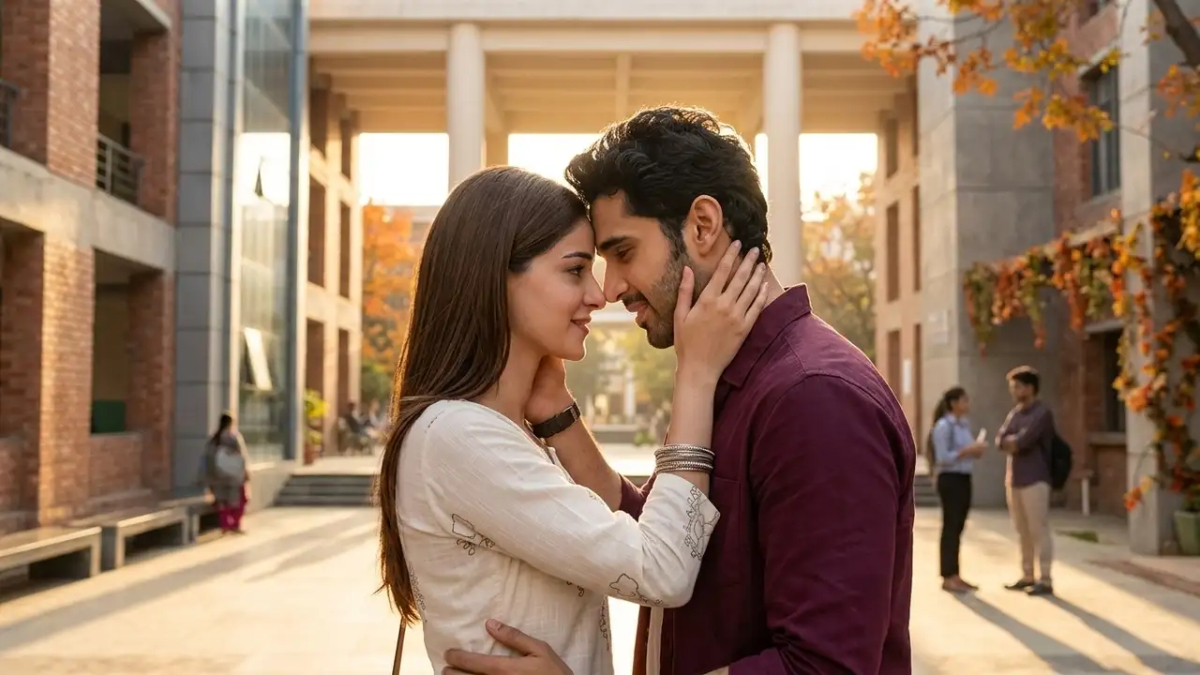
The much-anticipated romantic drama Chand Mera Dil, starring Ananya Panday and Lakshya, has officially made its way to the big screen. Produced under Karan Johar’s Dharma Productions and directed by Vivek Soni, the film arrived with a massive weight of expectations. Promoted with the tagline “Pyaar mein thoda paagal hona hi padta hai” (You have to be a little crazy in love), the movie promised to subvert the traditional, glossy Bollywood fairytale by exploring the gritty, messy, and sometimes toxic realities of modern-day relationships.
However, despite its grand ambitions and important central themes, Chand Mera Dil ultimately buckles under its own weight. The film tries to address too many complex emotional issues simultaneously—including unexpected pregnancy, childhood PTSD, and relationship violence—but fails to give any of them the narrative depth they deserve. The result is a tonally confused, unevenly written, and exhausting viewing experience that proves that good intentions do not always translate into good cinema.
From Sweet College Romance to Sudden Relationship Turmoil
The story begins in an engineering college in Hyderabad, where Aarav (played by Lakshya) falls in love at first sight with Chandni (played by Ananya Panday). The first half-hour follows a familiar, sugary Bollywood template complete with stolen glances, library study sessions, and cute text messages exchanged during lectures. The vibrant college romance quickly hits a massive speed bump when Chandni faces an unplanned pregnancy.
This is the exact moment Chand Mera Dil attempts a bold tonal pivot, shifting from a lighthearted romantic comedy into a serious relationship drama. While Aarav initially panics and suggests an abortion to protect their budding careers, Chandni stubbornly decides to keep the child and navigate single motherhood alongside her professional goals. Driven by deep-seated childhood trauma from witnessing domestic abuse in her parents’ failed marriage, Chandni pushes forward with a rigid exterior.
Unfortunately, as the couple tries to make things work, their bond deteriorates. Financial stresses, parental disapproval, and mutual insecurities boil over into bitter arguments. The ultimate breaking point occurs during a heated confrontation when Aarav loses his temper and physically strikes Chandni. This act of violence shatters the relationship entirely, sending both characters into a downward spiral of heartbreak, pride, and unresolved grief.
A Movie Caught Between Too Many Ideas
The primary flaw of Chand Mera Dil is its absolute lack of cohesion. Director Vivek Soni and co-writer Tushar Paranjape evidently wanted to create a mature, “woke” romance that subverts standard romantic cliches. Yet, the screenplay treats deep psychological issues like Instagram therapy slides rather than lived-in human experiences. It wants to be simultaneously romantic, feminist, toxic, stylish, and grounded, leaving it suffocated by its own checklist.
The film’s pacing is deeply erratic. Crucial plot developments—such as a secondary character named Kevin (Paresh Pahuja) suddenly entering Chandni’s life and rushing toward marriage—happen without any organic buildup. Major family confrontations are left completely underdeveloped. Furthermore, the film drags significantly in its second half, trapping the characters in beautifully lit, neon-soaked rooms where they stare at each other in perpetual sadness, dragging out a conflict that could easily be resolved with simple communication.
By the time the movie reaches its underwhelming climax, it has completely run out of steam. The final resolution feels unearned and fails to deliver the cathartic emotional payoff that a two-and-a-half-hour drama demands.
Performance Analysis: Hits and Misses
On the performance front, the lead pair receives mixed results, primarily due to how their characters are written.
-
Lakshya: Following his highly praised, action-packed turn in Kill, Lakshya proves once again that he is a sincere performer. He brings charm to the early college days and handles the intense, emotionally turbulent scenes of the second half with genuine vulnerability. When his character breaks down on screen, his anguish feels authentic. Unfortunately, the script limits him by forcing him into a melodramatic mold.
-
Ananya Panday: Ananya’s portrayal of Chandni is significantly more polarizing. While she has shown growth in recent years, she struggles to find the right balance here. Chandni is written with an intense rigidity that often translates on screen as sheer stubbornness rather than a complex defense mechanism. In heavy emotional scenes, Ananya delivers a capable performance, but her chemistry with Lakshya is largely absent. The romantic segments feel forced, making it difficult for the audience to invest in their pain later on.
Production, Censorship, and Box Office Reception
Visually, Chand Mera Dil attempts to stand out by using a magical realism color palette. The cinematography transitions from natural daytime lighting into highly stylized, moody neon colors to mirror the growing psychological distance between Aarav and Chandni. The soundtrack by Sachin-Jigar provides a few high points, particularly with the emotional title track and Aitbaar, which beautifully captures the ache of longing and distance. However, these technical strengths are not enough to salvage the clunky narrative.
The film also experienced an uphill battle before it even hit theatres. The Central Board of Film Certification (CBFC) initially granted the movie a U/A 16+ certificate only after ordering severe cuts. The board trimmed nearly 96 seconds of intense “lip-lock” scenes from the original cut. In an unusual move, the filmmakers reportedly went back to the censors at the last minute to insert four minutes of alternate footage across eight new scenes, stretching the final theatrical runtime to 145.53 minutes (2 hours and 25 minutes).
This turbulent pre-release cycle has translated into a slow start at the box office. Despite promotional discount tactics—such as capping ticket prices at ₹149 for all morning and afternoon shows on opening day—advance bookings have been sluggish. Chand Mera Dil faces an uphill battle to convince audiences through word-of-mouth.