
 on Thursday,)
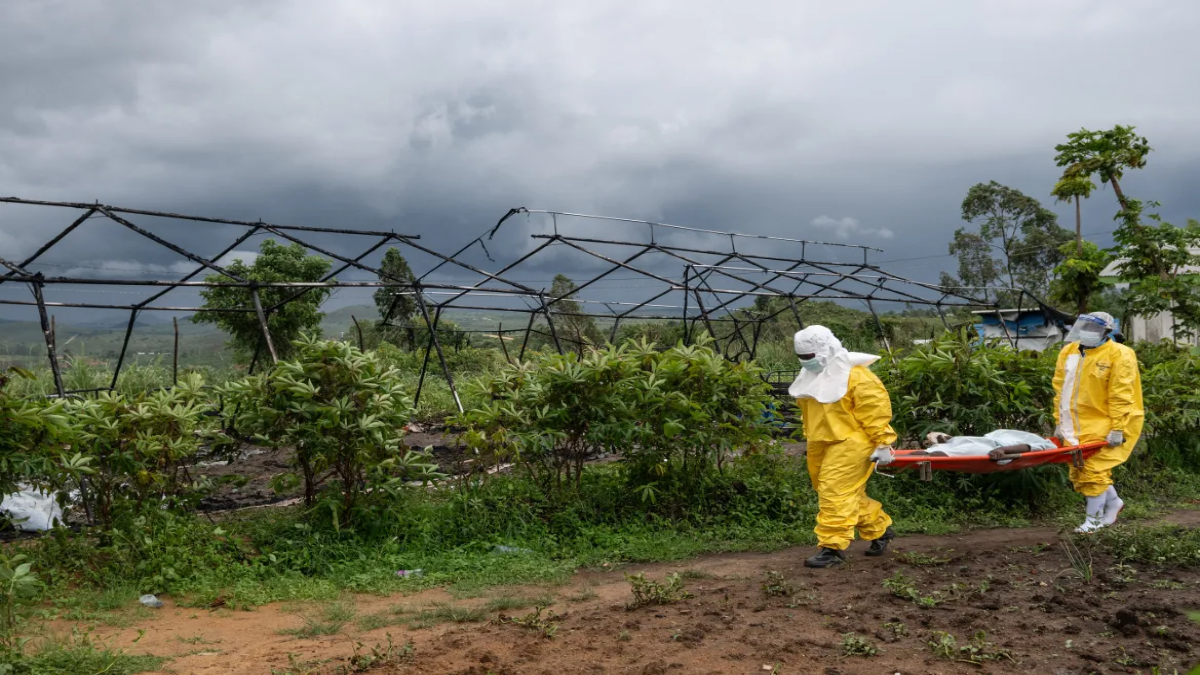
New Delhi, May 22, 2026:— A violent protest erupted at a regional hospital in the eastern Democratic Republic of the Congo (DRC) on Thursday, as an angry crowd clashed with medical workers and set fire to Ebola isolation tents. The attack at Rwampara General Hospital, located near the city of Bunia in Ituri province, highlights the volatile mix of grief, fear, and deep-seated misinformation that health officials face as they struggle to contain a fast-moving outbreak.
The unrest began when family members and local youth attempted to forcibly retrieve the body of a young man, a popular local football player, who had recently died at the facility. Authorities blocked the family from taking the body, citing strict international health protocols designed to halt the spread of the virus. The situation quickly escalated. Protesters began hurling rocks and projectiles at the hospital before setting fire to two isolation tents operated by the medical humanitarian organization ALIMA. Security forces were deployed to the scene and fired warning shots into the air to disperse the growing mob.
While initial reports suggested that patients inside the tents had fled during the chaos, ALIMA officials later confirmed that all six individuals undergoing treatment were safely accounted for. The patients have been moved deeper within the hospital facility to continue their medical care. One healthcare worker sustained injuries after being struck by stones during the attack, and the hospital’s medical staff has since been placed under heavy military protection to prevent further violence.
The Clash of Customs and Contagion
The violence in Rwampara exposes a recurring challenge in managing Ebola outbreaks: the direct conflict between essential public health measures and deeply entrenched cultural practices. In many communities across eastern Congo, traditional funeral rites involve washing, dressing, and closely embracing the bodies of deceased loved ones before burial.
However, medical experts warn that the body of an Ebola victim is highly contagious. The concentration of the virus remains exceptionally high in bodily fluids even after death, making unprotected contact with the deceased one of the primary drivers of rapid community transmission. To prevent a wider catastrophe, the World Health Organization (WHO) and the Congolese Ministry of Health mandate “safe and dignified burials,” which require trained, fully protected teams to handle and inter the bodies.
Local officials noted that the crowd’s anger was compounded by sudden grief over the loss of a prominent community figure. The young man’s mother publicly disputed the diagnosis, claiming her son had died of typhoid fever rather than Ebola. According to local leaders, this denial reflects a broader, dangerous skepticism regarding the current health crisis.
Misinformation and Mistrust Fuel the Fire
Public health workers on the ground report that a massive wave of rumors and conspiracy theories is severely undermining their containment efforts. In remote and conflict-affected pockets of Ituri province, a significant segment of the population remains convinced that Ebola is a myth.
Malembe added that deep systemic mistrust has led some residents to believe that international aid organizations and local hospitals are fabricating the crisis to secure foreign funding. This suspicion often drives families to hide sick relatives at home or smuggle bodies out of medical facilities, inadvertently accelerating the virus’s spread into new villages.
A Rare and Unpredictable Strain
The current crisis, which began in late April, marks the 17th recorded Ebola outbreak in the Democratic Republic of the Congo. However, this epidemic presents a unique and harrowing challenge for global health agencies: it is driven by the rare Bundibugyo strain of the virus.
Unlike the more common Zaire strain, for which highly effective licensed vaccines (such as Ervebo) and therapeutic treatments exist, there is currently no approved vaccine or specific cure available for the Bundibugyo variant. While international technical advisory groups are moving quickly to evaluate experimental candidates, experts estimate it will take at least six to nine months before a viable vaccine can be deployed on a large scale. Consequently, medical teams are forced to rely entirely on early supportive care, such as aggressive fluid replacement and symptom management, which can still reduce mortality rates significantly if administered early.
The initial detection of the outbreak was heavily delayed because local diagnostic tests in Bunia were calibrated to screen for the Zaire strain. The virus spread silently for several weeks before blood samples sent to the National Institute of Biomedical Research (INRB) in Kinshasa finally identified the Bundibugyo strain on May 15. The wide range of early symptoms — including fever, fatigue, vomiting, and joint pain — further caused clinicians to initially mistake the disease for malaria or typhoid.
Regional Escalation and the Road Ahead
The scale of the outbreak has already prompted the WHO to declare the crisis a Public Health Emergency of International Concern (PHEIC). According to international tracking data, there are currently nearly 600 suspected cases and at least 139 confirmed deaths, though local Congolese health officials suggest the actual death toll may already be higher.
The geographic footprint of the disease is also expanding rapidly. Confirmed cases have surfaced 500 kilometers south in North Kivu province, touching major urban hubs like Butembo and Goma. Furthermore, the virus has officially crossed international borders. Neighboring Uganda confirmed two cases in its capital, Kampala, linked to individuals who had recently traveled from the affected zones in the DRC. In response, Ugandan authorities have suspended cross-border public transport and halted passenger boat traffic along the shared Semliki River.
Compounding the medical emergency is the severe humanitarian crisis in eastern Congo, where ongoing conflict involving the M23 rebel group has displaced hundreds of thousands of people. The constant movement of displaced populations and miners makes contact tracing incredibly difficult. While the M23 group recently reported a death in territory under its control and expressed a willingness to cooperate with international health agencies, navigating active conflict zones places an immense burden on rapid response teams.
With medical supplies running low and personnel stretched to their limits, health organizations emphasize that clinical treatment alone will not end this crisis. Aid groups are pivoting heavily toward community engagement, working alongside local teachers, religious figures, and tribal leaders to dismantle rumors and rebuild public trust. As international emergency funds begin to arrive, health experts warn that the coming weeks are critical; stopping the transmission of Ebola will depend entirely on whether local communities choose to partner with the medical teams or continue to view them with suspicion.