

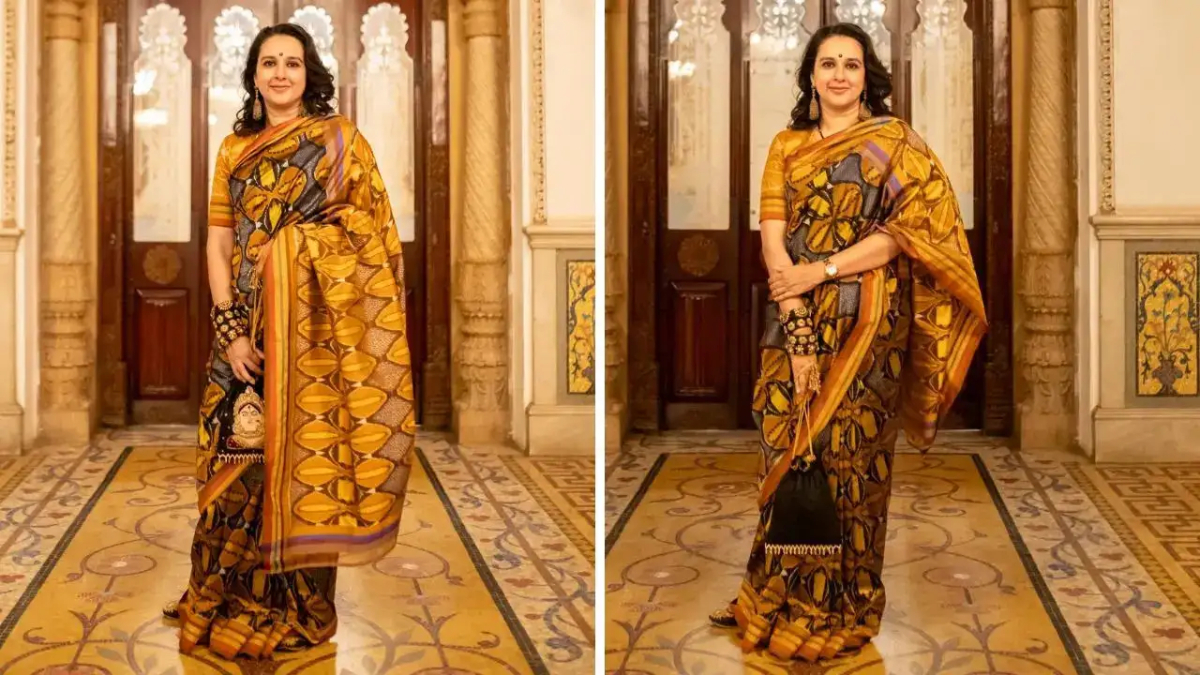
New Delhi, May 25, 2026: The world of Indian handlooms is experiencing a remarkable renaissance, led by a quiet movement toward ultimate complexity, historical revival, and royal patronage. At the center of this cultural moment stands Radhikaraje Gaekwad, the Maharani of Baroda, whose unparalleled personal textile collection continues to bridge the gap between ancient craftsmanship and contemporary relevance.
Among her most extraordinary acquisitions is a masterpiece of modern weaving engineering: a Pochampally Silk Double Ikat saree that features an astonishing 108 Telia Rumal motifs, brought to life using 30 distinct colors through a combination of double ikat and combined ikat techniques.
This single piece of wearable art represents not just a triumph for Indian handlooms, but an extreme test of mathematical precision and creative endurance that pushes the boundary of what can physically be achieved on a manual shuttle loom.
The Origin: What is Telia Rumal?
To appreciate the gravity of this saree, one must first understand its DNA. Telia Rumal is a historic textile art form originating from Chirala in present-day Andhra Pradesh, later kept alive by Master Weavers in the Puttapaka and Pochampally villages of Telangana.
The name reveals its historic roots:
-
Telia (Oil): Refers to the distinctive and lengthy oil-treatment process where raw cotton yarns are soaked in a mixture of castor oil, ash, and water. This treatment prepares the thread to absorb natural dyes deeply, providing extreme durability, a signature soft texture, and a faint, soothing oily fragrance.
-
Rumal (Handkerchief): Historically, these textiles were woven as square handkerchiefs or scarves rather than full-length sarees. They were worn as turbans by local fishermen and laborers or exported for centuries as high-status headgear to the Middle East, Burma, and East Africa.
Traditionally, Telia Rumal textiles adhered to a highly restricted, minimalist color palette: terracotta red, deep black, and stark white, organized in rigid geometric grids. Over centuries, these humble squares evolved into full-length sarees, but they rarely strayed from their classical colors—until now.
Deconstructing the Masterpiece: 108 Motifs, 30 Colours
What makes the saree championed by Radhikaraje Gaekwad so revolutionary is the explosive leap in complexity. Rather than relying on a repeating pattern of three or four standard geometric grids, this Pochampally silk saree incorporates 108 unique Telia Rumal motifs.
Each motif acts as an individual canvas. Instead of a uniform sequence, the surface of the saree shifts across a mesmerizing array of traditional geometric balances, historic representations, and intricate regional variations.
Even more staggering is the color theory applied to the design. Introducing 30 different colors into a traditional Ikat layout is an artistic gamble. In typical handloom weaving, colors are introduced across broad blocks or panels. To thread 30 distinct shades into highly intricate, independent geometric motifs requires a mathematical mapping of yarns before they ever touch the dye baths.
The Mathematics of the Weave: Double and Combined Ikat
The visual magic of this garment relies entirely on the interplay between double ikat and combined ikat techniques.
Ikat is inherently a “resist-dyeing” method. Instead of weaving a plain fabric and printing a pattern onto it afterward, the pattern is dyed directly onto the raw threads before they are loaded onto the loom.
Double Ikat
In single Ikat, either the warp (the vertical threads attached to the loom) or the weft (the horizontal threads woven through) are dyed with a pattern. In Double Ikat, both the warp and the weft threads are independently dyed with millimeter-level accuracy.
When the weaver operates the shuttle, the horizontal and vertical threads must intersect at exactly the correct cross-sections. If a thread shifts by even a fraction of a millimeter, the entire pattern blurs into a chaotic smudge.
Combined Ikat
To achieve the 108 distinct designs without structural chaos, the artisans utilized combined ikat. This technique seamlessly merges sections of pure double ikat with strategically placed areas of single ikat. This subtle shifting gives the saree an extraordinary depth, creating a visual rhythm where some geometric edges look flawlessly crisp while others possess that classic, beautifully soft, hazy “halo” that can only be achieved by authentic handmade Ikat.
The Human Cost of Precision
A textile of this caliber cannot be mass-produced, automated, or rushed. It represents months of calculation, manual labor, and generational skill.
-
The Blueprint: Before a single thread is dyed, the master weaver must draw the entire 5.5-meter layout on graph paper, calculating exactly how many centimeters of each thread must be tied to repel the dye.
-
The Tying and Dyeing: For 30 different colors, the threads must undergo dozens of consecutive rounds of tying (with plastic or rubber strips) and dipping into individual color baths. The areas meant to remain white or red are bound tight while other sections are exposed to new colors.
-
The Looming Stage: Once dyed and dried, the threads are loaded onto a manual flying shuttle loom. The weaver works at a painstakingly slow pace, manually adjusting the tension of the warp and weft with every throw of the shuttle to ensure all 108 motifs match up perfectly.
Royal Patronage and the Future of Luxury
Radhikaraje Gaekwad’s public celebration of this saree highlights a major shift in how modern luxury is defined in India. True luxury is moving away from generic global brands and turning toward rare, highly technical heritage items that tell a story of human capability.
As an active preservationist and voice for artisanal communities, the Maharani’s choice to highlight such a technically exhausting weave shines a massive spotlight on the weavers of Telangana and Pochampally. It proves that traditional Indian handloom is not a static, museum-bound craft—it is a living, breathing art form capable of unprecedented innovation.
Valued as a priceless modern heirloom, this 108-motif, 30-color Pochampally Silk Double Ikat saree serves as a definitive benchmark for what the human hand can accomplish, ensuring that the legacy of Telia Rumal continues to captivate the world for generations to come.