

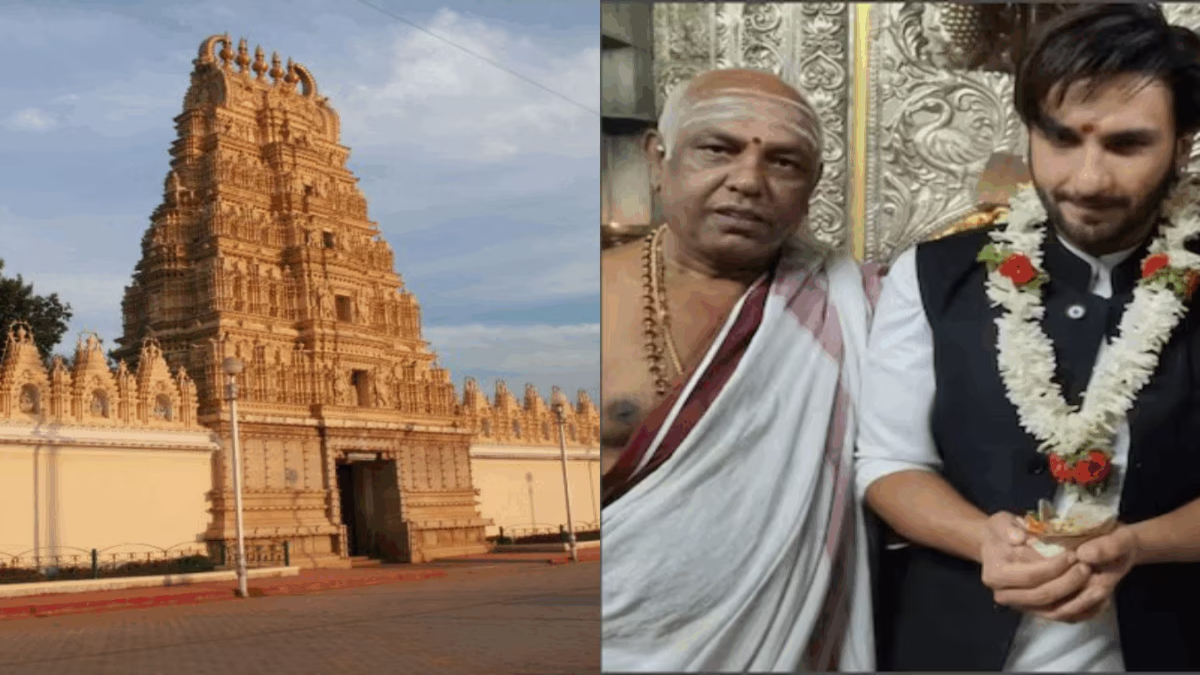
New Delhi, May 26, 2026 — There was no dramatic celebrity entourage, no heavy police barricades, and no flashing cameras on top of the misty Chamundi Hills early Tuesday morning. At around 7:30 AM, Bollywood actor Ranveer Singh walked into the historic Sri Chamundeshwari Temple just like any other ordinary devotee. Wearing a mask and keeping his head down, he stood patiently in the general queue to seek blessings from the presiding deity of Mysuru.
While the actor’s quiet visit caught many off guard, its timing was highly significant. It comes immediately after the Karnataka High Court officially closed a legal dispute against him regarding his mimicry of the sacred Kantara Daiva scene. The court had accepted his unconditional apology and specifically directed him to visit the holy shrine to make amends. Concurrently, the actor is dealing with a major professional standoff back in Mumbai, where the Federation of Western India Cine Employees (FWICE) recently issued a non-cooperation directive against him following his abrupt exit from the highly anticipated action film Don 3.
For centuries, when public figures, kings, and common citizens alike have found themselves at crossroads or facing immense turmoil, they have climbed these very hills. The Chamundeshwari Temple is not just a scenic landmark overlooking the heritage city of Mysuru; it is a profound epicenter of spiritual energy, deep-rooted royal history, and cosmic mythology.
The Mythological Origin: The Triumph Over Evil
To understand why this temple holds such an intense grip on the cultural and spiritual identity of South India, one must look at its ancient roots. Perched over 3,400 feet above sea level, Chamundi Hills was originally known in ancient texts as Mahabaladri, named after an ancient Shiva temple that still stands on the peaks. However, the hills were eventually renamed after Goddess Chamundeshwari, a fierce and fiery manifestation of Shakti (the divine feminine power).
According to sacred Hindu texts like the Devi Mahatmyam, the universe was once terrorized by Mahishasura, a powerful buffalo-headed demon who had obtained a boon making him invincible against any man or male god. As chaos spread across the worlds, the male deities combined their divine energies to create a supreme female warrior. This was Goddess Chamundeshwari.
Riding a fierce lion and wielding weapons gifted by every god, she waged a brutal, world-shaking battle against Mahishasura right on top of these very hills. The goddess ultimately slayed the demon, restoring peace to the universe. Because of this cosmic victory, she earned the revered title of Mahishasura Mardini (the slayer of Mahishasura). Today, pilgrims arriving at the hill are greeted by a colorful, giant statue of the defeated demon king, serving as a permanent visual reminder that good always triumphs over evil.
The Sacred Shakti Peeth Connection
Beyond the story of Mahishasura, the Chamundeshwari Temple holds an elite status among spiritual seekers because it is recognized as one of the 18 sacred Maha Shakti Peethas spread across the Indian subcontinent.
According to Vedic lore, when Lord Shiva performed his cosmic dance of grief and destruction (Tandava) while carrying the lifeless body of his consort, Goddess Sati, Lord Vishnu dismantled the body with his Sudarshana Chakra to calm him down. The places where pieces of Sati’s body fell to earth became highly charged centers of divine energy, known as Shakti Peethas.
It is widely believed that a strand of Goddess Sati’s hair fell upon the Chamundi Hills. This specific connection makes the shrine a literal anchor for cosmic energy. For millions of devotees, the deity inside is not a distant idol, but a protective, living mother figure capable of granting immense courage, psychological strength, and clarity during life’s most chaotic moments.
A Thousand Years of Royal Patronage
The architectural marvel that stands today evolved from a very modest, ancient shrine. The earliest historical inscriptions show that the temple was active during the Hoysala dynasty as far back as the 12th century. However, its true golden era began with the rise of the Wodeyar dynasty in 1399 A.D., the historic rulers of the Kingdom of Mysuru.
The Wodeyars adopted Goddess Chamundeshwari as their Kuladevi (family deity). They believed that her divine gaze directly protected their kingdom from foreign invasions and brought prosperity to their people. Over the centuries, successive kings transformed the humble structure into a grand palace for the goddess:
- The Dravidian Gopuram: In 1827, Maharaja Krishnaraja Wodeyar III undertook massive renovations, building the breathtaking, 7-tier Gopuram (entrance tower) that dominates the skyline today. He decorated it with intricate carvings of gods and brass finials plated in pure gold.
- The Royal Statues: The Maharaja was so devoted that he installed beautiful, life-sized statues of himself and his three queens inside the temple premises, standing with folded hands forever facing the goddess.
- The Colossal Nandi: Halfway up the ancient 1,008-step stone stairway leading to the temple sits a monolithic statue of Nandi, Lord Shiva’s sacred bull. Carved out of a single boulder of black granite during the 17th century under the orders of Maharaja Dodda Devaraja Wodeyar, it stands 16 feet tall and is one of the largest Nandi statues in all of India.
The Living Legacy of Mysuru Dasara
The legacy of the Chamundeshwari Temple is completely inseparable from the world-famous Mysuru Dasara festival held every autumn. While modern India celebrates Navaratri in various ways, Mysuru’s celebration is directly tied to Chamundeshwari’s victory over Mahishasura.
During the grand finale of the festival, the royal family hands over the spotlight to the goddess herself. A highly revered, solid-gold idol of Goddess Chamundeshwari is placed inside a 750-kilogram golden howdah (elephant saddle) mounted atop a beautifully decorated lead elephant. The grand procession, known as the Jumboo Savari, marches through the streets of Mysuru, drawing hundreds of thousands of spectators from across the globe.
Ultimately, Ranveer Singh’s quiet walk up the Chamundi Hills highlights a timeless aspect of Indian culture. Whether it is an 18th-century king preparing for battle or a modern Bollywood superstar navigating intense legal, personal, and career controversies, the powerful Shakti Peeth of Mysuru continues to stand as a universal sanctuary where people go to lower their heads, leave their egos at the door, and seek the inner strength to face tomorrow.