

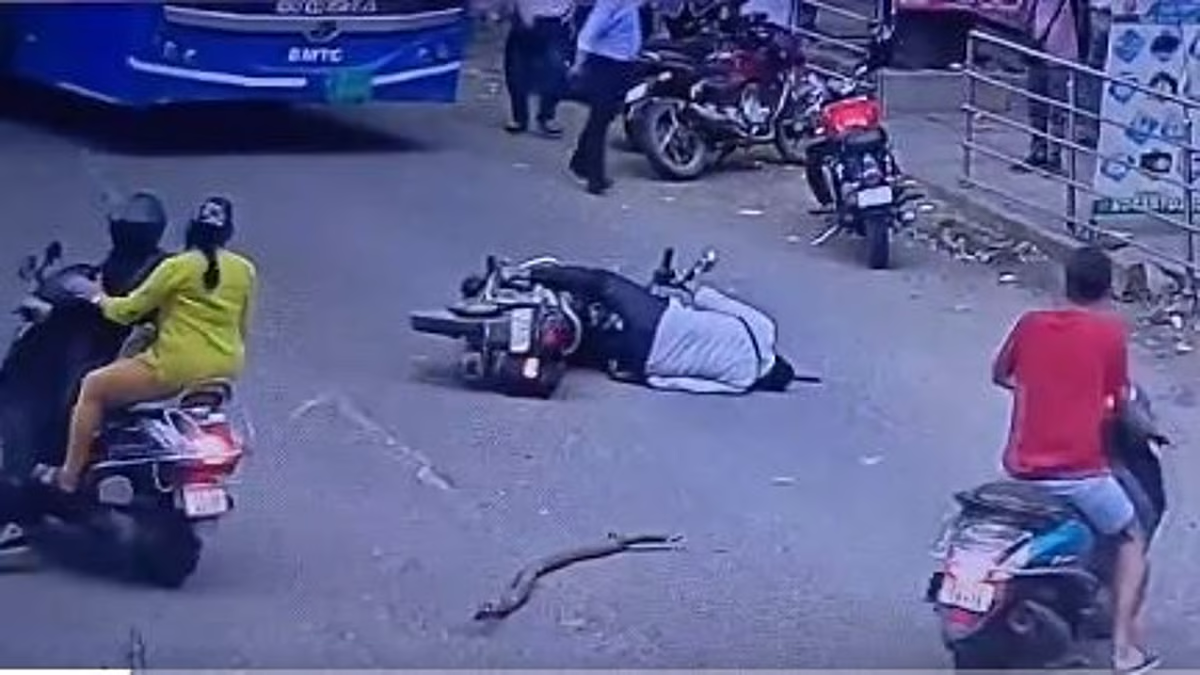
New Delhi, June 27, 2026 — In a harrowing reminder of the perils facing two-wheeler riders on city roads, a 52-year-old motorcyclist is battling for his life in a city hospital after a large, dry tree branch snapped and crashed directly onto his head. The horrific incident, which occurred on Ram Mandir Road in Rajajinagar, was captured entirely on a nearby CCTV camera. The footage has since gone viral on social media, igniting massive public outrage over civic negligence and renewing urgent conversations around two-wheeler safety.
The victim, identified as Satish, an employee at a local private finance firm, was out on the road conducting routine finance collection work when the freak accident occurred. He is currently in a coma at a private super-specialty hospital in Yeshwantpur, where doctors performed emergency brain surgery. Medical professionals have stated that his condition remains extremely critical, noting that the first 48 hours post-surgery are entirely vital to his survival.
The CCTV Footage: A Split-Second Disaster
The shocking video footage reveals the terrifying suddenness of the event. On a seemingly normal evening, traffic on the busy Rajajinagar stretch was moving at a standard pace. Satish can be seen navigating the road on his two-wheeler, moving alongside other commuters. Crucially, the video highlights that he was riding without a helmet.
Without any warning or prior rustling, a massive, dried-out branch from an old roadside canopy snapped from several meters above. It dropped like a stone, striking Satish squarely on his unprotected head. The brute physical impact appeared to cause instant unconsciousness.
The momentum threw Satish off balance, causing him to lose total control of his vehicle. He collapsed heavily into the middle of the main road, with his motorcycle pinning him down. Bystanders and local shopkeepers, shocked by the loud crack of the wood and the subsequent crash, acted with commendable speed. Abandoning their vehicles and shops, a crowd immediately rushed to the spot, lifted the heavy branch and motorcycle off him, and flagged down a vehicle to transport the heavily bleeding, unresponsive rider to a nearby medical facility.
Medical Status: Critical Hours Ahead
After receiving initial first aid at a neighborhood hospital, Satish’s worsening vitals required an immediate transfer to a advanced private hospital in Yeshwantpur. Neurosurgeons were mobilized instantly to tackle severe trauma to the skull and internal cranial bleeding.
Medical experts monitoring the case stressed that a standard, ISI-certified helmet could have absorbed the vast majority of the downward kinetic energy. While the neck might have still suffered strain, the fatal skull fractures and severe brain contusions currently threatening his life could have been significantly minimized, if not entirely prevented.
Public Backlash: Citizens Blame Civic Body Negligence
As the video continues to circulate across digital platforms, residents of Rajajinagar and Bengaluru urban activists have directed their anger squarely at local municipal governance. Neighbors and local shop owners allege that this tragedy was entirely preventable. They claim multiple official complaints had been lodged regarding the decaying state of the trees along that specific corridor.
According to local residents, the green canopy on Ram Mandir Road features several aging trees with heavily dried-out, decaying structures. Residents allege that they repeatedly requested the forest wing of the civic body to trim the weak branches before the onset of monsoon winds. However, these warnings reportedly went unheeded.
Furthermore, community members pointed out a growing hazard in Bengaluru’s older neighborhoods: heavy, unorganized internet and television cables bound tightly around weak branches. Activists argue that these heavy cable bundles add immense dead weight to aging branches, pulling them down and making them prone to snapping under minimal environmental stress.
Civic Authority Standard Defense: “A Sporadic Incident”
Faced with mounting public fury and a non-cognizable report registered by the Rajajinagar police, senior officials from the West City Corporation’s forest wing visited the accident site to inspect the remaining tree structure. However, their initial responses have done little to soothe public anger.
Speaking on the matter, a senior corporation official characterized the occurrence as a tragic but “sporadic incident.”
“The area is well-known for its old, heritage trees, which add to the green cover. However, many of these old trees harbor dead wood internally that does not visually appear dead from the ground level,” the official explained.
The official also highlighted an operational challenge faced by pruning crews: night shifts. “Due to immense daytime traffic, significant pruning work is pushed to late-night hours when complaints overwhelm us. During these times, low visibility can sometimes lead to uneven cutting, creating a weight imbalance that causes a tree to lean heavily to one side. We are investigating if an imbalance caused this specific branch to snap, and we are extending all possible support to the family.”
A Grim Pattern of Seasonal Urban Hazards
This horrific accident is sadly not an isolated event in Bengaluru’s history. Just last June, a remarkably similar tragedy claimed the life of Akshay Shivaram, a 29-year-old HR executive. Shivaram was riding his scooter through Hanumanthnagar when a heavy tree branch fell onto his head. He slipped into a coma and succumbed to his injuries days later. That incident led to criminal negligence charges against Forest Cell officials and the high-profile transfer of the District Conservator of Forests.
The recurrence of such an event just a year later highlights a systemic failure in routine pre-monsoon arboriculture inspections. Bengaluru’s iconic green canopy requires scientific, structured management rather than reactionary measures taken only after citizens are severely injured or killed.
Two Unavoidable Lessons for Every Commuter
As the civic blame game continues, the Rajajinagar incident serves as a stark, dual-layered warning for the public:
- The Absolute Necessity of Helmets: While the tree branch shouldn’t have fallen, Satish’s lack of protective gear turned a severe accident into a life-threatening disaster. Helmets are not just a tool to avoid traffic fines; they are the thin line between a concussive headache and a fatal skull fracture. Riding even short distances or on familiar neighborhood lanes without a helmet exposes riders to unpredictable urban variables.
- Active Reporting of Hazards: Citizens are urged to continuously document and escalate structural hazards—such as dead trees, leaning poles, or low-hanging transformers—through official civic grievance portals.
The upcoming days remain incredibly tense for Satish’s family and coworkers as he fights for survival. Meanwhile, Bengaluru’s daily commuters continue to navigate the beautiful but increasingly hazardous avenues of the city, looking up at the sky with a new sense of unease.