

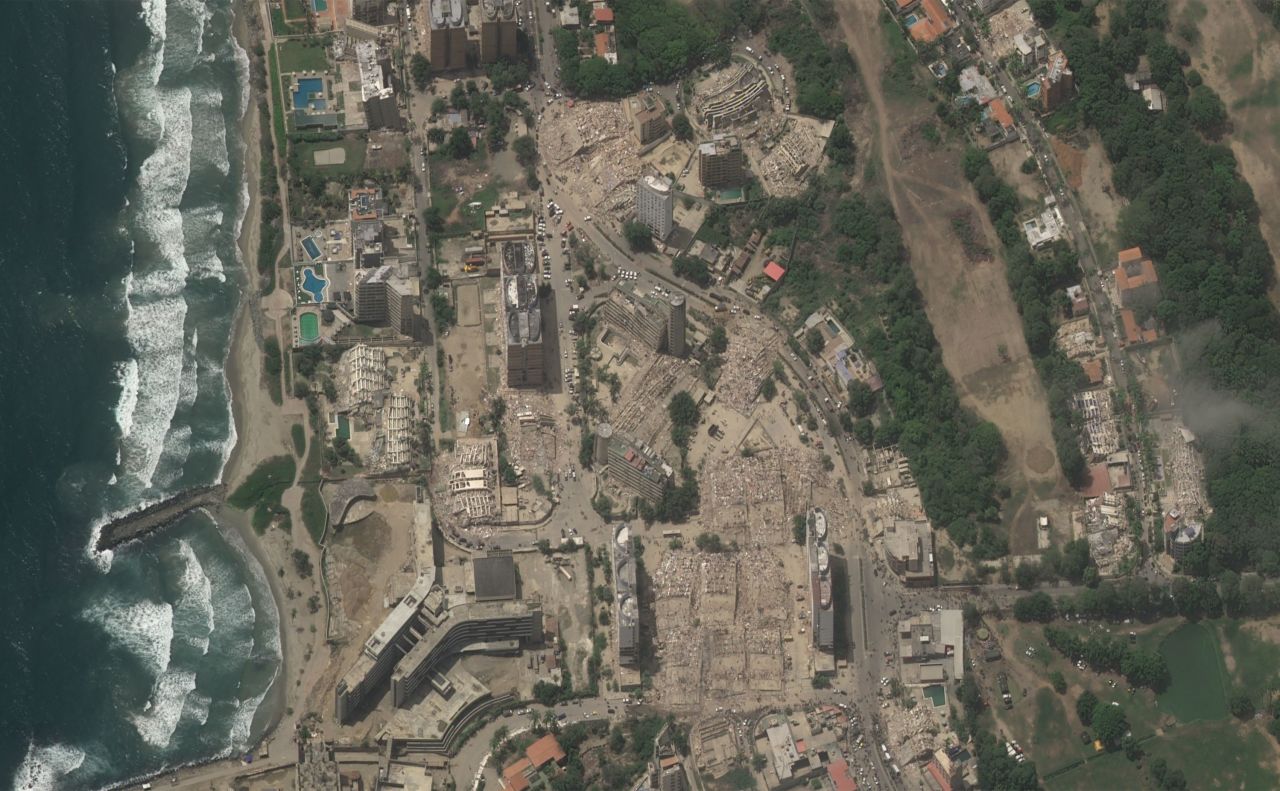
New Delhi, June 27, 2026 — High-resolution satellite images captured from space have laid bare the catastrophic destruction across northern Venezuela following two massive, back-to-back earthquakes. The powerful shocks, measuring 7.2 and 7.5 magnitude, struck the nation’s north-central coast in rapid succession, leaving major urban centers and coastal towns reeling under piles of concrete, twisted steel, and thick blankets of dust.
The double disaster—classified by seismologists as a “doublet” event because the tremors occurred less than 40 seconds apart—is the strongest recorded earthquake sequence to strike the country in more than 125 years. Ground observations combined with advanced orbital imagery reveal a rapidly escalating humanitarian crisis, with the official death toll climbing past 920, thousands injured, and tens of thousands still reported missing or unaccounted for beneath collapsed structures.
What the Satellite Imagery Shows
Newly released high-resolution images provided by Earth-imaging company Vantor show a stark, birds-eye view of the sheer power of the earthquakes. The most severe structural damage captured from orbit is centered in La Guaira, a dense coastal city located just north of the capital city, Caracas, and close to the earthquakes’ epicenters near San Felipe and Morón.
In before-and-after imagery separated by just 10 days, whole residential zones have been altered beyond recognition. In the heavily populated Playa Grande neighborhood, several high-rise apartment complexes that previously stood in organized rows are now reduced to mounds of gray rubble.
The orbital pictures reveal specific details of the destruction:
- Pancake Collapses: Multiple multi-story apartment buildings appear to have “folded in on themselves,” indicating sudden structural failure where floors stacked directly on top of one another.
- Tilted Structures: Several high-rises that did not entirely collapse have visibly shifted off their axes or tilted severely against neighboring properties, rendering them highly unstable.
- Industrial Failures: Large commercial warehouses in La Guaira’s industrial sector show completely collapsed roofs and exposed steel skeletons, indicating severe economic impact to manufacturing and storage hubs.
- Debris-Choked Streets: Entire street grids and intersections are completely obscured by thick piles of white masonry dust and building runoff, severely trapping local emergency routes.
Chaos on the Ground
While the satellite pictures show the structural geometry of the disaster, the view from the streets paints a terrifying picture of human survival. In the capital city of Caracas, neighborhoods like Altamira and Los Palos Grandes suffered intense shaking that caused older masonry and commercial facades to drop directly onto vehicles and pedestrians below.
Residents described a sudden, violent jolting with virtually no warning. Because the earthquakes struck during evening hours, families were caught inside their homes. Many survived by huddling beneath structural columns or fleeing into open town plazas as the earth rolled beneath them for nearly two minutes.
“The shaking was sudden and incredibly intense,” said María Andreína Pernalete, a resident of Caracas who was inside with her toddler and mother when the building began to crack. “We received an alert just a few seconds before everything started moving. Our building is heavily damaged, and we cannot go back inside because of the danger.”
Critical Infrastructure Crippled
The violent ground motion severely compromised Venezuela’s primary transit and utility networks, compounding the difficulty of the initial disaster response:
- Airport Closure: Simón Bolívar International Airport, the country’s main international gateway located in La Guaira, was shut down after engineers discovered severe structural damage to the terminal roof and main control facilities.
- Transit Halted: The Caracas Metro subway and regional rail lines were completely suspended due to fears of underground tunnel collapses and widespread electrical grid failures.
- Communication Blackouts: Thousands of neighborhoods lost electricity and cellular connectivity immediately after the second shock. In response, private satellite providers like Starlink announced free emergency internet connectivity across the country to assist residents in locating loved ones.
Emergency Response and International Aid
Venezuela’s government has declared a national state of emergency. Acting President Delcy Rodríguez and the army’s general staff have mobilized national emergency services, civilian firefighters, and heavy machinery to clear the rubble blocking critical coastal arteries.
Due to the overwhelming scale of the collapse and the fact that more than 50,000 people remain missing, authorities have restricted civilian entry into the hardest-hit zones of La Guaira to allow specialized search units to work unimpeded.
A massive international relief operation is quickly spinning up to assist local rescue crews. The United Nations Humanitarian Agency (OCHA) confirmed that international search-and-rescue teams from at least 17 countries are being deployed to the region. Highly specialized disaster response teams equipped with acoustic listening devices and search dogs are arriving from countries with extensive seismic experience, including Mexico, Chile, El Salvador, and a 250-member disaster assistance team from the United States.