

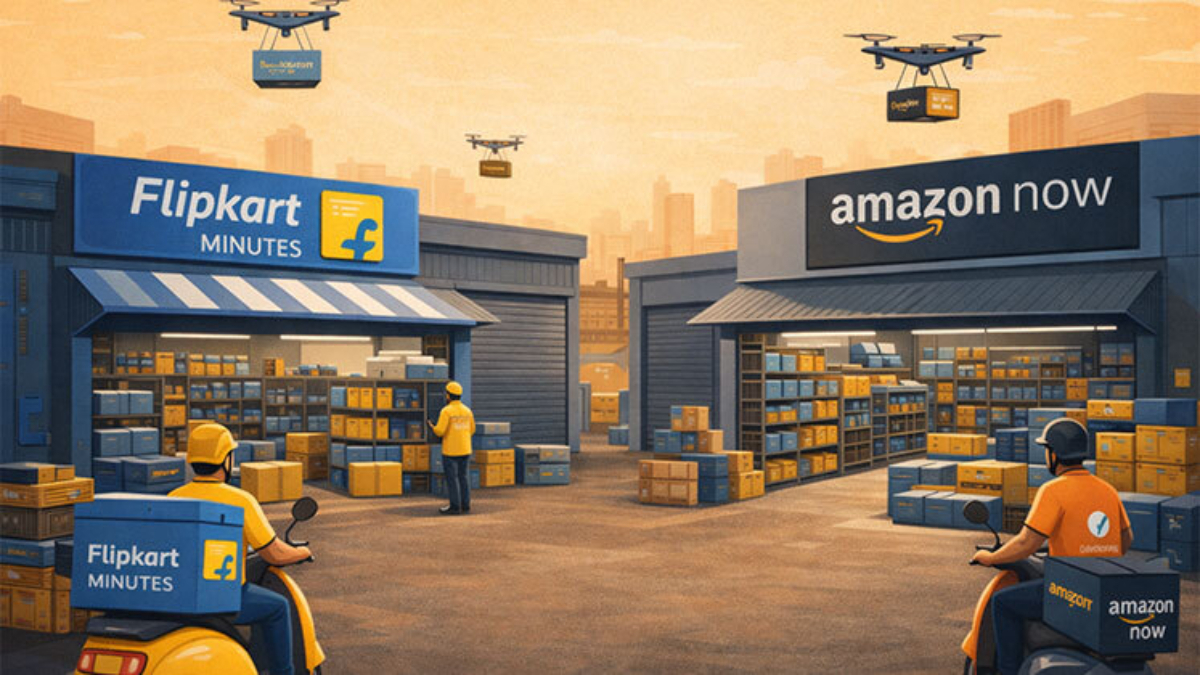
New Delhi, June 29, 2026 — For years, global e-commerce powerhouse Amazon.com Inc. watched from the sidelines as domestic startups revolutionized how India shops, transforming a casual craving for snacks or an urgent need for fresh groceries into a hyper-efficient, ten-minute delivery phenomenon. But now, Amazon has entered the arena in full force, and its massive logistics expansion has sent shockwaves through the public markets.
A fierce selloff has wiped out a staggering $15 billion (approximately ₹1.4 lakh crore) in combined market value from India’s pioneering quick-commerce leaders: Eternal Ltd., the parent company of market leader Blinkit, and its primary listed rival, Swiggy Ltd. Investors are aggressively repricing the sector as global internet giants and well-funded conglomerates lock horns in a brutal, margin-eroding price war.
The $15 Billion Correction
The market reaction has been swift and unforgiving. Eternal Ltd., which has enjoyed a dominant run under its Blinkit brand, has seen its stock slide roughly 28% from its October all-time high. Meanwhile, Swiggy Ltd., whose Instamart unit represents a massive portion of its core valuation, has plunged nearly 47% from its peak in September.
The primary trigger for this massive correction is investor anxiety surrounding Amazon Now, the Seattle-based giant’s specialized “delivery in minutes” service. Previously treated as a limited trial, Amazon recently announced aggressive plans to scale the rapid-delivery service to more than 300 Indian cities and towns, backing the rollout with a fresh multi-billion dollar commitment to build out its micro-fulfillment infrastructure.
Concurrently, Walmart-backed Flipkart has rapidly expanded its own “Flipkart Minutes” service, scaling to over 1,000 dark stores across 130 cities in less than two years, with aims to hit 1,500 stores shortly. Faced with competitors possessing seemingly bottomless balance sheets, Wall Street and Dalal Street investors are reassessing the long-term profitability of India’s home-grown delivery champions.
Shifting from Monopoly to Price War
Until recently, India’s ultra-fast delivery space was a tightly controlled, high-growth oligopoly. The top three platforms—Blinkit, Swiggy Instamart, and the heavily backed startup Zepto—controlled more than 90% of the market. Blinkit alone held an enviable 46% to 48% market share.
This concentration of power allowed the domestic leaders to slowly steer their operations toward profitability. Blinkit, for instance, was widely projected by analysts to hit net profitability by early 2026, while Zepto reported that a significant percentage of its neighborhood warehouses had turned operational cash-flow positive.
However, the aggressive entrance of Amazon and Flipkart threatens to derail that timeline. In quick commerce, buying customer loyalty usually requires heavy subsidies, resulting in a sudden return to deep discounts, lower delivery fees, and expensive marketing blitzes.
Dark Store Warfare and the Density Challenge
At the heart of this conflict is the race to build out dark stores—small, hyper-local warehouses hidden in residential neighborhoods, packed with thousands of high-turnover items ranging from milk and vegetables to smartphones and cosmetics. To achieve a 10-to-15-minute delivery promise, a dark store must be located within a tight 2-to-3 kilometer radius of the customer.
Building this network requires immense capital. Blinkit currently operates around 2,100 dark stores, while Swiggy Instamart and Zepto manage over 1,100 each. Industry experts estimate that establishing a comparable, nationwide network of micro-fulfillment centers could require Amazon to spend upward of $1.5 billion to $2 billion over the next few years.
Yet, industry analysts point out that quick commerce does not inherently reward global scale; it rewards extreme local density. To win a specific neighborhood, a company needs a massive, predictable volume of orders in that exact zip code to optimize rider routes and keep driver utilization high. Amazon is banking on its existing ecosystem—specifically its millions of high-spending, metropolitan Prime members—to instantly bridge this gap and drive immediate order density.
Future Outlook: Consolidation and a $100 Billion Prize
Despite the immediate stock market bloodbath, the long-term stakes explain why everyone is fighting so hard. According to projections by Bloomberg Intelligence, India’s quick-commerce sector is on track to explode from a niche multi-billion dollar market today into a staggering $100 billion powerhouse by 2035. If these estimates hold true, instant delivery will soon command nearly 20% of all online retail sales across the country.
This massive growth potential has prompted domestic players to arm themselves for a long winter. Zepto is currently preparing a massive initial public offering (IPO) aimed at raising up to $1 billion to fortify its cash reserves. Meanwhile, logistics heavyweights are predicting that the mounting financial pressure will eventually force smaller operators to sell out, leading to wider industry consolidation.
For the everyday Indian consumer, the immediate future promises faster deliveries, cheaper prices, and an astonishingly wide variety of goods available at the tap of a button. For the companies trying to bring those goods to the doorstep, however, the arrival of Amazon ensures that the road to profitability will be a long, expensive, and fiercely contested battle.
To gain a deeper understanding of how the retail landscape is shifting as major players alter their logistics networks, watch this insightful NDTV Profit analysis on Amazon India’s quick commerce expansion, which details the company’s aggressive infrastructure investments and plans to bring rapid delivery to 100 cities.