

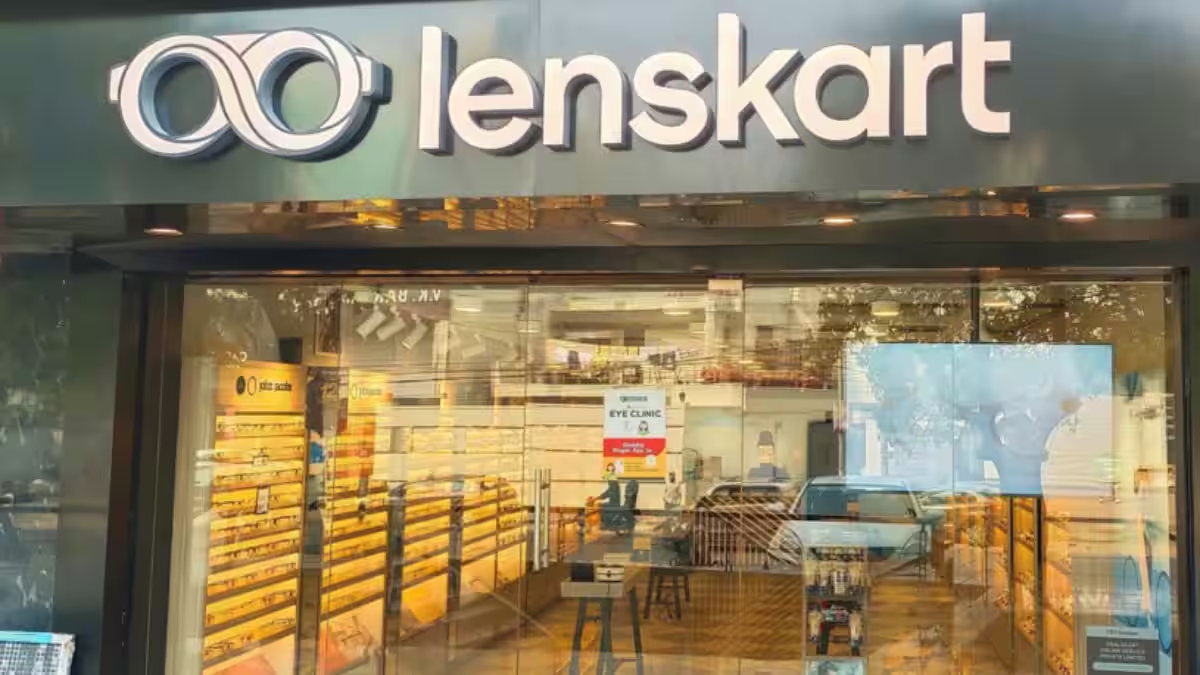
New Delhi, May 8, 2026 — Shares of India’s eyewear giant, Lenskart Solutions Limited, are the center of intense market chatter today as the mandatory six-month post-IPO lock-in period for several large shareholders officially expired. The event has triggered a massive wave of “block deals,” with existing institutional investors reportedly offloading stakes worth thousands of crores, reshaping the company’s cap table in the public market.
By mid-morning on Friday, reports indicated that a staggering ₹5,300 crore to ₹5,650 crore worth of shares were being shuffled through block transactions. This surge in volume comes as nearly 60% of Lenskart’s total equity—valued at approximately ₹51,000 crore—became eligible for trading for the first time since the company’s blockbuster listing in November 2025.
The Mechanics of the Deal
According to sources familiar with the development, the block deal was executed at a floor price of approximately ₹470 per share. This represents a modest discount of about 3.6% compared to Thursday’s closing price of ₹492.40.
Investors participating in the sell-off include prominent names that have backed Lenskart through its journey from a startup to a global eyewear powerhouse. Reports suggest that Birdseye View Holding, TR Capital Mauritius, ABG Capital, and Kariba Holdings are among the sellers looking to either trim or fully exit their positions. Alpha Wave Global, one of Lenskart’s largest backers with a nearly 7% stake, is also expected to be part of the transaction, though sources indicate they may remain subject to a fresh 90-day lock-in for their remaining holdings.
Market Reaction: A Stress Test for the Stock
As news of the massive supply hit the terminals, Lenskart’s stock price faced immediate pressure. The shares were trading down by roughly 1.3% to 3% in early Friday trade, hovering around the ₹481 mark.
While a dip is common when a large volume of shares enters the market (the “supply overhang” effect), analysts point out that the stock still holds a healthy lead over its IPO issue price of ₹402. Since its debut in late 2025, Lenskart has consistently traded above its listing price, bolstered by strong quarterly earnings and aggressive international expansion.
Understanding the “Lock-in” Expiry
For the uninitiated, SEBI regulations mandate a “lock-in” period for pre-IPO shareholders, promoters, and anchor investors to prevent a sudden exodus of capital immediately after a company goes public. This ensures price stability during the initial months of trading.
For Lenskart, which listed on November 10, 2025, the six-month window closed this week. The sheer scale of this expiry—involving over 104 crore shares—is one of the largest the Indian markets have seen this year. However, it is important to note that “eligible for trading” does not mean all these shares will be sold; many long-term investors like SoftBank and Temasek often choose to hold their positions for years post-listing.
A Look at the Fundamentals: “Compounding Has Begun”
The block deal buzz comes on the heels of a stellar Q3 FY26 performance. Founder and CEO Peyush Bansal recently remarked that the company’s “compounding has begun,” a sentiment backed by a 238% jump in net profit to ₹132 crore for the December quarter.
Lenskart’s growth story remains a compelling one for institutional buyers who might be on the other side of today’s block deals:
- Revenue Growth: The company reported an operating revenue of over ₹5,400 crore in FY24, with expectations of crossing ₹7,000 crore in the current fiscal.
- Profitability: After years of prioritizing scale, Lenskart has successfully pivoted toward consistent profitability, reducing its net losses to near-zero before turning the corner into substantial green territory this year.
- Global Footprint: With over 2,500 stores (roughly 2,000 in India and 500+ abroad), Lenskart is no longer just an Indian retailer. Its acquisition of the Japanese brand Owndays and its expansion into Thailand, the UAE, and Singapore have turned it into a pan-Asian leader.
Navigating Recent Controversies
While the financial metrics look robust, Lenskart has not been without its share of “noise.” In recent weeks, the company faced a social media storm regarding an alleged internal dress code policy that reportedly restricted religious symbols.
The company was quick to issue a public apology and a revised “In-Store Style Guide,” explicitly welcoming symbols of faith such as bindis, tilaks, turbans, and hijabs. While this controversy caused a brief 5% dip in the stock last week, today’s market activity suggests that institutional investors are focused squarely on the company’s long-term earnings potential rather than short-term PR hurdles.
What Lies Ahead?
The successful absorption of a ₹5,000+ crore block deal is often seen as a sign of “institutional depth.” If the market can soak up this supply without a free-fall in the share price, it signals that new, large-scale investors (likely mutual funds and foreign sovereign wealth funds) are eager to buy into the Lenskart story at these levels.
For retail investors, the end of the lock-in period marks a transition. Lenskart is moving from being a “newly-listed” stock to a mature, high-liquidity mid-cap play. With the supply overhang partially cleared through today’s deals, the focus will now shift to the upcoming Q4 and Annual FY26 results, where the market will look for confirmation that the “compounding” Peyush Bansal promised is indeed in full swing.