

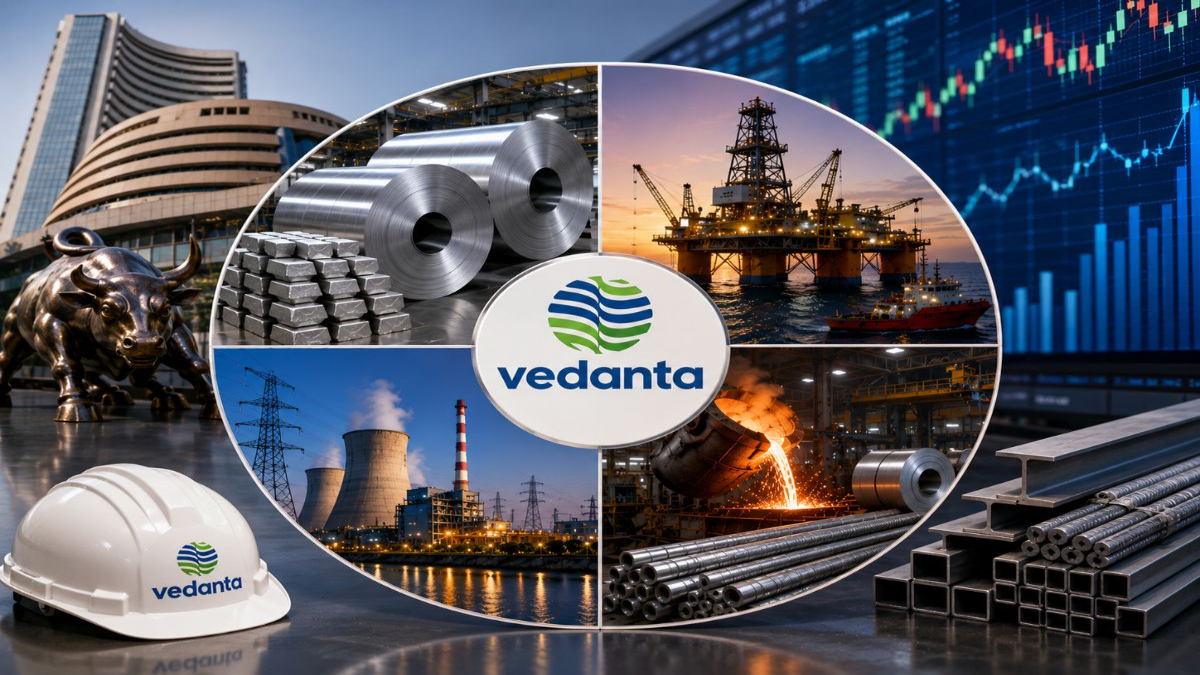
New Delhi, June 15, 2026: The Indian stock market witnessed a highly anticipated and historic restructuring milestone today as four newly carved-out entities of mining conglomerate Vedanta Limited made their trading debut on the National Stock Exchange (NSE) and Bombay Stock Exchange (BSE). However, the initial euphoria surrounding the mega-split quickly gave way to aggressive profit booking. Despite opening at premium valuations that outpaced consensus market estimates, both Vedanta Aluminium Metal Ltd (VAML) and Vedanta Oil & Gas Ltd (VOGL) sharply reversed course, shedding their listing gains to lock in their respective 5% lower circuits during early intraday trade.
The long-awaited listings mark the culmination of a massive structural overhaul first proposed by billionaire Anil Agarwal in September 2023. Under the approved 1:1 demerger scheme, eligible investors who held shares of the parent entity on the record date received one share of each of the four newly spun-off businesses for every single share they owned. The restructuring divided the industrial giant into five sector-focused, pure-play listed entities, a corporate move designed to simplify capital allocation, streamline the conglomerate’s heavy debt load, and unlock standalone value for independent commodity cycles.
High Openings Met with Rapid Profit Booking
The price discovery mechanism in the pre-open session initially delivered stellar results for the group’s crown jewel, Vedanta Aluminium. The stock debuted on the BSE at ₹527 and on the NSE at ₹522 per share—significantly higher than the conservative ₹400 to ₹475 range projected by top institutional brokerages. Powered by initial institutional demand, VAML quickly scaled an intraday high of ₹538 on heavy volume, with over 13 million equity shares changing hands across both exchanges.
The excitement, however, was short-lived. A wave of selling pressure triggered heavy profit-taking, dragging the heavy-industry stock down by 5% from its discovery baseline. Vedanta Aluminium quickly hit its lower circuit limit, freezing at ₹500.65 on the BSE and ₹495.90 on the NSE.
A nearly identical narrative unfolded for the group’s energy arm, Vedanta Oil & Gas. Trading under the ticker symbol VOGL, the stock found its discovery price at ₹38 on the NSE and ₹39 on the BSE. After briefly touching an intraday high of ₹40.95, it faced immediate liquidations, crashing 5% to lock tightly at its lower circuit of ₹37.05.
Understanding the Structural Performance Split
The multi-way corporate split created a highly fragmented performance matrix across the trading floor on Day 1. While the flagship aluminum and petroleum divisions faced heavy headwinds, the remaining spun-off entities experienced contrasting fortunes.
While the iron and steel branch displayed volatile swings, Vedanta Power Ltd emerged as the sole resilient performer among the newly traded units. Defying the broader group liquidations, the power business climbed steadily from its opening mark to post a 4.1% gain, hovering at ₹42.80 as investors repositioned capital into utility assets.
Technical Guardrails: The Impact of Trade-to-Trade Restrictions
Market analysts have emphasized that today’s sharp movements and quick circuit freezes must be viewed through the lens of strict regulatory protections. Because these are freshly listed, demerged equities, exchanges have placed all four new scrips into the Trade-to-Trade (T2T) segment for their first 10 consecutive trading session.
Because speculative day-trading is entirely barred during this initial window, trading volumes are naturally constrained. Combined with a restrictive 5% daily circuit filter, even a moderate imbalance between buy and sell orders can rapidly lock a stock at its floor or ceiling, explaining why the aluminum and oil divisions froze so quickly after institutional profit-taking began.
Valuation Success: The Big Picture for Shareholders
Despite the immediate downward movement in individual stock charts, the demerger has officially achieved its primary financial objective: major value creation for long-term retail and institutional shareholders.
Before the asset separation process began, Vedanta Limited traded at a pre-demerger closing price of ₹773.60. Following today’s structural debut, the aggregate implied value of the five broken-out pieces reached a combined total of ₹933 per share (calculated using the residual parent price of ₹311.20 alongside the new asset discovery points). This represents a massive 20.6% capital appreciation for investors who held the stock through the demerger timeline.
Furthermore, the collective market capitalization of the entire divided corporate family expanded to an estimated ₹3.55 trillion, up substantially from the undivided group’s market valuation of ₹3.02 trillion.
Long-Term Outlook for the Standalone Pure-Plays
Though short-term technical selling dominated day one, brokerages maintain a highly favorable medium-to-long-term fundamental outlook for the separated business units. By untangling these massive operations from a single conglomerate balance sheet, each management team can now aggressively pursue direct capital raises and target sector-specific expansion cycles.
- Vedanta Aluminium: Backed by massive smelting hubs in Jharsuguda and BALCO, alongside a captive refinery in Lanjigarh, VAML remains the group’s primary value driver. Analysts at ICICI Securities point to structurally high global aluminum prices, tight supply chains, and rising domestic demand from the electric vehicle (EV) and green energy sectors as long-term tailwinds.
- Vedanta Oil & Gas: Operating under the well-established Cairn India umbrella, the energy division commands a massive footprint of 44 hydrocarbon blocks spanning 47,000 square kilometers. Bolstered by resource reserves estimated at 1.4 billion barrels of oil equivalent, management has finalized a strategic roadmap targeting a production output of over 150,000 barrels per day by FY29.
As the mandatory 10-day Trade-to-Trade settlement window concludes later this month, institutional volume is expected to normalize. While the initial lower circuits reflect natural post-listing corrections, the broader separation has cleanly unbundled Vedanta’s empire, giving investors an unprecedented toolkit to play specific, direct commodity cycles in India.