

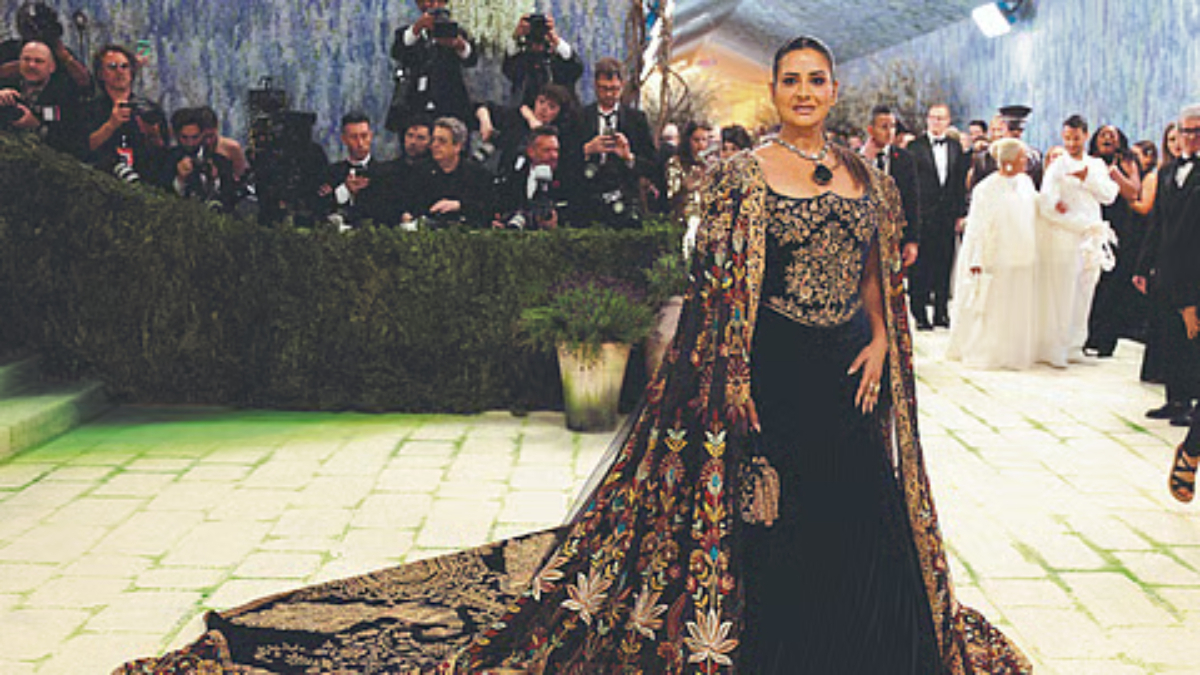
New Delhi, May 7, 2026: The steps of the Metropolitan Museum of Art have seen countless gowns, but few narratives are as intentional as the one brought by Sudha Reddy. At the 2026 Met Gala, the Hyderabad-based billionaire and philanthropist didn’t just walk the red carpet; she used it as a global podium to make a definitive statement: “The Met Gala is about representation, not just presence.”
In a world where high-fashion events can often feel like a blur of fleeting trends, Reddy’s third appearance at the “Oscars of Fashion” was a masterclass in cultural diplomacy. Under the 2026 theme “Fashion Is Art,” she moved beyond the spectacle of celebrity to showcase the soul of Indian craftsmanship.
A Canvas of Heritage: “The Tree of Life”
For the 2026 gala, Reddy collaborated with legendary Indian couturier Manish Malhotra and Hollywood stylist Mariel Haenn to create an ensemble titled The Tree of Life. The gown was less of a dress and more of a “living archive,” rooted in the 3,000-year-old textile tradition of Kalamkari from her home state of Telangana.
The statistics behind the garment are as staggering as its visual impact:
- 3,459 hours of meticulous labor.
- 90 artisans contributing their generational skills.
- 7-meter train featuring hand-painted and embroidered peacock motifs.
The look wasn’t just about the “wow” factor. It incorporated the Kalpavriksha (divine wishing tree) and the Palapitta (Indian Roller bird), symbols deeply embedded in South Indian identity. By bringing these specific motifs to New York, Reddy transitioned the conversation from “Indian-inspired” to “Indian-authored.”
Beyond the Bling: The “Queen of Merelani”
While the media often focuses on the price tags of Met Gala jewelry, Reddy’s choice of accessories carried a weightier purpose. She wore a jaw-dropping $15 million necklace featuring the “Queen of Merelani,” a rare 550-carat violet-blue tanzanite.
However, the real story lay in the symbolism. Paired with her main necklace was a back-piece by Kavya Potluri, inspired by the Surya (Sun) and Chandra (Moon)—the “eternal witnesses” in Telugu poetry. For Reddy, these weren’t just ornaments; they were a way to carry the blessings and history of her ancestors into a modern, Western space.
Representation as a Responsibility
In interviews following the event, Reddy was candid about her role. “Each time I return, it feels more purposeful,” she noted. “It’s an opportunity to shift the lens through which Indian craftsmanship is viewed—from something archival to something immediate and alive.”
Her approach challenges the “tokenism” often found in global fashion. By insisting on using traditional dyes, hand-painted Kalamkari, and gold zardozi work, she ensured that the thousands of hours logged by village artisans in India were recognized on the same level as Parisian haute couture.
“Hyderabad is not just my origin; it is a language, a rhythm, a way of being,” Reddy shared. “I aspired to translate that sensibility into a form that could exist effortlessly on a global stage.”
The Philanthropist Behind the Fashion
Sudha Reddy’s impact extends far beyond the red carpet. As a director at Megha Engineering and Infrastructures Limited (MEIL) and the founder of the Sudha Reddy Foundation, she treats her global visibility as a tool for advocacy. Her presence at the Met Gala, the Paris Olympics, and the White House Correspondents’ Dinner serves as a bridge between her business acumen and her humanitarian goals.
Her foundation’s work in healthcare and education mirrors the “Tree of Life” theme—aiming for growth, resilience, and interconnectedness. By championing South Indian textiles, she isn’t just promoting a look; she is advocating for the livelihoods of the craftsmen who keep these traditions alive.
Why It Matters
In 2026, the Met Gala saw a significant shift toward intentionality. While other stars leaned into the “Fashion Is Art” theme with avant-garde or abstract concepts, Sudha Reddy chose the art of identity.
She proved that true representation means:
- Authenticity: Not diluting cultural roots to fit Western silhouettes.
- Recognition: Crediting the specific artisans and regions (like Machilipatnam) behind the craft.
- Longevity: Treating fashion as a vessel for history rather than a costume for a single night.
As the curtains close on another Met Gala, Sudha Reddy’s “Tree of Life” remains a testament to the idea that being invited to the table is only the beginning. The real victory lies in bringing your whole village, your history, and your heritage to the table with you.