

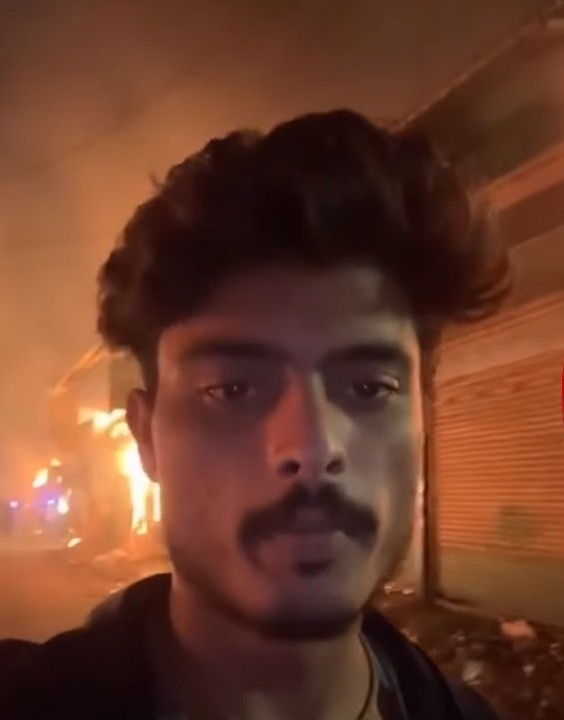
New Delhi, December 31, 2025: The digital landscape has been unsettled by a highly sophisticated deepfake video that surfaced during a period of heightened regional tension. On December 31, 2025, fact-checkers confirmed that a viral clip—purportedly showing a Bangladeshi Hindu man pleading for his life in front of a burning building—is entirely fabricated. The video, which has been viewed by millions across X and Instagram, was observed being used to stoke communal anxiety by claiming that minorities in Bangladesh are facing an “immediate existential threat.”
The Rajasthan Connection: Meet the Creator
The origin of the controversial footage has been traced back to an Indian digital content creator based in Rajasthan. Identified as Kuldeep Meena (who operates the Instagram handle tarobhaikuldeepp), the creator was observed posting a series of “vlog-style” videos where he appeared to be in the middle of arson and unrest. While the captions on his original posts occasionally mentioned the use of OpenAI’s Sora and other AI tools, the videos were quickly stripped of their context by other users and re-shared as “breaking news” from ground zero in Bangladesh.
Also Read: Ten Arrested for Distributing Swords in Ghaziabad
Anomalies in the AI Generation
Several technical red flags were highlighted by AI detection experts to debunk the clip’s authenticity. It was noted that the speaker in the video mispronounced the name of Dipu Chandra Das—a Hindu youth whose real-life tragic lynching in Mymensingh on December 18 was being exploited for the script—as “Dipu Chadar.” Furthermore, visual glitches such as an electric pole emitting light from its center and a car with mismatched door colors were observed. Tools like Hive Moderation and Deepfake-o-meter flagged the content as 99.7% AI-generated, confirming that no real person was in danger during the filming.
The Real Impact of Virtual Misinformation
Despite being fake, the video has had a tangible impact on diplomatic and social stability. It was observed being shared by prominent accounts, including The Jaipur Dialogues, which presented the AI footage as a “real-time look” at a collapsing Bangladesh. This has led to a surge in inflammatory rhetoric and demands for military intervention, even as the interim government in Bangladesh and local police confirmed that no such mass arson was occurring at the time. The incident has highlighted how “crisis deepfakes” can be weaponized to distract from actual human rights discussions with manufactured chaos.
A Call for Digital Literacy in 2026
As the world enters 2026, this case stands as a stark warning about the evolution of misinformation. Authorities have been heard urging netizens to verify the “source of the source” before sharing emotionally charged content. While the creator, Kuldeep Meena, has been observed claiming that his videos are merely “creative experiments,” legal experts have noted that such actions could fall under laws prohibiting the spread of communal disharmony. The “Bangladeshi Hindu plea” hoax serves as a reminder that in the age of Sora and generative AI, seeing is no longer believing.