

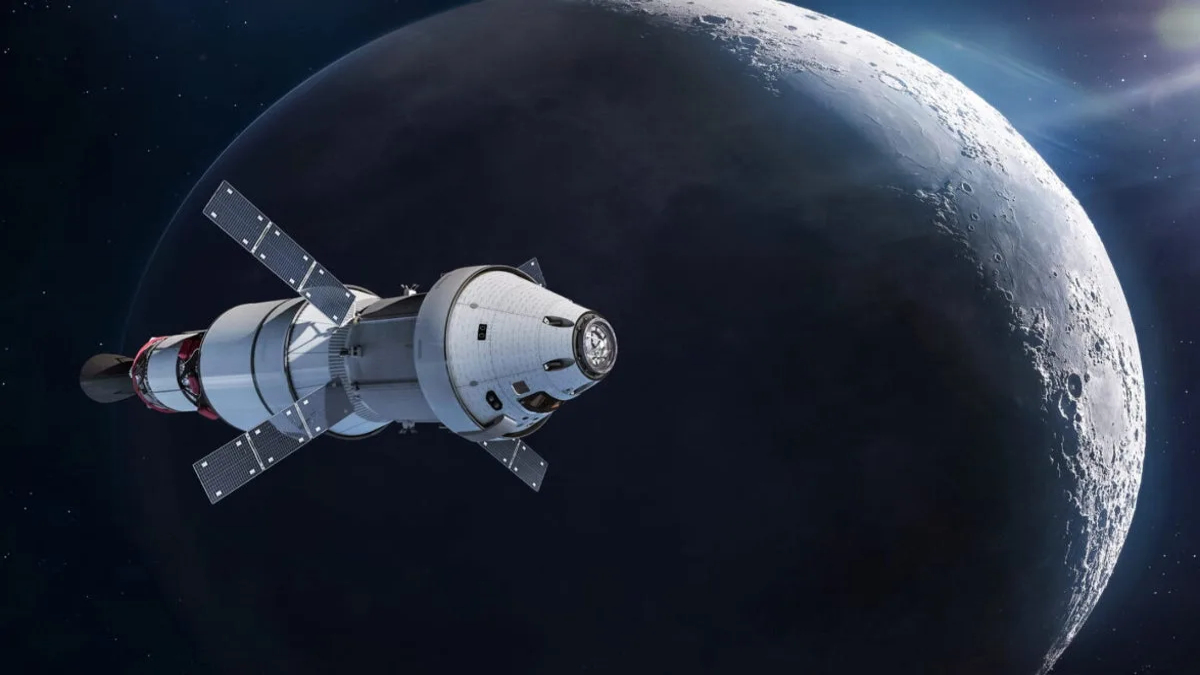
April 3, 2026 – In a moment that echoed the pioneering spirit of the Apollo era, NASA’s Artemis II mission successfully executed its Trans-Lunar Injection (TLI) burn late Thursday, propelling four astronauts out of Earth’s orbit and onto a historic trajectory toward the Moon. This maneuver marks the first time humans have ventured beyond low Earth orbit (LEO) in over 50 years.
The Orion spacecraft, which the crew has named Integrity, ignited its main engine at 7:49 p.m. EDT. The high-stakes burn lasted approximately five minutes and 50 seconds, providing the necessary velocity to break the shackles of Earth’s gravity.
Breaking Free: The TLI Burn
The TLI burn is the most critical propulsion event of the 10-day mission. To achieve the required speed to reach the Moon, Orion’s engine produced roughly 6,000 pounds of thrust, consuming nearly 1,000 pounds of fuel in under six minutes.
“When the engine ignites, you embark on humanity’s lunar homecoming arc,” Mission Control in Houston told the crew moments before the firing.
Upon confirmation of a successful burn, Mission Specialist Christina Koch responded with a poignant reflection: “With this burn to the moon, we do not leave Earth, we choose it.”
A Historic Crew on a Record-Breaking Path
The Artemis II crew represents a new chapter in space exploration, moving beyond the demographics of the 20th century. The team consists of:
- Commander Reid Wiseman (NASA): Leading the first crewed lunar mission of the 21st century.
- Pilot Victor Glover (NASA): The first person of color to leave Earth orbit.
- Mission Specialist Christina Koch (NASA): The first woman to travel to the vicinity of the Moon.
- Mission Specialist Jeremy Hansen (CSA): The first non-American to embark on a lunar mission.
As Integrity travels toward its destination, the crew is expected to set a new record for the farthest distance humans have ever traveled from Earth, surpassing the mark set by the Apollo 13 crew in 1970. The spacecraft will eventually reach a point more than 250,000 miles (402,336 km) away from home.
The Road Ahead: A Four-Day Transit
Now that the spacecraft is on its “free-return” trajectory, it is effectively on a cosmic slingshot. This path uses the Moon’s gravity to swing the capsule around the lunar far side and pull it back toward Earth without requiring a major engine burn to return.
| Mission Milestone | Expected Timing |
| Lunar Sphere of Influence | Day 5 |
| Closest Lunar Approach | Monday, April 6 |
| Lunar Far Side Flyby | Monday, April 6 |
| Pacific Ocean Splashdown | Friday, April 10 |
Early Mission Challenges
The journey hasn’t been without minor technical hurdles. During their first 24 hours in orbit, the crew addressed a temporary communication glitch and a malfunctioning toilet system. In a lighthearted update, Koch—who previously spent 328 days on the International Space Station—joked that she was “proud to call myself the space plumber” after successfully fixing the $30 million waste management system.
The astronauts have also begun their daily exercise routine using a compact 30-pound flywheel device designed to combat muscle and bone loss in microgravity—a critical test for the much longer missions to Mars planned for the 2030s.
The Bridge to the Surface
Artemis II is a “flyby” mission, meaning the crew will not land on the lunar surface. Instead, they are serving as the ultimate test pilots for the Orion spacecraft and the Space Launch System (SLS). Their success is the final prerequisite for Artemis III, currently slated for 2028, which aims to land the first woman and next man on the lunar South Pole.
As the Earth shrinks to a marble in the cabin window, the world watches. For the first time in half a century, the Moon is no longer just a destination for telescopes and robots—it is once again a destination for humanity.