

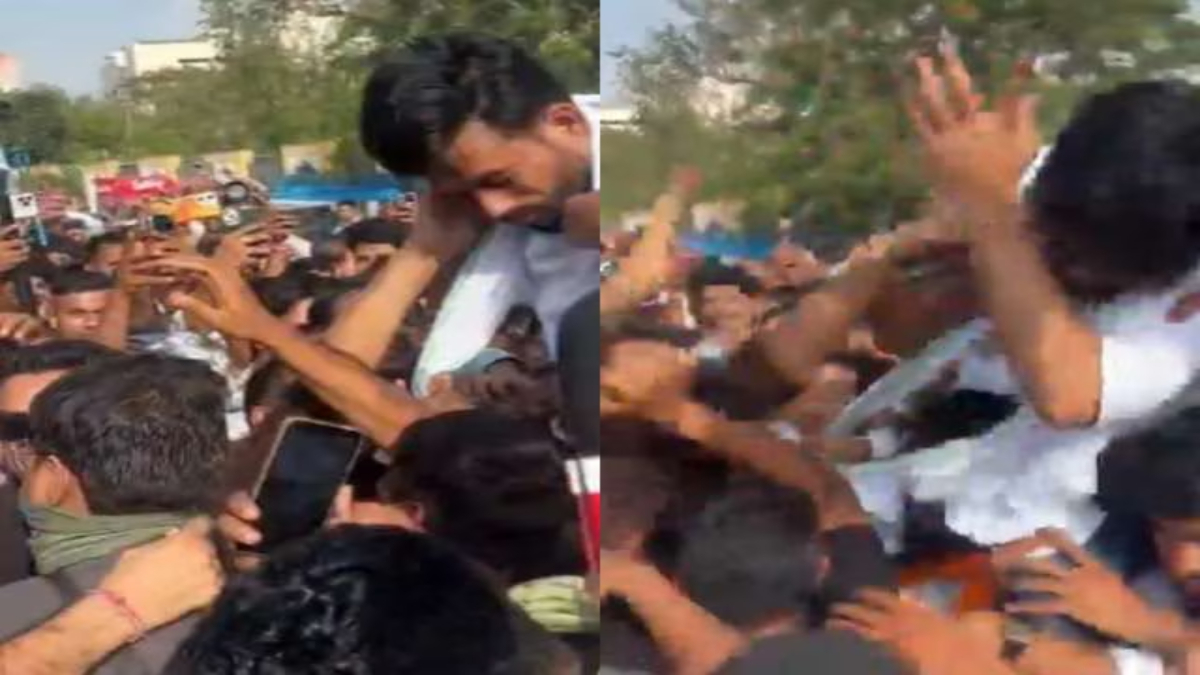
New Delhi, June 16, 2026: High drama and chaotic scenes unfolded at Jaipur’s historic Shaheed Smarak on Monday afternoon as Abhijeet Dipke, the founder of the internet-sensation satirical movement “Cockroach Janta Party” (CJP), was repeatedly slapped and manhandled during a massive student-led protest. The dramatic incident, which was captured live on camera and widely shared across social media platforms, triggered immediate tension at the protest site before local authorities intervened to bring the situation under control.
The demonstration, organized by the CJP to raise awareness against recent competitive examination paper leaks—including the NEET controversy—and mounting youth unemployment, had drawn thousands of students and Gen Z activists. What began as a highly charged but peaceful gathering quickly took a violent turn when the CJP chief became the target of an unexpected physical assault.
Assault Caught on Camera Amid Growing Chaos
The incident took place just as Abhijeet Dipke arrived at the venue to address the massive crowd of student demonstrators. Due to the dense gathering of young supporters, enthusiastic volunteers had hoisted Dipke onto their shoulders to carry him toward the main stage so he could be visible to the audience.
As he was being carried through the crowd, a small group of individuals suddenly breached the security perimeter formed by the volunteers. Eyewitness accounts and viral video footage show an assailant grabbing the scarf wrapped around Dipke’s neck, effectively trapping him. Within seconds, the attacker and another individual began repeatedly slapping and hitting the CJP founder across the face.
The unexpected assault triggered immediate pandemonium. Shocked and angered by the physical attack on their leader, a section of CJP supporters immediately retaliated, overpowering the assailants and engaging in a brief, violent scuffle. Fearing a full-blown riot at the venue, local police personnel deployed at the site moved in swiftly. Officers pushed back the crowd, separated the warring factions, and escorted a shaken Dipke to a secure location, preventing further escalation.
Attackers Identified; Police Launch Investigation
Following the incident, the Jaipur Police acted quickly to restore law and order at Shaheed Smarak. According to senior police officials, law enforcement authorities have detained six individuals from the spot for questioning.
Initial investigations revealed that one of the primary accused involved in the physical assault has been identified as Rakesh Gurjar. Following his detention, Gurjar allegedly claimed to be a “nationalist” and openly criticized the ideology and satirical nature of the Cockroach Janta Party, suggesting that his actions were a protest against Dipke’s political commentary.
Interestingly, the protest itself had faced bureaucratic hurdles prior to the incident. The Jaipur Police had initially denied permission for the CJP rally, citing potential law-and-order risks given the massive anticipated turnout of coaching students in the city. However, after intense negotiations and public pressure from the organizers, authorities granted a conditional nod, capping the maximum permissible attendance at 800 participants—a limit that appeared visibly breached by the sheer volume of youth who arrived at the venue.
“Attacks are a Sign of Cowardice,” Says Dipke
Taking to his official social media handle shortly after the assault, Abhijeet Dipke condemned the violence but maintained that his movement would not be intimidated by physical threats. He reiterated that the Cockroach Janta Party remains deeply committed to peaceful, democratic dissent.
“Physical attacks are a clear sign of fear and cowardice,” Dipke wrote on X (formerly Twitter). “We are raising legitimate questions about the ruined futures of millions of students due to constant paper leaks, and those in power have no answers. I am a firm follower of Mahatma Gandhi and Dr. B.R. Ambedkar. I will continue to fight this battle for youth rights with peace, love, and constitutional means.”
The CJP leadership has stood firm on its core demands, continuing to call for the immediate resignation of Union Education Minister Dharmendra Pradhan over structural failures in national-level entrance examinations.
The Meteoric Rise of the Cockroach Janta Party
The violent incident in Jaipur highlights the growing real-world impact of the Cockroach Janta Party, which has rapidly transformed from an online parody into a significant offline political force.
The movement was founded on May 16, 2026, by Dipke, a digital communications strategist, in direct response to controversial remarks made by the Chief Justice of India. During a Supreme Court hearing, the CJI had criticized certain unemployed youths and social media activists, colloquially referring to them as “cockroaches” and “parasites.” Turning the insult into a badge of honor, Dipke launched the CJP as a satirical front representing the “lazy and chronically online youth.”
The party’s anti-establishment memes and sharp political satire struck a massive chord with India’s frustrated Gen Z demographic, allowing its official Instagram page to cross 20 million followers in less than a month—surpassing the digital handles of mainstream political giants like the BJP and the Indian National Congress.
What started as internet culture has successfully transitioned into physical mobilization. Following a successful large-scale protest at New Delhi’s Jantar Mantar on June 6, the Jaipur rally was part of the CJP’s announced nationwide offline campaign. High-profile activists, including environmentalist Sonam Wangchuk and lawyer Prashant Bhushan, have previously extended their solidarity to the movement, labeling themselves “honorary cockroaches” to demand transparency in public examinations.
As the Jaipur Police continue their investigation into the security lapse at Shaheed Smarak, political analysts note that the assault on Dipke may inadvertently fuel further momentum for the CJP, amplifying the anger of the youth who feel their systemic grievances are being met with physical suppression rather than administrative accountability.