

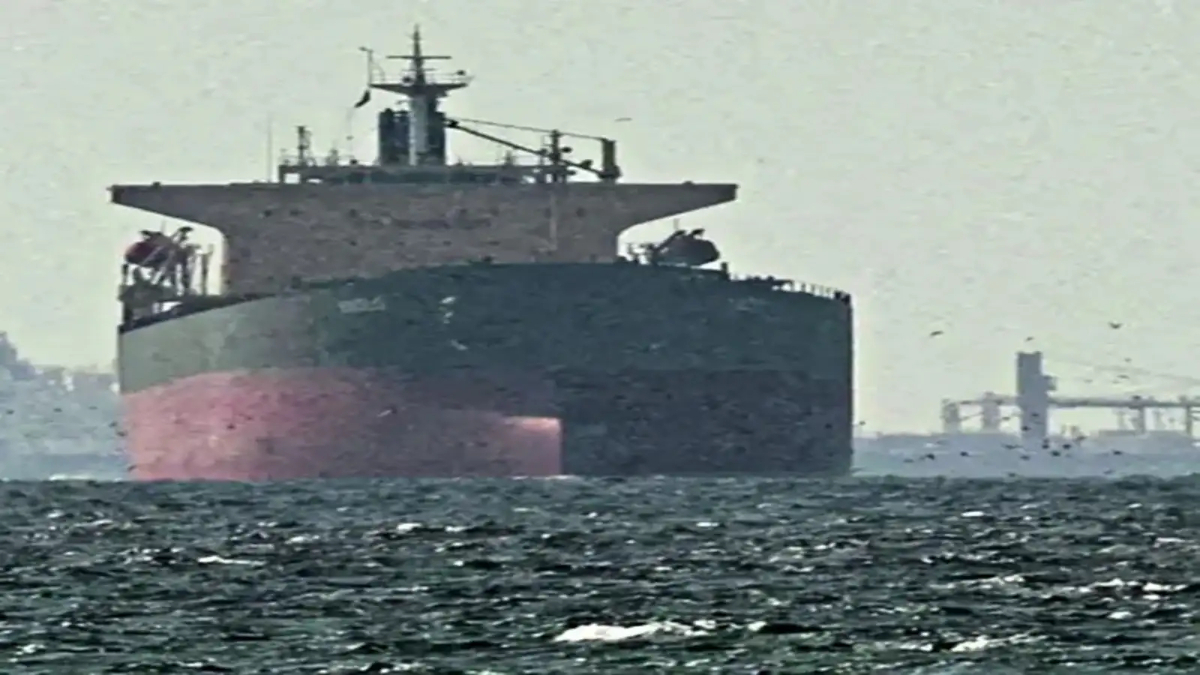
New Delhi, June 11, 2026 — Tensions in the Middle East have dramatically spilled over into international shipping lanes after the United States military carried out back-to-back airstrikes against commercial oil tankers in the Gulf of Oman. The strikes, executed as part of an aggressive US-led naval blockade against Iranian ports, have triggered a diplomatic standoff between Washington and New Delhi. While the US maintains it is enforcing strict economic blockades, Indian authorities have issued strong condemnations after dozens of Indian seafarers were caught in the crossfire, leaving three sailors missing at sea.
Dramatic video footage has captured the moments when advanced American fighter jets fired precision guided missiles directly into civilian merchant vessels. The videos, which have rapidly circulated on global maritime networks and social media platforms, show thick plumes of black smoke billowing into the sky from the vessels’ shattered engine compartments as military helicopters circle above to coordinate emergency evacuations.
The U.S. Blockade and the Strategy of “Precision Disabling”
According to the US Central Command (CENTCOM), the strikes are part of a targeted enforcement mechanism deployed after Iran severely restricted maritime traffic through the vital Strait of Hormuz. In response, Washington initiated a sweeping blockade of all Iran-related shipping.
The military strategy utilized by the US Navy in these incidents involves “precision disabling”—firing heavy munitions specifically into a vessel’s engine room and steering mechanics to neutralize its propulsion without sinking the entire ship or causing a catastrophic oil spill.
The recent crisis developed across two distinct engagements within less than 72 hours:
- The Attack on the MT Marivex: On Monday, a US Navy F/A-18 Super Hornet, launched from the aircraft carrier USS Abraham Lincoln, fired on the Palau-flagged tanker MT Marivex. CENTCOM stated that the ship was attempting to evade the US blockade for a fourth time to reach an Iranian port. After ignoring multiple verbal warnings to turn around, its engine and steering spaces were targeted, causing a massive fire.
- The Strike on the Settebello: On Tuesday evening, a nearly identical strike crippled a second Palau-flagged oil products tanker, the Settebello, approximately 20 nautical miles northeast of Sohar, Oman. US forces targeted the engine room with precision ordnance, asserting the ship had violated the ongoing blockade by attempting to transport Iranian fuel.
Indian Crews Caught in the Crossfire
While the targeted tankers are registered under foreign flags, both ships relied entirely on Indian merchant mariners to operate. The consecutive strikes have placed civilian Indian sailors directly in the line of military fire, turning a geopolitical struggle between Washington and Tehran into an urgent humanitarian emergency for New Delhi.
During the first strike on the MT Marivex, all 24 Indian nationals on board managed to survive. The crew abandoned the burning ship and was rescued via an emergency airlift coordinated by Omani military helicopters before being safely transported to Oman’s Masirah Island.
However, the second strike on the Settebello resulted in casualties. While a rapid search-and-rescue operation successfully pulled 21 Indian sailors from the burning vessel, three Indian seafarers remain missing. Rescue vessels and local Omani authorities are scouring the Gulf of Oman to locate the lost crew members, though hopes are dimming given the intensity of the engine room explosion and the resulting fire.
Diplomatic Fallout: India Summons US Envoy
The strikes have sparked a sharp rift between India and the United States, two nations that typically maintain close strategic and maritime ties. Following the strike on the Settebello and the disappearance of the three citizens, India’s Ministry of External Affairs (MEA) moved from quiet concern to public condemnation.
New Delhi formally summoned US Charge d’Affaires Jason Meeks to lodge a “strong protest” over the military action taken against commercial vessels staffed by Indian citizens. In an official statement, the MEA characterized the recurring attacks as deeply worrisome and entirely unacceptable.
International bodies have echoed India’s sharp rebuke. Arsenio Dominguez, the Secretary-General of the International Maritime Organization (IMO), strongly condemned the military action, emphasizing that the safety of innocent seafarers must remain a baseline priority under global law, regardless of the sanctions in place.
The Economic Context: The “Shadow Fleet”
Shipping data reveals that the vessels targeted belong to what global economists refer to as the maritime “shadow fleet”—a network of older, foreign-flagged tankers that operate under complex corporate structures to transport sanctioned oil from countries like Iran and Russia.
Because these ships frequently change names, disable their mandatory automatic tracking transponders, and hide their true ownership, they present a massive challenge for Western authorities trying to enforce financial blockades. However, the crews hired to sail these high-risk routes are almost always civilian mariners from developing nations, particularly India, the Philippines, and Bangladesh, who take on the dangerous voyages for employment.
What Lies Ahead for Global Shipping?
The deployment of direct airstrikes by US warplanes against merchant vessels represents a significant escalation in maritime warfare tactics. Previously, blockades were enforced through physical interceptions, boarding parties, or financial asset seizures. By resorting to kinetic missile strikes inside international waters, the US has signaled a zero-tolerance policy toward the transport of Iranian oil, even at the risk of fracturing alliances with neutral trading partners like India.
For India, the immediate priority remains the search-and-rescue operation for the three missing sailors off the coast of Sohar. Beyond the rescue efforts, the incident is forcing a major re-evaluation of maritime security for thousands of Indian seafarers working in the Middle East. With the Strait of Hormuz and the Gulf of Oman turning into active combat zones, commercial shipping lanes face severe disruptions, threatening to drive up global oil prices and insurance premiums for merchant vessels worldwide.