

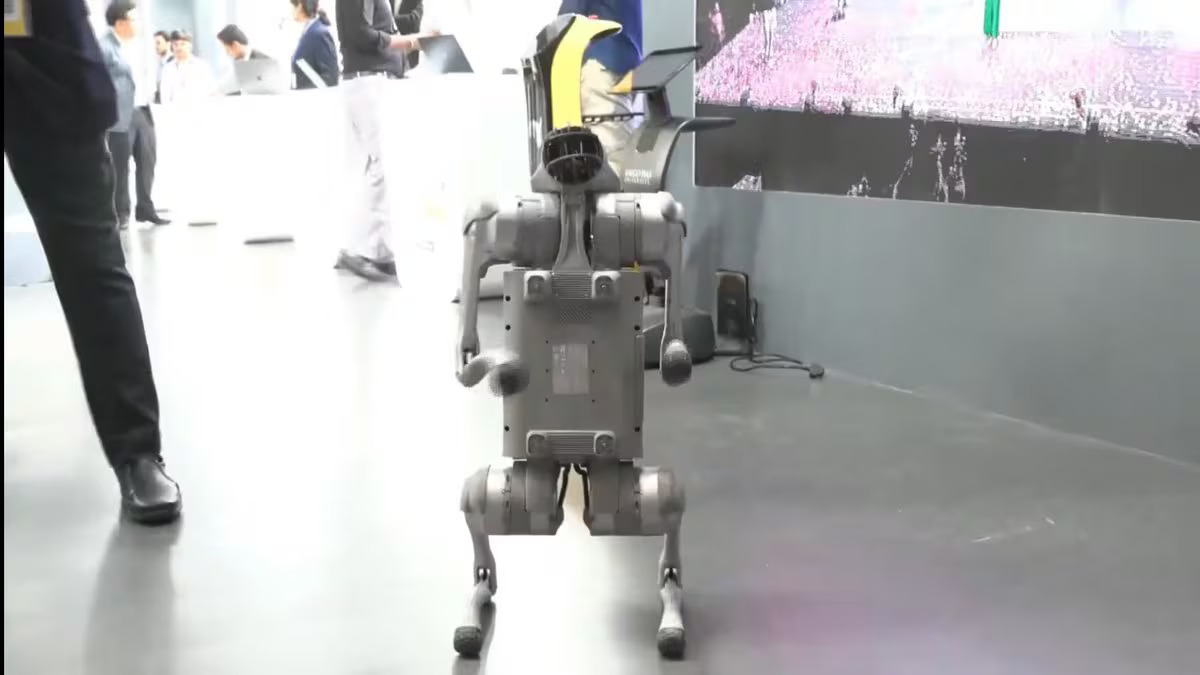
New Delhi, February 21, 2026: A major controversy erupted at the prestigious India AI Impact Summit 2026, held at Bharat Mandapam, involving Noida-based Galgotias University. The institution, which was showcasing its advancements in Artificial Intelligence, found itself at the center of a national storm after allegations surfaced that it attempted to pass off a commercially available Chinese robotic dog as its own in-house innovation.
The incident has sparked a massive debate on social media, drawing criticism from tech experts, opposition leaders, and government officials alike.
The Spark: “Orion” vs. Unitree Go2
The controversy began when a video of Professor Neha Singh, a representative of the university, went viral. In the footage, she was seen introducing a quadruped robotic dog named “Orion” to the media. She claimed the robot had been developed by the university’s Centre of Excellence and highlighted its capabilities in surveillance and campus monitoring.
However, the “innovation” was quickly debunked by netizens and tech enthusiasts. Within hours, observers identified the robot as the Unitree Go2, a popular model manufactured by the Chinese firm Unitree Robotics. The robot is widely available for purchase online for approximately $1,600 to $2,800 (roughly ₹1.3 to ₹2.3 lakh).
Government Action: Stall Vacated and Power Cut
As the backlash intensified, the Ministry of Electronics and Information Technology (MeitY) took decisive action. To maintain the integrity of the summit—intended to showcase indigenous Indian AI prowess—authorities asked Galgotias University to vacate its stall immediately.
- Power Disconnection: Reports indicated that the power supply to the university’s pavilion was cut off before they were asked to leave.
- Official Stance: S. Krishnan, Secretary of MeitY, emphasized that exhibitions must reflect “genuine and actual work,” stating that the government does not want to encourage misinformation or plagiarism at such high-profile events.
University’s Defense: “Ill-Informed” Representative
Faced with the threat of being “blacklisted” from future events, Galgotias University issued a formal apology, shifting the blame onto the individual staff member.
“One of our representatives manning the pavilion was ill-informed. She was not aware of the technical origins of the product and, in her enthusiasm for being on camera, gave factually incorrect information,” the university stated.
The institution clarified that while they purchased the robot for student research and learning, they never intended to claim it as a manufactured product of the university. They described the robot as a “classroom in motion” intended to inspire students to eventually build similar technologies in India.
Expanding Scrutiny: The Drone Soccer Case
The “robodog” wasn’t the only exhibit under fire. Critics and opposition groups, including the Indian Youth Congress, pointed out that a “Drone Soccer” arena showcased by the university also appeared to be a borrowed innovation. Allegations suggest the drones were actually Striker V3 ARF models from South Korea, despite claims of being built from scratch on campus.
Impact and Public Reaction
The incident has caused significant embarrassment for the university and has raised questions about the pressure on Indian educational institutions to “market” innovation over performing genuine research.
| Entity | Reaction |
| Government | Ordered immediate exit to avoid “National Embarrassment.” |
| Opposition | Termed it a “disorganized PR spectacle” and criticized the branding of imported goods. |
| Students | Expressed concern over the impact on their degrees and future placements. |
| Social Media | A flurry of memes and “Community Notes” debunking the university’s claims. |
While Galgotias University maintains that its long-term vision is to foster local talent, this episode serves as a cautionary tale for the Indian tech ecosystem regarding transparency and the fine line between educational tools and indigenous innovation.