

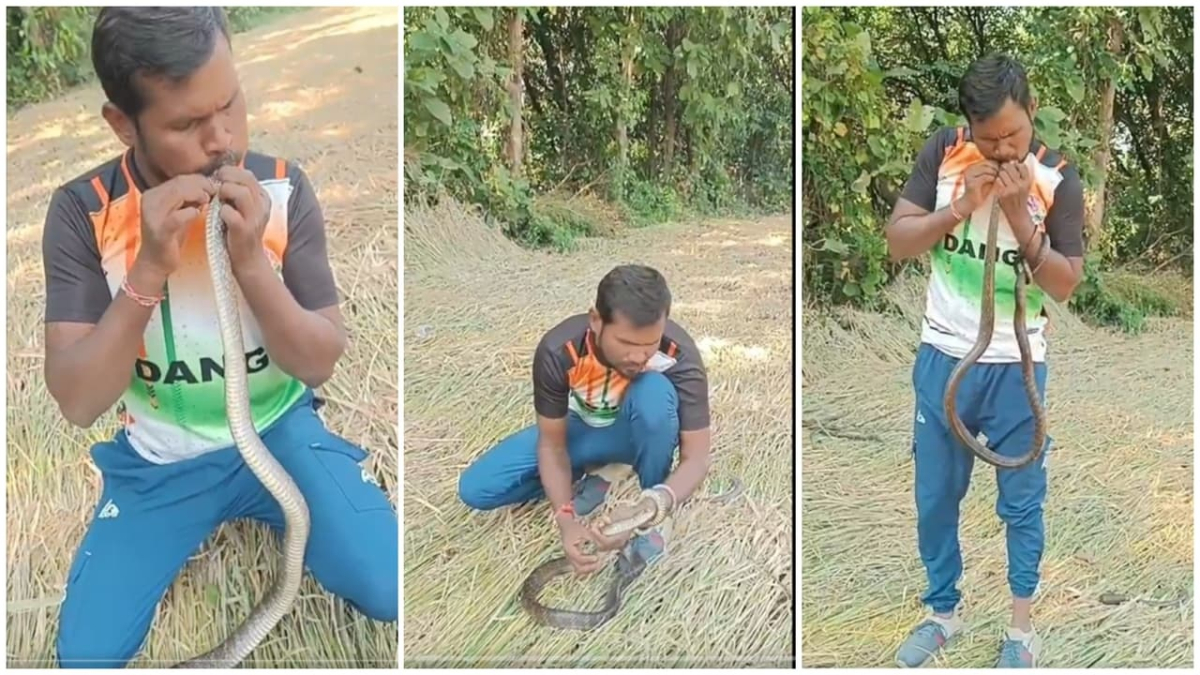
December 04, 2025: In a truly remarkable display of compassion and quick thinking, a trained wildlife rescuer in Gujarat successfully administered mouth-to-mouth Cardiopulmonary Resuscitation (CPR) to save a snake that had suffered a severe electric shock. This extraordinary act, captured on video, has not only gone viral but has also ignited conversations about the deep bond some people share with wildlife.
The Dramatic Incident
The incident, which recently took place in Amdha village of Valsad district, involved a large Rat Snake—a non-venomous species—that was climbing an electric pole. The snake unfortunately came into contact with a high-tension overhead power line, resulting in an electric shock that caused it to fall approximately 15 feet to the ground.
Farm labourers nearby rushed to the spot and found the snake lying motionless and unconscious. They immediately contacted local wildlife rescuer Mukesh Vayad, who lives in the same village and has over a decade of experience in snake rescue, including training from the Snake Research Institute at Dharampur.
The Life-Saving Attempt
Upon arrival, Mr. Vayad carefully examined the reptile, noting its lack of response and cold body, but he detected a faint heartbeat. Believing the snake could be revived, he took the courageous and unconventional step of performing CPR.
- He gently held the snake, opened its mouth, and began blowing air into it, in an attempt to provide artificial respiration.
- He also administered gentle compressions, tapping the snake’s heart area at intervals.
For a tense period of nearly 25 to 30 minutes, Mukesh Vayad persisted with his efforts. His persistence paid off: the snake slowly started showing signs of movement, opening its eyes, and eventually regaining its breath. Moments later, the fully revived reptile slithered away into the nearby bushes, a miraculous recovery caught on the cameras of the amazed onlookers.
A Viral Moment of Compassion
Pictures and videos of the dramatic rescue quickly spread across social media platforms. Users praised Mr. Vayad’s bravery and humanity, with many calling his actions an inspiring example of animal welfare and empathy. “This is true compassion,” one social media user wrote, while others applauded him for risking his life, even though the snake was non-venomous, as working with any wild animal carries risks.
Expert Caution
While the incident has been widely celebrated, wildlife experts have issued a word of caution to the general public. Wildlife Biologist Krunal Trivedi pointed out that while the rescuer’s intentions were admirable, the method is not typically recommended for untrained individuals.
In veterinary medicine, specifically for animals with narrow respiratory pipes like snakes, specialists would use an endotracheal tube to provide artificial respiration. The shock or fall might have only rendered the snake unconscious, and any direct intervention, especially with a venomous species, could be highly dangerous for a person without proper training and equipment.
The incident highlights the passion and dedication of wildlife rescuers like Mukesh Vayad, who go above and beyond to protect creatures great and small. It remains a poignant reminder that every life, regardless of its size or species, is valued and worthy of being saved.