
 met with a major accident on Saturday)
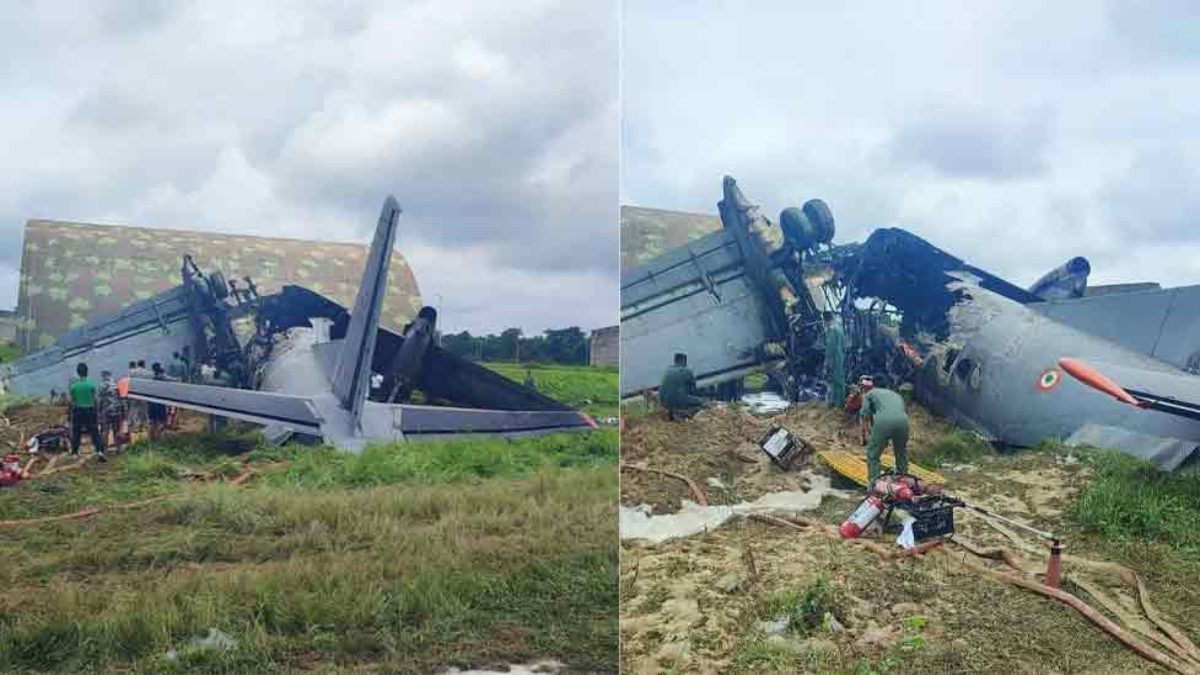
New Delhi, June 13, 2026: An Antonov AN-32 medium tactical transport aircraft belonging to the Indian Air Force (IAF) met with a major accident on Saturday while attempting to land at the Air Force Station in Jorhat, Assam. The twin-engine turboprop aircraft reportedly caught fire immediately after touchdown within the high-security military facility. Emergency response teams and firefighting units were immediately deployed to the site to contain the blaze and secure the area.
The Indian Air Force officially confirmed the incident through a statement on social media platform X (formerly Twitter), announcing that a high-level probe has been initiated to investigate the mishap. “An IAF AN-32 aircraft met with an accident today while landing at Jorhat. A Court of Inquiry is being constituted to ascertain the cause of the accident,” the IAF stated. While early ground reports suggest severe damage to the airframe due to a post-impact fire, defense officials have kept details regarding the exact condition of the crew and passengers tightly guarded as rescue operations continue.
Emergency Response at Rowriah Airbase
The accident took place at the IAF’s Rowriah airbase in Jorhat, a premier military airfield that serves as a vital logistical hub for operations across India’s northeastern frontier. According to preliminary reports from the site, the aircraft was executing a routine landing maneuver when something went wrong during the touchdown phase, causing the heavy transport plane to veer or suffer a structural failure, which led to an immediate outbreak of fire.
Thick smoke was seen rising from the runway area inside the base perimeter shortly after the crash. Crash fire tenders and specialized military rescue teams stationed at the airbase rushed to the runway within seconds of the impact. A defense spokesperson confirmed that senior IAF officials from the Eastern Air Command have reached the site to supervise the ongoing emergency operations. Firefighters worked through the afternoon to completely douse the flames and prevent any secondary explosions from the aircraft’s fuel tanks.
Status of the Crew and Extent of Damage
At the time of writing, official clarity on casualties remains limited. While early local reports expressed grave concerns regarding the safety of the pilots and aircrew on board, the Ministry of Defence and the IAF have stated that an official headcount and assessment of injuries are still underway. Tactical transport flights like the AN-32 typically fly with a minimum crew of four, including a pilot, co-pilot, navigator, and flight engineer, and often carry extra service personnel or essential supply cargo.
Medical teams at the Air Force Hospital in Jorhat have been placed on high alert to treat any survivors pulled from the wreckage. Security around the Rowriah airbase has been significantly tightened, with civil police cordoning off the approach roads leading to the military station to ensure unhindered access for emergency vehicles.
The Strategic Importance of the AN-32 Fleet
The Soviet-designed Antonov AN-32 has been the undisputed backbone of the Indian Air Force’s tactical transport fleet for over four decades. Known for its distinct high-mounted twin turboprop engines, the aircraft was specifically engineered to fly under challenging environmental conditions, including hot tropical climates and high-altitude Himalayan regions.
The IAF utilizes its fleet of around 100 AN-32s extensively to maintain a vital lifeline for forward deployments along the Line of Actual Control (LAC). These planes transport essential rations, military hardware, ammunition, and personnel to remote Advanced Landing Grounds (ALGs) in Arunachal Pradesh and Sikkim that are otherwise inaccessible by road. Because of the region’s volatile weather and unforgiving mountainous terrain, operating out of bases like Jorhat requires exceptional piloting skills and absolute mechanical precision.
Growing Concerns Over Fleet Safety in the Northeast
Saturday’s crash has once again turned the spotlight on the safety record of older military assets operating in the eastern theater. The IAF has suffered notable losses involving this specific aircraft type in the past. Most prominent was the tragic June 2019 crash, where an AN-32 took off from this exact same base in Jorhat heading for the Mechuka ALG in Arunachal Pradesh, only to crash into a remote hillside, killing all 13 personnel on board.
The region has witnessed multiple aviation setbacks in recent months. Earlier this year, in March, an IAF Sukhoi Su-30MKI fighter jet crashed during a training sortie in Assam’s neighboring Karbi Anglong district—roughly 60 kilometers away from Jorhat—resulting in the tragic loss of both pilots. The back-to-back incidents involving both fighter and transport fleets have raised valid questions among defense experts regarding maintenance schedules, structural fatigue, and the challenging flying dynamics of the northeastern airspace.
Focus of the Court of Inquiry
The newly constituted Court of Inquiry face a meticulous task ahead. Investigators will focus on a few critical vectors to decode exactly what caused a routine landing to turn catastrophic:
- Mechanical or Structural Failure: Technical teams will inspect the landing gear assembly, brake systems, and engine performance logs to see if a sudden mechanical malfunction occurred during touchdown.
- Environmental Factors: While the landing took place during daylight hours, investigators will look into sudden wind shear or runway conditions that might have destabilized the aircraft.
- Airframe Integrity: With the aging AN-32 fleet undergoing progressive upgrades, the inquiry will cross-examine the specific maintenance history of the involved tail number.
The flight data recorder (black box) and the cockpit voice recorder, if successfully recovered intact from the charred wreckage, will provide the definitive timeline of the final seconds of the flight. The IAF has maintained that further detailed updates will be made public once the site is fully secured and initial findings are compiled by the inquiry board.