

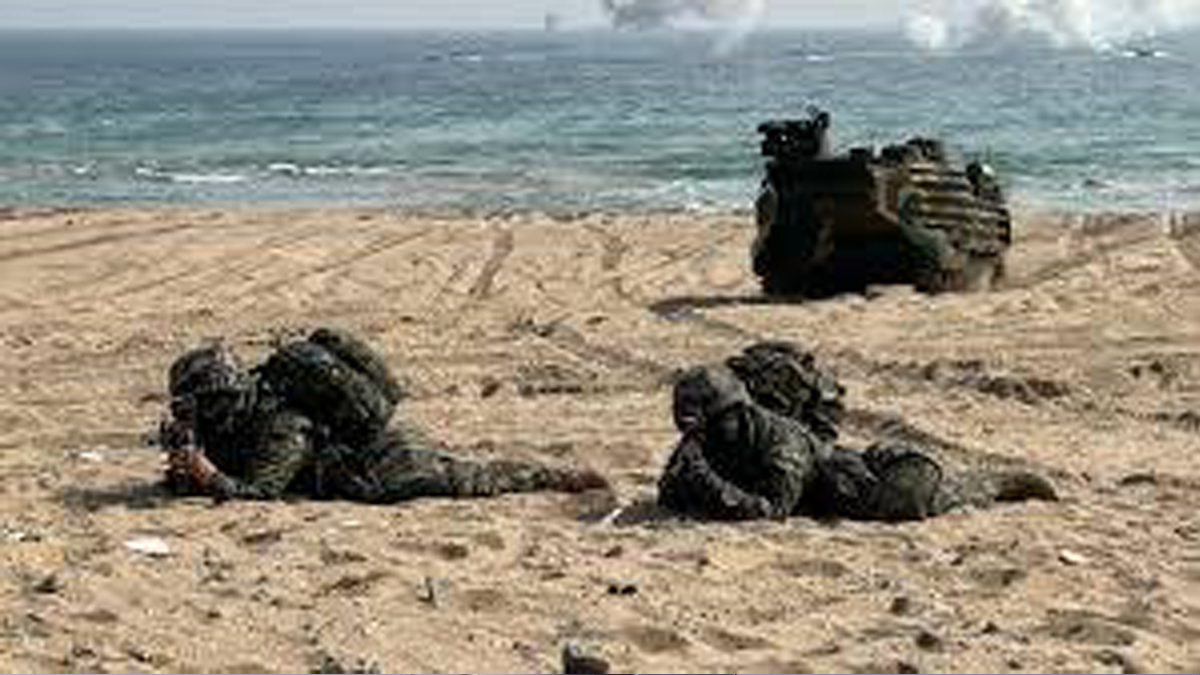
New Delhi, February 27, 2026: The shoreline is no longer just a boundary; it is a high-stakes battlefield. In a display of overwhelming maritime power, the U.S. Marine Corps is redefining the “beach invasion” for the 21st century. Moving away from the slow-moving, vulnerable landings of the past, today’s amphibious operations are a masterclass in speed, stealth, and advanced technology.
From the roar of the massive CH-53K King Stallion heavy-lift helicopters to the high-speed transit of the new Ship-to-Shore Connectors (SSC), the “scary” reality of a modern Marine invasion lies in its ability to transform an empty beach into an armored stronghold in a matter of minutes.
The New Kings of the Coast: Next-Gen Hovercraft
The traditional image of a landing craft involves a slow, metal ramp dropping into the surf. Today, that image has been replaced by the Ship-to-Shore Connector (SSC)—the Navy’s newest class of air-cushion vehicle (hovercraft).
- All-Terrain Access: Unlike traditional boats that run aground on sandbars, these hovercraft glide over water, mudflats, and even ice. They can access more than 70% of the world’s coastlines, compared to just 15% for conventional landing ships.
- Heavy Metal at 40 Knots: The SSC can carry a 74-ton payload—including a fully combat-loaded M1A2 Abrams tank—at speeds exceeding 35 knots (40 mph).
- Over-the-Horizon Stealth: These craft allow the Navy’s “motherships” to stay far offshore, out of the range of enemy coastal missiles, while the hovercraft sprint to the beach, unload, and vanish back into the horizon.
Vertical Envelopment: The CH-53K King Stallion
While the hovercraft take the beach, the skies belong to the CH-53K King Stallion. As the most powerful helicopter in the U.S. military, its role in an invasion is terrifyingly efficient.
The King Stallion can lift 36,000 pounds externally—triple the capacity of its predecessors. This means it doesn’t just drop off troops; it “vertically inserts” entire light armored vehicles, artillery pieces, and tons of ammunition directly behind enemy lines. With advanced fly-by-wire controls, it can land in “brown-out” conditions where dust and sand blind the pilot, ensuring the mission continues even in the chaos of a desert or tropical beach landing.
Force Design 2030: A Paradigm Shift
This isn’t just about bigger toys; it’s about a new way of fighting. Under a strategy known as Force Design 2030, the Marines are evolving into a leaner, more lethal force specifically designed for the “contested littorals” (coastal zones under enemy fire).
| Feature | Legacy Operations | Modern Amphibious Assault |
| Landing Zone | Deepwater ports or gentle beaches | 70% of world coastlines (Marshes, atolls, ice) |
| Primary Speed | 8–10 knots | 35+ knots (SSC) / 170+ knots (Air) |
| Command | Centralized on ships | Distributed; small units with “kill web” tech |
| Technology | Analog/Manual | AI-integrated drones & Fly-by-wire aviation |
The “Scary” Factor: Speed and Precision
What makes a modern Marine invasion truly daunting for an adversary is the “Kill Web.” Small, highly mobile teams—like the newly formed Marine Littoral Regiments—land quickly via hovercraft, deploy long-range anti-ship missiles (NMESIS), and use drones to scout and strike before the enemy even realizes a beachhead has been established.
These units don’t just hold ground; they hunt. By utilizing the Amphibious Combat Vehicle (ACV)—a 30-ton armored beast that can swim from ship to shore and then drive at highway speeds inland—the Marines maintain a relentless momentum that leaves defenders with no time to react.
Why It Matters
As global tensions shift toward island chains and coastal regions, the ability to project power from the sea is more critical than ever. The combination of advanced hovercraft that ignore terrain and heavy-lift helicopters that bypass defenses makes the U.S. Marine Corps a “force in readiness” that is nearly impossible to pin down.