

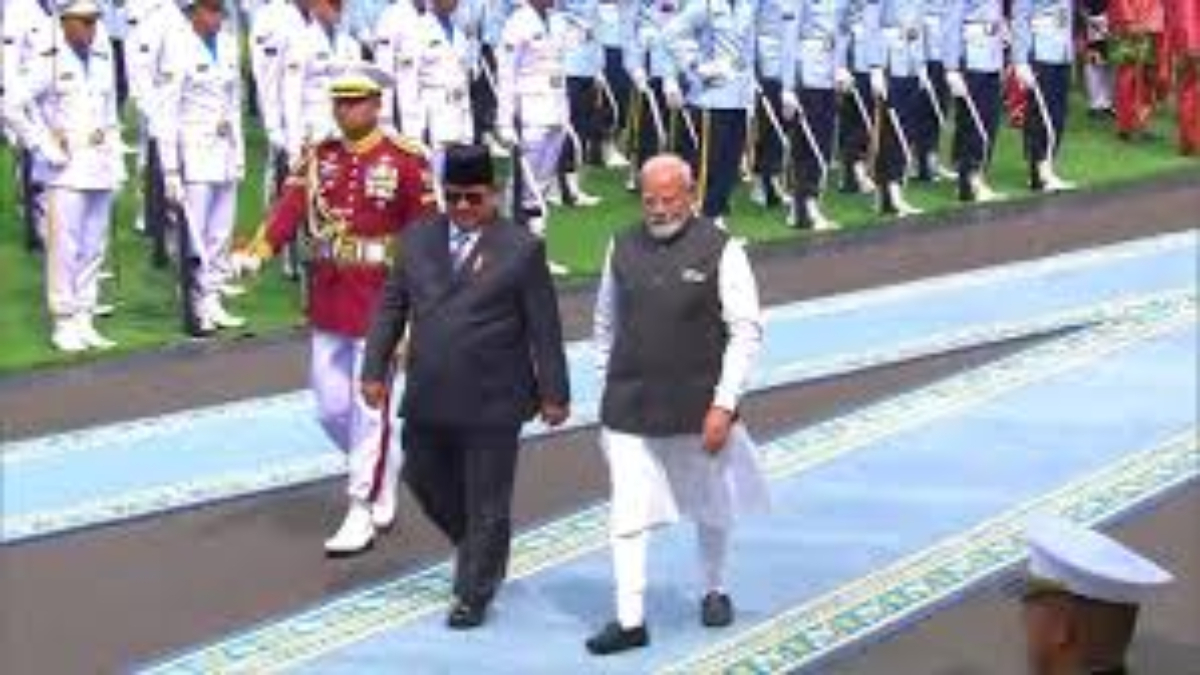
July 7, 2026 — Marking a significant milestone in Southeast Asian diplomacy, Indian Prime Minister Narendra Modi was accorded a grand, high-profile ceremonial welcome at the Merdeka Palace in Jakarta today. The official state visit, extending from July 6 to July 8 at the personal invitation of Indonesian President Prabowo Subianto, kickstarts PM Modi’s three-nation Indo-Pacific tour, which will later take him to Australia and New Zealand.
The visit holds deep geopolitical weight. It is the first formal bilateral tour since India and Indonesia elevated their relationship to a Comprehensive Strategic Partnership in 2018, signaling a mutual intent to co-architect a secure, autonomous, and economically resilient Indo-Pacific region.
Fighter Jets and Flying Flags: A Spectacular Arrival
The diplomatic choreography began long before the Prime Minister’s aircraft touched down on Indonesian soil on Monday. As the Indian head of government entered the nation’s airspace, the Indonesian Air Force deployed a special escort consisting of an F-16 multirole fighter and a Sukhoi-30 fighter jet to fly alongside the Prime Minister’s plane—a rare and highly respectful diplomatic gesture extended to visiting heads of state.
Breaking standard diplomatic protocol, President Prabowo Subianto personally arrived at the airport tarmac to welcome PM Modi with a warm embrace. PM Modi later expressed his appreciation on social media, stating he was “deeply touched” by the President’s hospitality.
The momentum carried directly into Tuesday morning’s formal state reception at the historic Merdeka Palace. The national anthems of both India and Indonesia echoed across the palace grounds as PM Modi inspected a formal military Guard of Honour. Along the procession route, hundreds of local schoolchildren lined the pathways, enthusiastically waving flags from both nations.
The Bilateral Agenda: Maritime Security and “Nickel Diplomacy”
Following the welcoming ceremonies, the two leaders shifted focus to high-level delegation talks. With a combined population of nearly two billion people, India and Indonesia are the dominant maritime lynchpins anchoring the Indian Ocean and Southeast Asian trading lanes.
At the top of the strategic agenda is an expanded defensive alliance. Following Indonesia’s recent landmark decision to acquire the Indo-Russian BrahMos supersonic cruise missile system, the two countries are exploring deeper military-industrial co-production and technical transfers. These measures aim to secure a “free and open Indo-Pacific,” aligned closely with India’s MAHASAGAR Vision (Mutual and Holistic Advancement for Security Across the Regions).
Parallel to defense, economic talks focused on supply-chain integration, specifically surrounding critical minerals. Indonesia holds roughly 21% of the world’s global nickel reserves—a resource vital to India’s domestic electric vehicle (EV) manufacturing and green energy goals. The leaders discussed joint-venture processing facilities to minimize supply vulnerabilities and build an independent “arc of trust” spanning trade lanes from New Delhi through Jakarta to Canberra.
Shared Civilizational Roots and Cultural Ties
Beyond defense contracts and mineral rights, the visit highlights nearly two millennia of deep-rooted commercial and cultural contact. To celebrate these civilizational links, the Prime Minister interacted with members of the vibrant Indian diaspora in Jakarta, thanking them for acting as a living bridge between the two democracies.
During his stay, PM Modi is scheduled to join President Prabowo on a visit to the iconic, UNESCO-listed Prambanan Temple Complex in Yogyakarta—a sweeping 9th-century Hindu temple site that stands as a monumental reminder of the historical ties between the two societies. The cultural exchange also featured a traditional Wayang Kulit (Javanese shadow puppetry) performance depicting chapters of the Ramayana epic, alongside classical Bharatanatyam dance recitals performed by local cultural groups.
Re-shaping Regional Trade
While current bilateral trade stands at an impressive $30 billion annually—outpacing India’s trade margins with western nations like the United Kingdom—both governments acknowledged that the economic ceiling has not yet been reached. Future plans include upgrading the India-ASEAN Free Trade Agreement, exploring direct shipping lanes connecting India’s strategic Andaman and Nicobar Islands with Indonesia’s northern Aceh Province, and expediting a Comprehensive Economic Cooperation Agreement.
As PM Modi prepares to depart for the Australian leg of his tour on July 8, this visit successfully lays a firm foundation for an autonomous, collaborative partnership capable of navigating the changing geopolitical currents of the Indo-Pacific.