

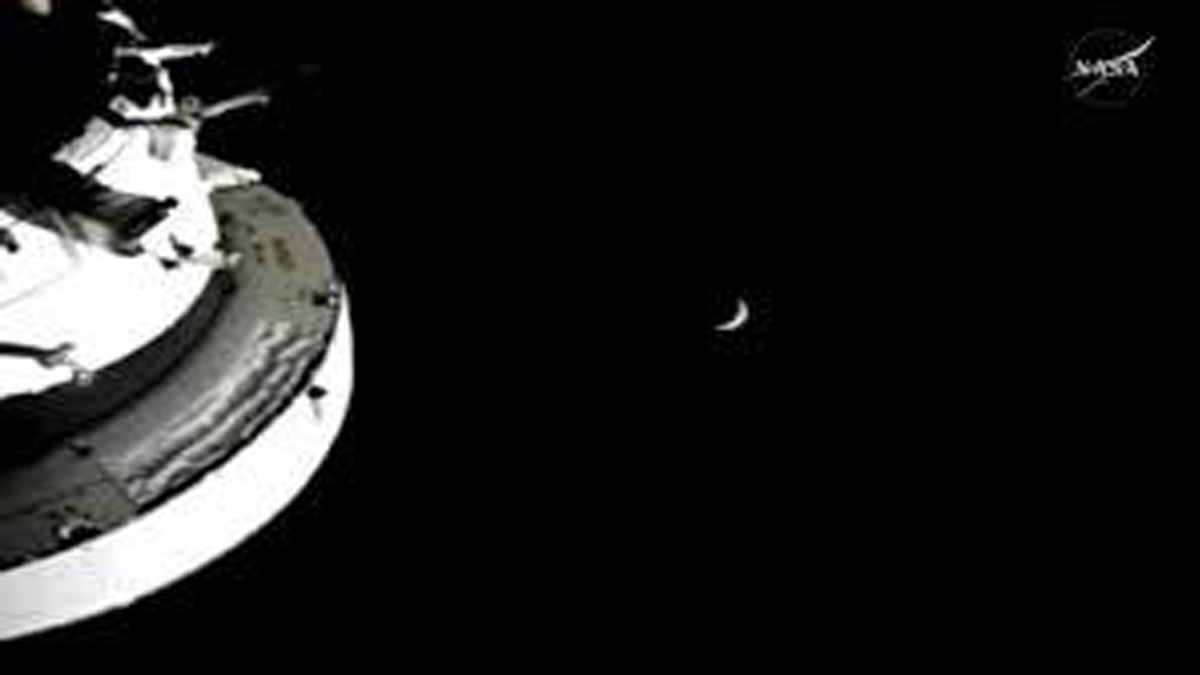
New Delhi, April 7, 2026 – In a move that mirrors the most heart-pounding moments of the Apollo era, NASA’s Artemis II crew is preparing to “go dark.” As the Orion spacecraft swings around the lunar far side today, April 6, 2026, the four-person crew will lose all contact with Mission Control for approximately 40 minutes, marking the most isolated stretch of their historic 10-day journey.
The planned Loss of Signal (LOS) is a result of basic orbital mechanics: as Orion passes behind the massive body of the Moon, the lunar surface will physically block the line-of-sight required for radio and laser signals to reach Earth.
The Anatomy of the Silence
The communication blackout is expected to begin at approximately 6:44 p.m. EDT. During this window, the Moon serves as a 2,000-mile-wide shield, preventing the electromagnetic waves used by NASA’s Deep Space Network (DSN) from reaching the capsule.+1
- Duration: ~40 minutes
- Cause: Lunar occultation (The Moon blocking signal paths to Earth)
- Distance from Moon: Approximately 4,070 miles at closest approach
- Distance from Earth: ~252,756 miles (A new human record)
While the silence often sparks tension for those watching from home, NASA flight directors remain confident. “Physics takes over,” noted Artemis II Flight Director Judd Frieling. “The same laws of motion that carry them behind the Moon will absolutely bring them back to the front side.”
A Milestone of Extreme Isolation
While the world waits for the signal to return, the crew—Commander Reid Wiseman, Pilot Victor Glover, and Mission Specialists Christina Koch and Jeremy Hansen—will be far from idle.
During these 40 minutes of profound solitude, the crew is scheduled to:
- Capture High-Res Imagery: Use handheld cameras to document geologic features of the lunar far side, a region never before seen by human eyes in person.
- Monitor Autonomous Systems: Orion is designed to handle navigation and life support entirely on its own during the blackout.
- The “Earthset” Experience: Just before LOS, the crew will witness “Earthset,” where our blue planet vanishes behind the lunar horizon, leaving them the most isolated humans in history.
Breaking Records in the Dark
The blackout coincides with the mission’s most significant milestones. While out of contact, the crew will surpass the distance record set by Apollo 13 in 1970, reaching a maximum distance of over 250,000 miles from Earth.
Following the flyby, the crew will also witness a rare total solar eclipse from their unique vantage point in space before beginning the four-day trek back home.
What Happens Next?
Signal re-acquisition is expected at approximately 7:25 p.m. EDT. The first words from the crew upon re-emerging will be a critical “handshake” with the DSN stations in California, Spain, or Australia.
This mission serves as the final crewed rehearsal before Artemis III, which aims to return humans to the lunar surface. If Artemis II continues its streak of precision, the crew is on track for a Pacific Ocean splashdown on April 10, 2026.