

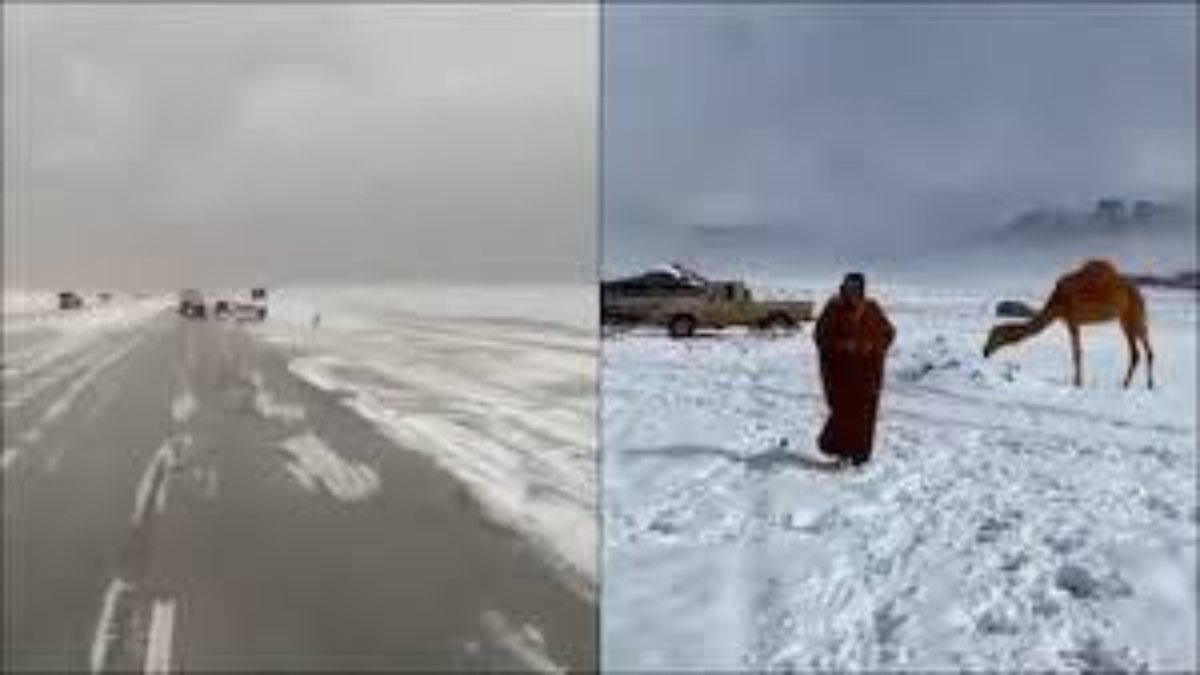
December 22, 2025: While Saudi Arabia is famous for its heat, recent headlines about it seeing its “first snowfall in 30 years” are slightly misleading. Snow in the northern mountains is actually a semi-regular occurrence, but the recent 2024 and 2025 events were significant because of where the snow fell and the intensity of the weather systems involved.
Why did it snow in the desert?
The recent snowfall (and heavy hail) was triggered by a specific set of rare meteorological conditions:
- Low-Pressure Systems: A low-pressure system originating in the Arabian Sea moved across Oman and into the Saudi interior.
- Moisture-Heat Collision: This system carried high levels of moisture. When this humid air collided with the intense heat of the desert, it triggered massive instability in the atmosphere.
- Cold Air Masses: Simultaneously, a “polar push” or cold air mass moved down from the north (via the Levant or Siberia). When the moisture from the south met the freezing air from the north, it resulted in heavy rain, massive hailstorms, and—in high-altitude or northern regions—actual snow.
Was it really the first time in 30 years?
The “30-year” claim often refers to specific regions or the sheer scale of the event, rather than the country as a whole.
| Region | Frequency of Snow | Recent Event (2024–2025) |
| Tabuk (Jabal Al-Lawz) | Almost every year | Heavy snowfall in Dec 2025; standard for the elevation. |
| Al-Jawf Region | Extremely rare | Experienced its first recorded snowfall in Nov 2024. |
| Central Regions (Riyadh/Hail) | Once every few decades | Reports of rare snow/ice in Dec 2025 described as “historic.” |
Snow vs. “White Deserts”
It is worth noting that many viral videos showing a “white desert” are actually showing heavy hail accumulation. In early November 2024, the Al-Jawf region was blanketed in white, but the Saudi Press Agency clarified that much of this was a layer of hail followed by intense rain, though technical snowfall was also recorded in higher altitudes.
Is Climate Change responsible?
Meteorologists are investigating whether these “extreme” events are becoming more frequent. While a single snowstorm isn’t proof of climate change, the increasing volatility of Middle Eastern weather—shifting from extreme droughts to “medicane-like” storms and desert snow—aligns with global climate models that predict more erratic weather patterns in arid regions.