

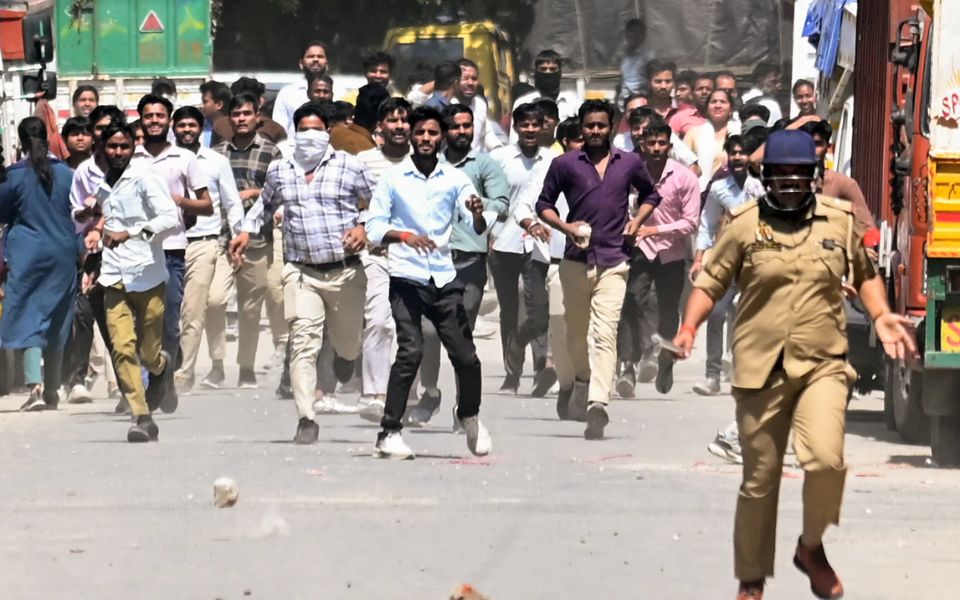
New Delhi, April 14, 2026 – In a scathing critique of the Union Government’s economic narrative, Congress leader Rahul Gandhi on Tuesday described the violent labor unrest in Noida as the “final cry” of India’s working class. Gandhi’s remarks came a day after thousands of industrial workers took to the streets of Noida’s Phase-2 and Sector 60, demanding a hike in minimum wages—a protest that eventually spiraled into arson, stone-pelting, and clashes with law enforcement.
The Congress MP used the incident to challenge the Prime Minister’s vision of “Viksit Bharat” (Developed India), arguing that while the government touts macroeconomic growth, the “backbone of the country”—its laborers—are drowning in debt and stagnant wages.
The Spark: From Gurugram to Noida
The unrest, which has paralyzed parts of the National Capital Region (NCR), did not emerge in a vacuum. Earlier this month, industrial workers in Gurugram successfully secured a wage hike following intense agitations. This victory served as a catalyst for workers in Noida’s garment and manufacturing hubs.
By Monday, April 13, 2026, the peaceful sit-ins near the Noida Special Economic Zone (NSEZ) metro station turned volatile. Protesters, primarily from the garment sector, blocked arterial roads and demanded that their monthly minimum wage be raised to ₹20,000. The situation escalated when protesters allegedly set vehicles on fire and vandalized factory properties, prompting police to use tear gas and carry out over 50 arrests.
Rahul Gandhi’s “Final Cry” Argument
Taking to social media platform X (formerly Twitter), Rahul Gandhi presented a grim breakdown of the math governing a laborer’s life in 2026. He highlighted the “vicious cycle” of inflation that renders small wage increments meaningless.
“What happened yesterday on the roads of Noida was the final cry of this country’s workers—one whose every voice was ignored. A worker in Noida earns roughly ₹12,000 to ₹13,000 a month. Rent alone costs ₹4,000 to ₹7,000. By the time they receive a ₹300 annual raise, the landlord hikes the rent by ₹500. This is the stark reality of ‘Viksit Bharat’.”
Gandhi further alleged that the burden of global economic shocks—including U.S. tariff wars and supply chain disruptions caused by Middle Eastern conflicts—has been shifted onto the poor. He claimed that while “industrialist friends” of the Prime Minister remain cushioned, the common worker is struggling to afford basic necessities like LPG cylinders, which reportedly touched ₹5,000 during peak local shortages.
The Policy Conflict: The New Labor Codes
A significant portion of Gandhi’s criticism was directed at the four Labor Codes implemented in November 2025. He argued that these reforms, which allow for 12-hour work shifts, have “crushed” worker rights.
- Work Hours: Gandhi highlighted that workers are being forced into 12-hour shifts but are still unable to pay for their children’s school fees.
- Stagnant Wages: While productivity demands have increased, real wages have remained flat when adjusted for 2026 inflation rates.
- Social Security: The Congress leader claimed the government’s “hasty” implementation of these codes occurred without proper consultation with labor unions.
Government Response: A Retrospective Wage Hike
Under pressure from the escalating violence and political backlash, the Uttar Pradesh government, led by Chief Minister Yogi Adityanath, announced a retrospective interim wage hike late Monday night.
Effective from April 1, 2026, the new wage structure for the Gautam Buddha Nagar (Noida) and Ghaziabad regions is as follows:
| Worker Category | Old Monthly Wage | New Interim Wage |
| Unskilled | ₹11,313 | ₹13,690 |
| Semi-Skilled | ₹12,445 | ₹15,059 |
| Skilled | ₹13,940 | ₹16,868 |
While the 21% increase is a significant jump, it still falls short of the ₹20,000 baseline demanded by the protesters. District Magistrate Medha Roopam stated that the decision was aimed at balancing industrial sustainability with worker welfare.
The Ground Reality: Hidden Grievances
Beyond the headline figures of wage hikes, workers on the ground have reported deeper systemic issues that fueled the anger:
- Overtime Discrepancies: Many workers alleged that while they clock over 100 hours of overtime monthly, their payslips only reflect a fraction of that, leading to massive wage theft.
- Retaliatory Cuts: Female workers at major garment units claimed their salaries were deducted as “punishment” for participating in the strike.
- Cost of Living: In industrial hubs like Sector 84, the cost of basic groceries and education has outpaced the nominal wage increases of the last three years.
Political Fallout
The Noida unrest has become a rallying point for the Opposition. Samajwadi Party chief Akhilesh Yadav also joined the fray, criticizing the “double engine” government for using police force against “the creators of India’s wealth.”
As the 2026 political calendar advances, the clash between the government’s “Viksit Bharat” branding and the industrial unrest in the NCR highlights a growing friction. For the thousands of workers still gathered in Noida’s industrial blocks, the hike to ₹13,690 is a start, but as one protester put it, “You cannot build a ‘developed nation’ on the empty stomachs of those who build it.”
The Noida administration remains on high alert, with additional forces deployed to prevent further flare-ups, while the Centre maintains that the new National Floor Minimum Wage, currently under development, will eventually solve these regional disparities.