

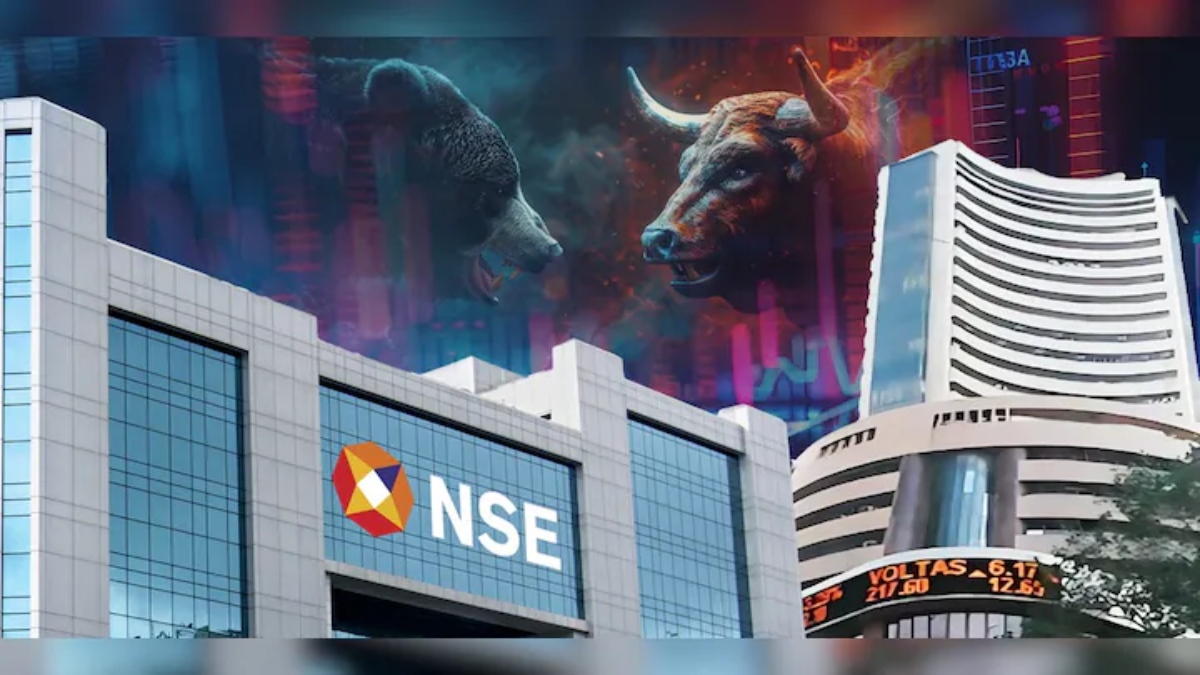
New Delhi, July 20, 2026: Indian equity markets experienced a sharp downturn on Monday as benchmark indices succumbed to heavy selling pressure. The BSE Sensex plunged over 600 points during intraday trade to test levels near 77,450, while the NSE Nifty 50 slipped below the critical psychological threshold of 24,200, touching an intraday low of 24,150. The dominant catalyst behind the weakness was an aggressive selloff in private banking giants—most notably HDFC Bank, Axis Bank, and Kotak Mahindra Bank—following the announcement of their latest quarterly financial results. Compounding the domestic earnings disappointment was a sudden spike in global geopolitical tensions between the United States and Iran, which sent crude oil prices soaring and dampened investor risk appetite across global financial markets.
1. Banking Heavyweights Lead the Market Downslide
The financial sector, which commands a massive weighting in both the Sensex and Nifty 50, proved to be the primary anchor pulling the index down. Investors reacted negatively to the First Quarter (Q1) earnings released over the weekend by key private lenders.
While top-line numbers and deposit growth showed steady momentum, net interest margins (NIMs) across major private lenders failed to satisfy market expectations. Analysts pointed out that elevated cost of funds and intense competition for low-cost CASA (Current Account Savings Account) deposits continue to squeeze interest margins. Axis Bank and HDFC Bank bore the brunt of the institutional exit, dragging the Nifty Bank index down by nearly 1.6% in early trading hours.
2. Geopolitical Tensions and the Crude Oil Surge
Beyond domestic corporate earnings, a sharp deterioration in international geopolitical stability severely rattled Dalal Street. Fresh military exchanges between the United States and Iran in the Middle East led to heightened fears of supply disruptions through the Strait of Hormuz—a crucial maritime corridor responsible for roughly a fifth of global petroleum traffic.
For an economy like India, which imports over 80% of its crude requirements, elevated oil prices present a direct threat to macroeconomic stability. Higher energy costs worsen the country’s current account deficit, exacerbate import-driven inflation, and reduce the likelihood of near-term interest rate cuts by the Reserve Bank of India (RBI). The energy shock swiftly led to selling across rate-sensitive sectors, including automobiles, consumer durables, and real estate.
3. Global Cues and Foreign Institutional Outflows
The pessimistic sentiment in India mirrored broader weakness across global equity markets. Major Asian benchmarks posted steep losses, with Japan’s Nikkei 225 dropping over 4% and South Korea’s KOSPI falling sharply amid widespread profit-taking in technology and artificial intelligence (AI) stocks. Overseas, Wall Street had already set a cautious tone, with the S&P 500 and Nasdaq ending the previous session lower.
Concurrently, benchmark US 10-year Treasury yields hardened past 4.55%, making fixed-income assets more attractive to global asset managers. This shift pushed the US dollar higher against major currencies and weighed heavily on emerging market currencies, including the Indian Rupee. The combination of a strengthening dollar, elevated crude prices, and rich equity valuations prompted Foreign Portfolio Investors (FPIs) to maintain a net-selling stance in the cash market.
4. Sectoral Divergence and Midcap Resilience
Despite the steep fall in front-line benchmarks, internal market breadth presented a more nuanced picture. While heavyweights in private banking and realty faced the heat, select defensive and cyclical pockets witnessed buying interest.
- Outperformers: Oil & Gas, Public Sector Undertaking (PSU) Banks, Healthcare, and select IT stocks managed to trade in the green, offering partial cushion to the indices. State-owned lenders like Punjab National Bank gained ground following solid quarterly updates.
- Broader Market Strength: Interestingly, the mid-cap and small-cap segments displayed notable resilience. The Nifty Midcap 100 and Nifty Smallcap 100 indices edged up by 0.1% to 0.3%, indicating that retail and domestic institutional participation remained healthy outside the heavy index-weighted names.
5. Technical Outlook and What Investors Should Do
From a technical perspective, market experts view the drop below 24,200 as an expected consolidation following the recent sharp rally. The India VIX, commonly referred to as the market’s fear gauge, ticked higher by over 3.5% to cross 13.6, signalling that short-term volatility is likely to stay elevated.
Market strategists advise investors against panic selling. The fundamental long-term domestic growth narrative remains intact, buoyed by strong domestic institutional flows (DIIs) and robust infrastructure spend. Short-term traders are recommended to adopt a cautious “sell-on-rise” strategy until global crude prices stabilize and the earnings season progresses further, while long-term investors can utilize dips to systematically accumulate quality banking and technology stocks at attractive valuation entry points.