

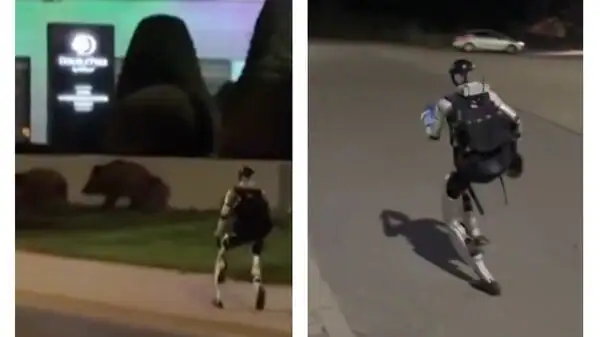
New Delhi, April 15, 2026: A surreal spectacle was captured on video recently in Warsaw, where a high-tech robot was witnessed chasing a group of wild boars through the city streets. The footage has been shared widely across social media, where it quickly achieved viral status among global audiences. This peculiar encounter is being hailed as a sign that the “wild future” of urban management has finally arrived.
The mechanical unit was observed navigating the pavement with precision as it steered the startled animals away from busy intersections. It is reported that no injuries were sustained by the boars or the onlookers during the operation. This event marks a significant shift in how human-wildlife conflicts are being handled in modern metropolitan environments.
The Evolution of Municipal Wildlife Control
Traditional methods of animal control are being replaced by autonomous solutions in several European districts. In the Warsaw incident, the robot was utilized to provide a non-violent deterrent to the boars, which have become a common sight in Polish residential areas. These machines are designed to be operated remotely or programmed with advanced AI to manage unexpected biological intrusions.
Public reaction to the video has been characterized by a mix of fascination and mild concern. It is argued by many netizens that the sight of a robot patrolling for wildlife feels like a scene extracted directly from a futuristic film. Despite the humor found in the “robot vs. boar” narrative, the efficiency of the machine is being praised by local authorities who seek to minimize human-animal contact.
Also Read: Clarifying the Status of Monalisa Bhosle and Farman Khan’s Relationship
Redefining the Modern Cityscape
The integration of robotics into public safety is being accelerated by the success of such deployments. It is expected that more autonomous units will be commissioned to handle tasks that were previously deemed too unpredictable for machines. The data collected during this pursuit is likely being analyzed to refine the movement patterns of future urban drones and ground units.
As the video continues to circulate, the conversation has shifted toward the ethics and practicalities of an automated society. The streets of Warsaw are now being viewed as a testing ground for the coexistence of nature and high-level technology. It is concluded by many that while the future may indeed be “wild,” it will also be meticulously monitored by the machines we create.