

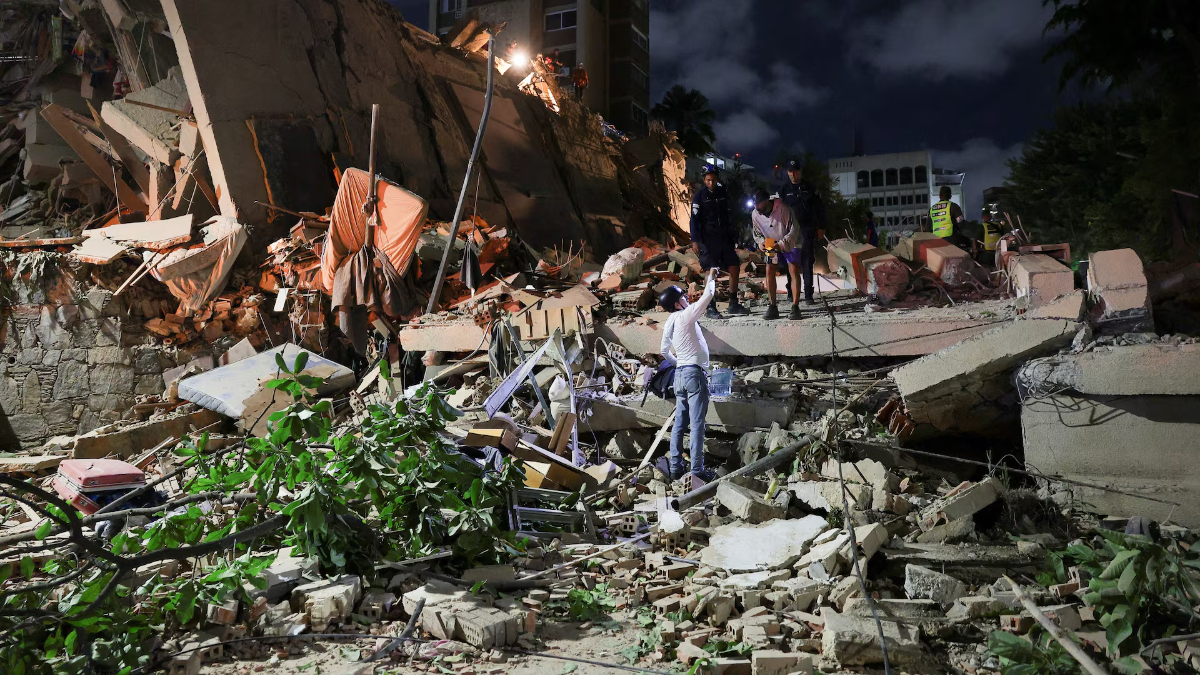
New Delhi, June 25, 2026 — A catastrophic seismic event has pushed Venezuela into a state of national emergency. On Wednesday evening, June 24, 2026, two incredibly powerful strike-slip earthquakes tore through the north-central region of the country within a mere 39 seconds of each other. The dual tremors, measuring magnitudes of 7.2 and 7.5 respectively, have triggered widespread building collapses, ripped major roadways apart, and sent millions of panicked residents fleeing into the streets. The event marks some of the most violent seismic activity recorded in the nation in over a century.
The double disaster struck during the early evening rush hour, shortly after 6:00 PM local time. According to data provided by the United States Geological Survey (USGS), the first earthquake—initially registering as a magnitude 7.2 foreshock—ruptured the earth at 18:04 local time at a depth of roughly 20 kilometers, centered in the state of Yaracuy near the municipality of Veroes. Before citizens could even process what was happening, an even larger magnitude 7.5 mainshock struck just 39 seconds later. This second, shallower tremor occurred at a depth of just 10 kilometers, magnifying its destructive capability across the surface.
The sequential shocks proved to be a deadly combination for the nation’s infrastructure. While the initial tremor weakened structures across several states, the massive secondary shock less than a minute later delivered a finishing blow, causing dozens of buildings to give way completely.
Capital Under Siege: Structural Collapses and Infrastructure Failure
The sheer force of the dual earthquakes was felt across a massive portion of the country, shaking neighboring states like Carabobo, Aragua, Miranda, La Guaira, and Falcón. However, the most visible and heart-wrenching devastation occurred in the capital city of Caracas. Thick columns of dust rose into the evening sky above various neighborhoods as multi-story apartment buildings, local restaurants, and storefronts collapsed under the stress.
Interior Minister Diosdado Cabello confirmed that the upscale municipalities of Altamira and Los Palos Grandes were among the hardest-hit areas in the capital. In Altamira alone, at least three high-rise buildings completely collapsed into mountains of concrete and twisted rebar. In the southeastern sectors of Caracas, the structural integrity of numerous high-rise residential blocks failed, leaving several buildings pancaked. On the streets, the aftermath resembled a war zone: massive fissures split open asphalt roads, crushed vehicles sat buried under falling debris, and shattered glass carpeted the sidewalks.
The destruction extended heavily to the country’s critical infrastructure. North of the capital, in La Guaira, the Simón Bolívar International Airport—the primary aviation gateway into Venezuela—sustained severe structural damage. Authorities immediately suspended all inbound and outbound flights, completely halting air travel. Power grids and telecommunication networks failed across multiple states, plunging major urban areas into darkness and severing cell phone signals, which has severely crippled initial rescue coordination efforts.
Moments of Absolute Terror: Eyewitness Accounts
The timing of the earthquakes caught millions of people off guard, trapping many inside swaying skyscrapers and tightly packed commuter zones. Viral videos capturing the immediate chaos showed terrifying scenes of water violently sloshing out of rooftop swimming pools on high-rises, terrified passengers stampeding out of shaking airport terminals, and drivers abandoning their vehicles as the ground rolled violently beneath them.
For those on the ground, the experience was profoundly traumatic. “It started off gently and then gradually grew, and in the end, we all had to leave our houses, go outside and gather together,” explained Caracas resident Hector Ricci, who stood out on a public park long after sunset.
As darkness fell, millions of residents refused to return to their homes, fearing the imminent threat of strong aftershocks. Families gathered in public plazas, highway medians, and open soccer fields, wrapping themselves in blankets and holding onto their pets. In many residential neighborhoods, walls had sheared away entirely, leaving living room furniture, TVs, and bookshelves completely exposed to the open air from the street below.
Rising Casualties and the Race Against Time
While initial media reports conservatively indicated at least three confirmed deaths in the immediate aftermath, emergency officials warn that the true human toll is expected to rise exponentially as rescue teams finally reach isolated rubble sites. The USGS Prompt Assessment of Global Earthquakes for Response (PAGER) system issued a grim outlook, estimating a very high statistical probability that fatalities could eventually reach thousands due to the density of the collapsed high-rises in Caracas.
In the state of Falcón, Governor Víctor Clark reported that local medical facilities had already treated dozens of severely injured people within the first few hours. He also confirmed a frantic race against the clock, noting that at least 15 individuals were actively confirmed trapped beneath the ruins of collapsed structures in his jurisdiction alone.
Emergency operations centers have been activated at the national level, and the Venezuelan Red Cross is deploying ambulances and search-and-rescue teams to the worst-affected sectors. First responders and local volunteers are using their bare hands, shovels, and heavy machinery to dig through the remnants of collapsed apartments in Altamira, listening intently for signs of life beneath the concrete slabs. Interior Minister Cabello has pleaded with the public to stay off major roads, urging motorists to give immediate right-of-way to emergency vehicles trying to transport the wounded to local hospitals, many of which are already running on backup generators.
Regional Impact and International Assistance
The violence of the twin earthquakes triggered immediate shockwaves through the wider Caribbean basin. Shortly after the tremors, the Pacific Tsunami Warning Center issued a series of tsunami advisories and alerts for Venezuela’s immediate coast, as well as nearby islands including Aruba, Bonaire, Puerto Rico, and the Virgin Islands. Fortunately, these marine warnings were later rescinded after sea-level gauges confirmed that no catastrophic wave had been generated by the strike-slip fault movement.
As the full scale of the crisis continues to unfold, neighboring countries are moving swiftly to offer humanitarian aid. El Salvador’s President Nayib Bukele was among the first global leaders to respond, publicly offering to dispatch 300 specialized search-and-rescue personnel, medical teams, and 50 tons of emergency food and relief supplies to Venezuela.
With communications still heavily fractured and the ground continuing to tremble from minor aftershocks, the people of Venezuela face a long, grueling road to recovery. The primary focus for the next 72 hours remains entirely on finding survivors trapped in the ruins, restoring power to critical medical facilities, and providing emergency shelter for the hundreds of thousands of citizens left homeless by 39 seconds of unimaginable geological fury.