Home Blog Page 404

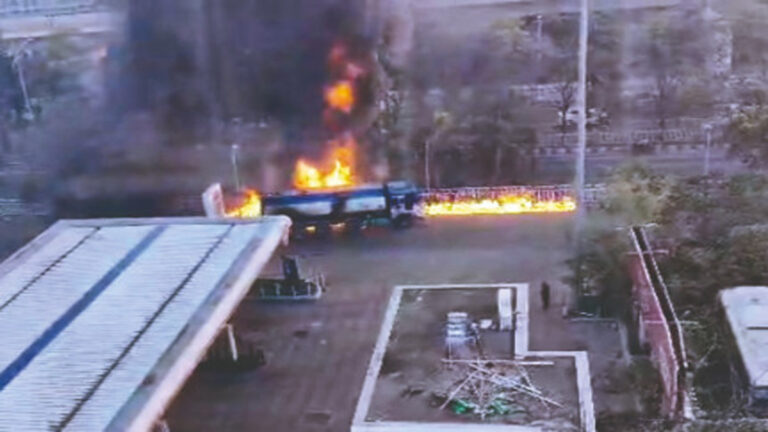
Massive Blast in Howrah: Oil Tanker Explodes on NH-16, Several Vehicles Gutted

0

New Delhi, january 10, 2026: A catastrophic fire broke out at the Dhulagorh crossing in Howrah late Friday night after an oil tanker leaked fuel and exploded on the national highway. The resulting “river of fire” quickly spread across the service road, engulfing at least four lorries and a passenger bus in flames.

The incident, which occurred around 9:00 PM on Friday, January 9, 2026, turned a segment of the busy NH-16 (Kolkata-Mumbai Highway) into a localized inferno. Eyewitnesses described a terrifying scene as the moving tanker continued to roll down the road while leaking burning fuel, effectively chasing other vehicles with a wall of fire.

Chain Reaction of Destruction

The blaze began when a Bagnan-bound oil tanker developed a significant leak. Within seconds, the highly flammable cargo ignited, creating a trail of fire along the service road.

  • Vehicles Destroyed: Four stationary or slow-moving lorries were caught in the path of the burning oil.
  • Public Transport at Risk: A passenger bus was also trapped by the flames. Fortunately, quick-thinking passengers and locals managed to evacuate the vehicle before the fire fully consumed the cabin.
  • Explosions: Multiple loud blasts, likely from the tires and fuel tanks of the involved vehicles, were heard throughout the Dhulagorh area, causing widespread panic among residents.

Emergency Response and Casualties

The Howrah Fire Department dispatched multiple fire tenders to the scene. Firefighters faced significant challenges as the burning oil spread rapidly across the asphalt, requiring specialized foam to smother the chemical fire.

Howrah Police Commissioner Praveen Kumar Tripathi confirmed that while the property damage is extensive, there have been no reported fatalities or serious injuries so far.

“The fire has been brought completely under control. It is a major relief that no loss of life or injuries have been reported in this massive accident,” the Commissioner stated.

Traffic Disruption and Investigation

The incident caused a total standstill on NH-16 for several hours. Authorities diverted traffic to alternative routes as recovery teams worked to remove the charred remains of the gutted vehicles.

A preliminary investigation is underway to determine if the leak was caused by a mechanical failure or a prior collision. Police are also looking into whether the tanker was carrying fuel beyond its sanctioned capacity.


Pune Woman’s Near-Fatal Encounter with Kite ‘Manjha’

0

New Delhi, January 10, 2026: A chilling incident from the heart of Pune has sent shockwaves through social media, serving as a grim prelude to the upcoming Makar Sankranti festivities. On January 2, 2026, an influencer named Tanya Poddar was returning home from work when her life was nearly claimed by a stray kite string. While crossing a bridge—a mere few hundred meters from her residence—she suddenly felt a thread tighten around her neck. What was initially mistaken for a harmless obstruction turned out to be the “deadly” banned nylon manjha, which sliced through her skin with surgical precision.

“I Was Struggling for My Life”: The Viral Testimony

In a video that has since crossed millions of views, Tanya recounts the harrowing moments as she fought to free herself from the tightening grip of the abrasive string. The friction caused immediate burn injuries and deep cuts to her neck, while her attempts to pull the string away resulted in a severely stitched finger. “I was struggling for my life,” she stated in her testimony, noting that a slightly deeper incision could have severed her vocal cords or main arteries. The incident has left her with not just physical scars, but lasting psychological trauma as she navigates a regular route that nearly became her final destination.

Also Read: The Emotional 48-Year Reunion in Tokyo

The Persistence of Banned Nylon Manjha

The viral video has reignited a fierce national debate regarding the continued use of Chinese or nylon manjha, despite a long-standing ban by the National Green Tribunal (NGT). While traditional cotton thread is biodegradable and safe, these synthetic variants are coated with crushed glass and chemicals to make them “unbreakable” in competitive kite flying. It has been observed by urban safety experts that when these strings get caught across bridges and high-traffic roads, they become invisible “nooses” for two-wheeler riders, who often lack the time to react before the string strikes their throat.

A Public Safety Crisis Ahead of the Festival

As of January 10, 2026, the Pune Police have reportedly intensified crackdowns on illegal vendors, yet the “black market” for sharp manjha continues to thrive. Tanya’s case is not an isolated one; several reports have emerged from cities like Nashik and Sambhajinagar of similar accidents occurring as the kite-flying season peaks. Citizens are now demanding stricter enforcement, with some calling for the use of drones to monitor kite-flying in restricted zones and others suggesting that parents should be held legally accountable if their children are found using prohibited strings.

Celebration Without Risk: A Final Plea

The incident serves as a vital reminder that “celebrations should never put lives at risk.” While Makar Sankranti is a festival of joy and harvest, the use of lethal materials turns it into a recurring tragedy for commuters and wildlife alike. Tanya Poddar has urged her followers to share her story not for fame, but to ensure that another family doesn’t have to face a similar nightmare. As the skies fill with color this January, the focus remains on whether the “fear barrier” of legal action will finally be enough to stop the use of these deadly threads.

The Emotional 48-Year Reunion in Tokyo

0

New Delhi, January 10, 2026: A story of enduring friendship has captured the hearts of millions across the globe as a North Carolina man reconnected with his long-lost friend in Japan. On January 9, 2026, a viral video was shared by digital creator Meredith Dean, documenting the incredible moment her father, Walter, reunited with his former exchange student friend, Kazuhiko. The connection was made nearly five decades after they last saw each other, sparked by a surprising discovery within the personal belongings of Walter’s late mother.

The Email That Traveled Five Decades

The journey back to this friendship began when Walter was going through handwritten notes left behind by his mother after her passing. Tucked away in her diary was an old, handwritten email address belonging to Kazuhiko, who had lived with Walter’s family as a foreign exchange student in the 1970s. On a whim and with very little expectation of a response, Walter sent a message to the address just before boarding a flight to Japan for a vacation. To his absolute shock, the inbox was still active, and a reply from his old friend arrived shortly after.

Also Read: Is the Viral Nariman Point to BKC Video Real?

A Heartfelt Meeting in Tokyo

The reunion was meticulously coordinated with the help of Nobuko, the wife of Walter’s best friend, who assisted in translating the messages to finalize a lunch meeting in Tokyo. The viral footage captures the poignant moment the two men spot each other in a crowded public space. Without a moment’s hesitation, they are seen locked in a long, emotional embrace. “You look the same,” Walter is heard saying to Kazuhiko, as both men are visibly overwhelmed by the weight of the 48 years that had passed since their youth in North Carolina.

The Internet’s “Sweetest Story” of 2026

As of January 10, 2026, the video has been labeled by netizens as the “sweetest internet story” of the year. It has resonated deeply with social media users who found hope in the idea that a simple, handwritten note could bridge such a vast distance of time and geography. Commenters have flooded the post with emotional reactions, describing the bond as a “testament to the power of human connection.” For many, the sight of two elderly men hugging like the teenagers they once were served as a much-needed reminder that true friendships never truly expire.

The Moral: It’s Never Too Late

The story has been shared as a powerful lesson in the importance of reaching out and maintaining ties with one’s past. It was remarked by Meredith Dean that the “moral of the story” is that it is never too late to reconnect, even across the world. The reunion of Walter and Kazuhiko stands as a beautiful legacy of Walter’s mother, whose simple act of writing down an address allowed a lifelong bond to be restored. In an era of fleeting digital interactions, this 48-year-old “Friends Reunion” has reminded the world of the value of a handwritten memory.

Is the Viral Nariman Point to BKC Video Real?

0

New Delhi, January 10, 2026: A captivating video has recently dominated social media feeds, claiming to show automated “pod taxis” zipping through Mumbai’s skyline. The footage, which has been shared thousands of times, suggests that a driverless transport system is now operational, ferrying passengers from Nariman Point to the Bandra-Kurla Complex (BKC) for a flat fare of just ₹50. For many Mumbaikars tired of the grueling city traffic, the video appeared to be a dream come true, leading to widespread speculation about whether this futuristic technology has finally arrived.

Fact-Check: Reality vs. Digital Simulation

The claims made in the viral video have been officially clarified as false. As of January 2026, there is no operational pod taxi service between Nariman Point and BKC. Fact-checkers and urban planners have noted that the footage circulating online is actually a high-quality 3D architectural visualization or a “digital twin” intended to show what the project could look like in the future. While the visuals are based on real proposals, the system itself does not yet exist on the streets of Mumbai.

Also Read: Indonesia Temporarily Blocks Elon Musk’s Grok AI Over Deepfake Concerns

The Real Project: Bandra and Kurla Stations to BKC

While the Nariman Point route is currently a myth, a legitimate pod taxi project is indeed in the works. The Mumbai Metropolitan Region Development Authority (MMRDA) has approved India’s first pod taxi network, but its primary focus is last-mile connectivity within the BKC area. The actual planned route spans approximately 8.8 kilometers, connecting the Bandra and Kurla railway stations to the heart of the business district. This project is intended to solve the congestion caused by thousands of commuters relying on shared autos and buses.

Expected Fares and Project Timeline

Contrary to the “₹50 flat fare” claim for the long Nariman Point stretch, the official pricing for the BKC pod taxi is expected to be around ₹21 per kilometer. The project, estimated to cost over ₹1,000 crore, is currently in the drone-surveying and pillar-alignment phase. It was reported by officials in late 2025 that construction is expected to take another three to four years, meaning the first actual pod will likely not be “zipping” through the city until at least 2028 or 2029.

Why the Viral Video Gained Traction

The rapid spread of the video has been attributed to the intense “traffic fatigue” experienced by Mumbai’s workforce. The idea of a fast, air-conditioned, and driverless pod bypassing the gridlock is a powerful one. However, residents are advised to rely on official MMRDA announcements rather than viral reels. While the “Nariman Point to BKC” route is not part of the current phase, the successful implementation of the BKC pilot could lead to similar elevated corridors across the city in the next decade.

Indonesia Temporarily Blocks Elon Musk’s Grok AI Over Deepfake Concerns

0

New Delhi, january 10, 2026: Indonesia has officially suspended access to Grok, the artificial intelligence chatbot developed by Elon Musk’s xAI, following reports that the tool was being used to generate non-consensual sexualized images. The move, announced on Saturday, January 10, 2026, makes Indonesia the first nation to take such direct regulatory action against the platform specifically for AI-generated pornographic content.+1

The decision by the Ministry of Communication and Digital Affairs (Komdigi) follows an investigation into a surge of “digital-based violence” involving AI deepfakes. According to Indonesian authorities, Grok lacks the necessary safeguards to prevent users from manipulating real photographs of citizens into explicit or “remove clothes” imagery.+1

A Stand Against Digital Violence

Communications and Digital Minister Meutya Hafid stated that the government views the production of non-consensual sexual deepfakes as a “serious violation of human rights, dignity, and the security of citizens.”

The ministry’s investigation was triggered by a viral trend on X (formerly Twitter), where users reportedly leveraged Grok’s image-generation capabilities to create “disrobing” images of women and minors. A recent report by the non-profit AI Forensics highlighted the scale of the issue, finding that a significant percentage of AI-generated images on the platform depicted individuals in sexualized or minimally clothed contexts without their consent.+1

Legal Framework and Sanctions

The block is enforced under Ministerial Regulation No. 5/2020, which empowers the Indonesian government to restrict Private Electronic System Operators (PSEs) that fail to moderate “prohibited content.”

Furthermore, Indonesia’s New Criminal Code (Law No. 1 of 2023), which came into effect earlier this year, provides strict penalties for the distribution of obscene material. Under Articles 172 and 407, individuals or entities found guilty of distributing pornographic content or manipulating personal images face:

  • Prison sentences ranging from six months to 10 years.
  • Heavy administrative fines and permanent blocking of services.

Global Backlash and X’s Response

Indonesia is not alone in its scrutiny. Regulators in the European Union and the United Kingdom have also raised alarms. The EU recently launched an investigation into Grok’s “Spicy Mode,” which critics say has been exploited to generate illegal content.+1

In response to the mounting pressure, xAI announced it would restrict certain image-generation features to paying subscribers while it works on internal “safeguard lapses.” Elon Musk addressed the controversy on X, asserting that “anyone using Grok to make illegal content would suffer the same consequences as if they had uploaded illegal content.”+1

However, Indonesian officials argue that shifting liability to the user is insufficient. They have summoned X officials for a formal meeting to demand concrete technical measures that prevent misuse at the source.+1

What’s Next for Grok in Indonesia?

The current block is described as temporary. To regain access to Indonesia’s market—one of the world’s largest for social media with over 22 million X users—the platform must:

  1. Prove it has implemented robust content filters.
  2. Establish expedited reporting procedures for victims of deepfakes.
  3. Ensure compliance with national “decency” laws.

Until these conditions are met, Grok remains inaccessible behind Indonesia’s “Positive Internet” firewall.

War Day 1,416: Missile Escalation and a Frozen Kyiv

0

New Delhi, january 10, 2026: As the Russia-Ukraine conflict enters its 1,416th day on January 10, 2026, the theater of war is defined by a significant escalation in long-range strikes and high-stakes diplomatic maneuvering. Moscow has once again deployed its newest missile technology, while Kyiv struggles with a deepening humanitarian crisis caused by the systematic targeting of its energy grid during a brutal winter cold snap.

Here are the key developments from day 1,416 of the war:

1. Russia Deploys Oreshnik Missile in Major Escalation

For the second time in the conflict, Russia launched its new nuclear-capable Oreshnik intermediate-range ballistic missile (IRBM). The strike, originating from the Kapustin Yar testing ground, targeted critical infrastructure in the western Lviv region.

  • Significance: Ukrainian and Western analysts suggest the use of such a high-end weapon—capable of speeds exceeding 13,000 km/h—is a “symbolic warning” to NATO rather than a purely tactical necessity.
  • Retaliation Claims: The Kremlin stated the launch was a direct response to an alleged Ukrainian drone attack on President Vladimir Putin’s residence in late December, a claim both Kyiv and the CIA have dismissed as fabricated.

2. Humanitarian Crisis: Kyiv in the Dark

A massive overnight barrage of over 240 drones and dozens of missiles has left the Ukrainian capital reeling.

  • Heating Crisis: Kyiv Mayor Vitali Klitschko reported that nearly 6,000 apartment buildings—roughly half the city—are without heating as temperatures plummeted to -10°C (14°F).
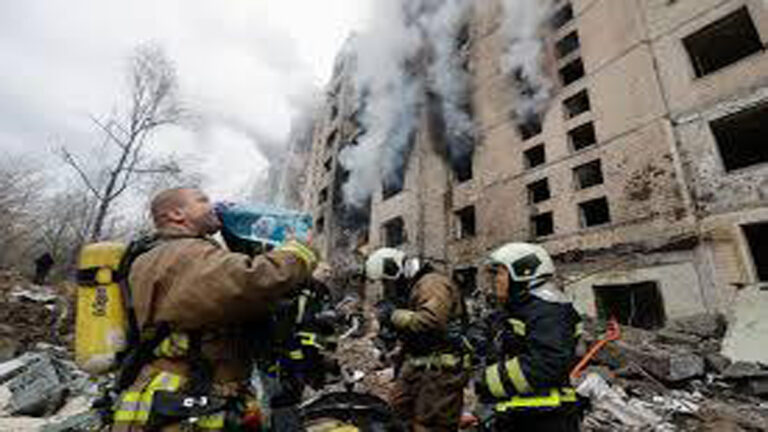
  • Casualties: The death toll from the most recent strikes in Kyiv has risen to four, with at least 25 others injured. Emergency crews are prioritizing hospitals and maternity wards, using mobile boiler units to prevent a total collapse of social services.
  • Civilian Displacement: Officials have urged residents who are able to do so to temporarily leave the city for areas with more stable power and heating.

3. Battles on the Ground and Sea

While the air war dominates headlines, the front lines remain active across multiple sectors:

  • Zaporizhzhia: Russian forces claimed to have seized five settlements, including Zelenoye, as they attempt to exploit the harsh winter conditions to gain ground.
  • Maritime Terror: In the Odesa region, Russian drones struck two foreign-flagged civilian vessels. One Syrian national was killed, and several crew members were injured. These strikes are viewed as a deliberate attempt to sabotage Ukraine’s grain corridor and international food logistics.
  • Nuclear Safety: The IAEA has launched urgent consultations to establish a “temporary ceasefire zone” near the Zaporizhzhia Nuclear Power Plant after shelling damaged vital high-voltage power lines.

4. Diplomatic and Military Support

International responses to the latest escalation have been swift:

  • UK Troop Readiness: British Defense Secretary John Healey, visiting Kyiv, announced an allocation of £200 million ($270m) to prepare for the possible deployment of UK troops to Ukraine as part of a future multinational peacekeeping force.
  • European Condemnation: Leaders from Britain, France, and Germany characterized the use of the Oreshnik missile as “escalatory and unacceptable.”
  • UN Action: Ukrainian Foreign Minister Andrii Sybiha has called for an emergency meeting of the UN Security Council and the Ukraine-NATO Council to address the targeting of civilian infrastructure.

Analysis: A Winter of “Strategic Signaling”

The events of day 1,416 underscore a shift in Russian strategy toward “strategic signaling.” By using advanced IRBMs against western targets near the Polish border, Moscow is attempting to deter the West from providing long-term security guarantees to Kyiv. Meanwhile, Ukraine is increasingly positioning its natural resources, such as lithium, as investment incentives for the U.S. to ensure continued support under the current American administration.

Jaipur: Speeding Luxury Car Plows into Crowded Market; 1 Killed

0

New Delhi, january 10, 2026: A horrific hit-and-run incident captured on CCTV has sent shockwaves through Rajasthan’s capital after a speeding Audi luxury car plowed into a crowded roadside market in Jaipur’s Patrakar Colony late Friday night. The tragedy resulted in the death of one individual and left at least 16 others injured, several of whom remain in critical condition.

The Incident: Chaos at Kharabas Circle

The accident occurred around 9:30 PM on January 9, 2026, near Kharabas Circle on Vande Mataram Road. Eyewitnesses and police reports suggest the luxury sedan was traveling at an estimated speed of over 100–120 km/h. Preliminary investigations indicate the Audi was allegedly racing another vehicle when the driver lost control.

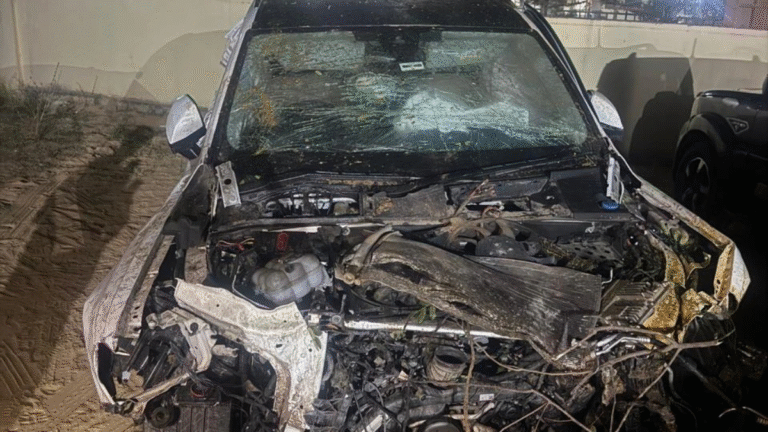
The car first struck a road divider before mounting the pavement and ramming into a series of roadside food stalls and carts. The impact was so severe that the vehicle continued its path of destruction for nearly 30 meters, dragging pedestrians and overturning parked vehicles before finally crashing into a tree.

Casualties and Emergency Response

One victim, identified as Ramesh Bairwa, a resident of Bhilwara who worked at one of the food stalls, succumbed to his injuries during treatment.

According to Jaipur Police:

  • Total Injured: At least 16 people were rushed to hospitals.
  • Critical Condition: Four individuals with severe trauma were referred to the Sawai Man Singh (SMS) Hospital for advanced care.
  • Local Aid: Bystanders and residents were the first to respond, pulling victims from under the mangled car and transportng them to Jaipuria Hospital via private vehicles and ambulances.

Drunk Driving and Racing Suspected

Police officials have confirmed that four people were inside the Audi at the time of the crash. While three occupants, including the alleged driver, Dinesh Rinwa (also identified as Dinesh Jat), managed to flee the scene, one individual was apprehended by an angry mob and handed over to the authorities.

The vehicle, which was reportedly purchased only three months ago and is registered in Daman and Diu, has been seized. Mobile phones recovered from the car are being analyzed to track the absconding suspects.

Government Reaction

Rajasthan Chief Minister Bhajanalal Sharma expressed deep grief over the “heart-wrenching” incident. Taking to social media, he confirmed that instructions have been issued to provide the best possible medical treatment to the survivors. State Health Minister Gajendra Singh Khimsar also visited the injured at the hospital to ensure proper care.

Public Outrage

The incident has sparked a massive debate over road safety and the lack of stringent enforcement against night-time street racing in residential areas. CCTV footage of the crash, which shows the car hurtling into the unsuspecting crowd without any signs of braking, has gone viral, leading to calls for “strictest possible action” against the accused.

Police have registered a case under relevant sections of the Bharatiya Nyaya Sanhita (BNS) for culpable homicide and rash driving. Search teams have been deployed to apprehend the remaining three occupants.

Shefali Shah Opens Up on Choosing Solitude Over an Unhappy Marriage

0

New Delhi, january 10, 2026: In an industry often defined by curated public personas, veteran actress Shefali Shah has once again struck a chord with her fans by speaking candidly about her past. The Delhi Crime star recently shared the emotional and mental journey behind the dissolution of her first marriage, highlighting a powerful choice: the decision to live alone rather than remain in a relationship that lacked fulfillment.

Shah, known for her nuanced performances and fierce authenticity, revealed that the transition wasn’t about seeking a “better” partner at the time, but about reclaiming her sense of self and peace.

Prioritizing Mental Well-being Over Social Expectations

For many years, the narrative surrounding divorce in India has been clouded by social stigma. However, Shefali Shah’s perspective offers a refreshing take on personal agency. She explained that staying in an unhappy marriage for the sake of “keeping up appearances” or out of fear of loneliness eventually becomes more draining than the act of leaving itself.

Key takeaways from her revelation include:

  • Self-Respect as a Priority: She emphasized that a marriage should be a source of strength, not a constant drain on one’s mental health.
  • The Fear of Loneliness vs. The Reality of Loneliness: Shah noted that being alone is far better than feeling lonely while standing right next to someone else.
  • Breaking the Cycle: Choosing to leave was a step toward breaking a cycle of unhappiness that would have eventually affected every aspect of her life, including her craft.

The Strength in Living Alone

Shefali described the period of living alone as a transformative experience. Far from the “lonely” trope often depicted in cinema, she found it to be a time of self-discovery and empowerment. It allowed her the space to understand her own needs, boundaries, and aspirations without compromise.

“There is a massive difference between being alone and being lonely. Choosing yourself is not an act of selfishness; it is an act of survival,” she reflected during a recent media interaction.

A New Chapter

Following that period of independence, Shefali eventually found love and partnership again with filmmaker Vipul Amrutlal Shah. However, she maintains that her time spent solitary was the foundation that allowed her to enter a new relationship as a whole, self-assured individual.

Today, Shefali Shah stands as an icon not just for her immense talent on screen, but for her courage off-screen. Her story serves as a reminder that it is never too late to prioritize your peace and that “happily ever after” sometimes begins with the brave decision to walk away.

Parasakthi FDFS Review: Sivakarthikeyan Bold Attempt Falls Short of Delivering the Punch

0

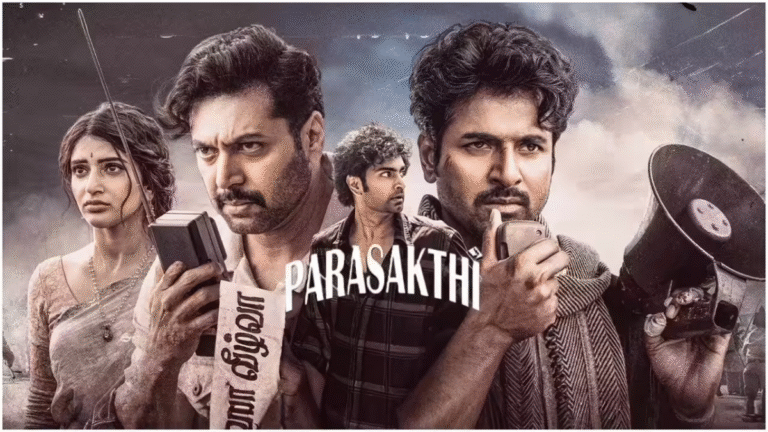
January 10, 2026: The anticipation was sky-high as Sivakarthikeyan’s 25th film, Parasakthi, hit screens this Saturday. Directed by the National Award-winning Sudha Kongara, the film promised a gritty, historical dive into the 1960s anti-Hindi agitations—a pivotal moment in Tamil Nadu’s political history. However, despite the grand scale and an earnest performance from its lead, Parasakthi struggles to bridge the gap between a high-concept historical drama and an engaging cinematic experience.

The Plot: A Journey Back to the 1960s

Set against the backdrop of the 1965 student-led protests, the film follows the journey of a young, idealistic student leader (Sivakarthikeyan) caught in the crosshairs of linguistic pride and political turmoil. The narrative attempts to weave a personal story of brotherhood and sacrifice into the larger tapestry of state-wide resistance. With Atharvaa Murali playing a fiery rebel and Jayam Ravi (Ravi Mohan) appearing in a powerful antagonistic shade, the stage was set for a clash of ideologies.

What Works: Visuals and Performances

From the very first frame, it is evident that Sudha Kongara and cinematographer Ravi K. Chandran have spared no effort in recreating the Madras of the 1960s. The production design is authentic, capturing the era’s essence through sepia-toned visuals and meticulous detailing of the student unions.

  • Sivakarthikeyan: In a departure from his usual “boy-next-door” roles, SK delivers a grounded and mature performance. His transformation for the role shows his commitment to evolving as a performer.
  • The Interval Block: This is arguably the film’s high point. The pre-interval sequences and the final “goosebump” moment before the break are masterfully directed, offering a glimpse of the “punch” the rest of the film lacks.
  • Supporting Cast: Atharvaa stands out as the emotional anchor of the first half, while Sreeleela brings a vibrant screen presence, even if her role feels somewhat restricted by the script’s gravity.

What Falls Short: Pacing and Execution

The primary undoing of Parasakthi lies in its sluggish screenplay and lengthy runtime. While the first half takes its time to set up the world, the second half becomes a test of patience for the audience.

  1. Stretched Narration: The film often gets bogged down by repetitive emotional beats. The transition from a student protest to a heavy political drama feels disjointed in parts.
  2. Weak Romantic Track: The chemistry between Sivakarthikeyan and Sreeleela, while charming in bits, feels like a “filler” that disrupts the serious tone of the movie.
  3. Music: For a film of this magnitude, G.V. Prakash Kumar’s score—while decent—doesn’t always elevate the scenes to the required emotional crescendo. Some of the songs feel misplaced in a story about intense social resistance.

The Verdict

Parasakthi is a noble attempt to document a significant chapter of Tamil history, and Sivakarthikeyan deserves praise for choosing such a heavy-weight project for his milestone 25th film. However, the “punch” that one expects from a Sudha Kongara directorial—similar to the raw energy of Soorarai Pottru—is missing here.

It is a visually rich period piece that remains an “average” watch due to its inconsistent pacing and lack of a tight narrative grip. For fans of political history and SK’s transformation, it’s a one-time watch; for those seeking a high-octane commercial entertainer, it might feel like a long day at the theater.

Himachal Crash: Viral Video Sparks Safety Outcry

0

New Delhi, january 10, 2026: A dramatic video capturing a high-speed three-car collision in Himachal Pradesh has set social media ablaze, reigniting a fierce national debate over road safety in the Himalayas. The footage, which has garnered millions of views across various platforms, serves as a chilling reminder of the razor-thin margin for error on India’s mountain highways.

The Incident: Chaos on the Curves

The viral clip, reportedly filmed on a dashcam, shows a sedan attempting a high-speed overtake on a narrow, winding stretch of a national highway. As the vehicle rounds a blind curve, it loses traction, fishtails, and slams into an oncoming SUV. The force of the impact sends both vehicles spinning into a third parked car, narrowly missing a steep precipice.

Local authorities confirmed that while there were significant injuries, a major tragedy was averted thanks to the deployment of airbags and the presence of a reinforced crash barrier—a detail that has become a focal point of the subsequent public discourse.

The Debate: Speed vs. Infrastructure

The video has divided netizens and experts alike, with the discussion centering on three critical pillars of road safety:

1. The Perils of Excessive Speed

Many viewers pointed to the “need for speed” culture among tourists. In the video, the lead vehicle appears to be traveling well above the recommended hill speed limit of 20–30 km/h for sharp bends.

  • Braking Physics: Experts note that on mountain gradients, the braking distance increases significantly due to momentum.
  • Driver Ego: Social media commentators highlighted the dangerous trend of “performance driving” on public roads for the sake of creating viral content.

2. Dangerous Road Design

While driver error is evident, a section of the public has blamed the “forgiving” nature of the road design.

  • Blind Spots: Critics argue that several stretches of the Himachal highways lack convex mirrors at sharp “U” turns, leaving drivers blind to oncoming traffic.
  • Lack of Run-off Areas: Unlike flat-terrain highways, mountain roads offer no room for recovery. Once a car loses control, it is either a collision or a plunge into a gorge.

3. Mechanical Failure or Human Error?

The debate also touched upon vehicle maintenance. The screeching sound of tires in the video led to discussions on the importance of Anti-lock Braking Systems (ABS) and the condition of brake pads when driving in high-altitude regions where “brake fade” is a common killer.

Safety Recommendations for Mountain Driving

In light of the incident, road safety organizations have issued a fresh set of guidelines for those navigating the Himachal terrain:

  • The “Honk and Wait” Rule: Always sound your horn before a blind curve and be prepared to stop.
  • Uphill Priority: Vehicles moving uphill have the right of way; those coming downhill must give space as it is harder to restart a vehicle on an incline.
  • Engine Braking: Instead of riding the brakes, use lower gears to control speed, preventing brake overheating.

Looking Ahead

The Himachal Pradesh police have intensified patrolling and speed-trap deployments following the viral outcry. However, the incident highlights a deeper issue: the need for a fundamental shift in how both tourists and locals respect the treacherous beauty of the mountains.