

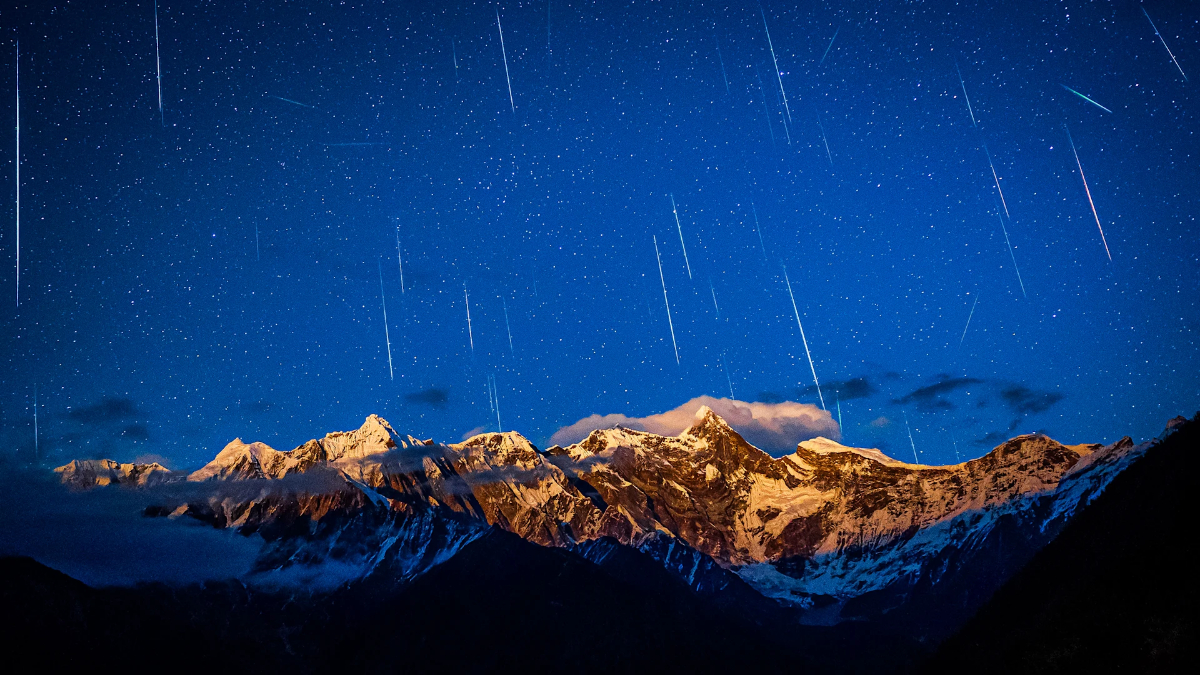
New Delhi, December 13, 2025: The annual Geminids meteor shower, often hailed as the most spectacular celestial event of the year, is once again gracing our skies. Stargazers are eagerly anticipating the peak of this dazzling display, which promises an exceptional show thanks to favorable moon conditions.
When and Where to Look
The Geminids are active throughout December, but the grand finale—the peak—is expected on the night of Saturday, December 13, into the early morning of Sunday, December 14, 2025.
- Peak Viewing Time: The best viewing window is from midnight to around 4:00 AM local time on December 14th, when the constellation from which the meteors appear to originate—Gemini, the Twins—is high in the sky. However, this is one of the few showers that offer good activity earlier in the evening, sometimes as early as 9:00 PM.
- Hourly Rate: Under ideal dark-sky conditions, observers could witness an impressive Zenithal Hourly Rate (ZHR) of up to 120 to 150 meteors per hour! Even from suburban areas, a significant number of bright streaks should be visible.
- Minimal Moon Interference: This year, conditions are near-perfect. A waning crescent moon will be present but will only rise in the pre-dawn hours (around 2:00 AM local time for many in the Northern Hemisphere). This leaves the prime midnight hours with a wonderfully dark, moon-free sky, a crucial factor for seeing fainter meteors.
What Makes the Geminids Unique?
Most meteor showers, like the famous Perseids, are born from the icy debris left behind by comets. The Geminids, however, are an anomaly.
- The ‘Rock Comet’ Parent: The source of the Geminids’ debris is not a comet, but an unusual object known as 3200 Phaethon. This object is classified as an asteroid, a rocky body. However, its highly elliptical, comet-like orbit and its tendency to brighten and even shed a small, temporary tail as it gets close to the Sun have earned it the nickname “rock comet.”
- Bright and Colorful Meteors: The rocky, denser nature of Phaethon’s debris produces meteors that are often brighter and more intensely colored than those from comets. Trace metals burning up in the atmosphere create flashes of white, yellow, and sometimes even green, red, or blue. These meteors also move at a moderate speed, making them easier to spot and enjoy.
Essential Viewing Tips
Meteor watching is a game of patience and preparation. To get the most out of the Geminids, follow these simple steps:
- Find the Darkest Sky: Get as far away from city lights as possible. Light pollution is the biggest enemy of meteor viewing.
- Look Up Comfortably: Bring a reclining chair or lie flat on a blanket. You don’t need a telescope or binoculars—your naked eyes are the best tools for scanning the wide expanse of the sky.
- Allow Eyes to Adjust: Give your eyes at least 20-30 minutes to fully adapt to the dark. Avoid looking at bright phone screens or other lights during this time.
- Know the Radiant (But Don’t Stare): The meteors will appear to shoot away from the constellation Gemini, specifically near the bright star Castor. However, you are more likely to see longer, more dramatic streaks by looking a little to the side, about 30 degrees away from the radiant.
- Dress Warmly: December nights can be freezing. Bundle up in layers, including hats, gloves, and warm footwear, to ensure a comfortable viewing experience.
Don’t miss this opportunity to catch one of the best annual cosmic displays. With favorable moonlight and a strong forecast, the 2025 Geminids are set to put on a truly unforgettable show.