

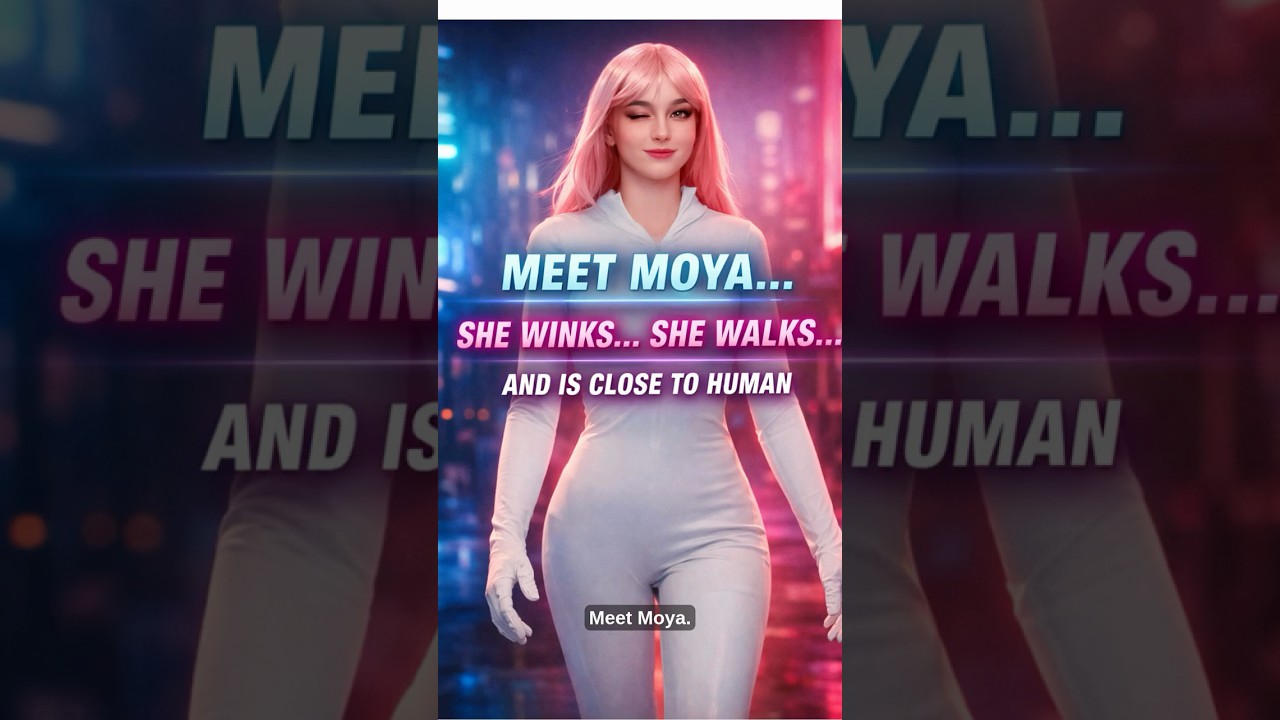
New Delhi, February 9, 2026: In a significant breakthrough for the robotics industry, a Shanghai-based startup has unveiled Moya, a humanoid robot that aims to bridge the gap between machinery and humanity. Developed by DroidUp (also known as Zhuoyide), Moya is being hailed as the world’s first “fully biomimetic embodied AI robot,” designed not just to perform tasks, but to simulate the physical and emotional presence of a human being.
Unveiled at the Zhangjiang Robotics Valley in early February 2026, Moya has quickly gone viral for its ability to mimic subtle human behaviors that traditional robots often lack, such as winking, maintaining eye contact, and even radiating body heat.
Redefining the “Human” in Humanoid
While companies like Tesla and Boston Dynamics have focused on industrial utility and athletic agility, DroidUp has prioritized social intelligence and emotional connectivity. Moya’s design philosophy centers on “Embodied AI”—a system where the artificial intelligence is deeply integrated into a physical form that can perceive, reason, and act within a human environment.
Key Technical Specifications
- Physical Proportions: Standing at 1.65 meters (5’5″) and weighing a lightweight 32 kg (70 lbs), Moya mirrors the average adult human frame.
- Walking Accuracy: The robot boasts a 92% human-like walking accuracy. While it still exhibits some mechanical stiffness, its gait is remarkably fluid compared to its predecessors.
- The “Walker 3” Chassis: Built on an upgraded modular skeleton, Moya utilizes lightweight lattice “muscles” and a hybrid carbon-fiber spine to achieve grace in movement.
Lifelike Features: Warmth and Expressions
What truly sets Moya apart is its “warm touch.” Unlike the cold, metallic feel of standard droids, Moya features internal thermal regulation that maintains a skin temperature between 32°C and 36°C (89.6°F to 96.8°F).
According to DroidUp founder Li Qingdu, a robot designed to serve people should not feel lifeless. To complement this physical warmth, Moya is equipped with over 25 independent facial motors, allowing it to execute “micro-expressions”—those tiny, fleeting movements like a slight smile or a curious tilt of the head that make a conversation feel authentic.
Practical Applications: Beyond the Factory Floor
DroidUp is not positioning Moya as a warehouse worker. Instead, the company sees a future for the robot in sectors where human empathy is vital:
- Healthcare & Elderly Care: Providing companionship, monitoring vitals, and offering reminders for medication in a way that feels less clinical and more personal.
- Education: Serving as an interactive tutor or teaching assistant capable of gauging a student’s engagement through facial recognition.
- Public Service: Acting as an approachable guide in museums, banks, or airports, where its ability to maintain eye contact can make navigation less intimidating for travelers.
Crossing the “Uncanny Valley”
Moya’s debut has reignited the debate over the Uncanny Valley—the psychological phenomenon where a near-perfect human likeness can trigger a sense of unease or “creepiness” in observers. Social media reactions have been starkly divided; while some marvel at the technological leap, others find the robot’s realistic gaze and warmth “disturbing.”
Despite the mixed reviews, the market potential is clear. DroidUp plans to launch Moya commercially by late 2026, with a starting price tag expected to be around ¥1.2 million (approximately $173,000).
As China continues to push the boundaries of the 14th Five-Year Plan for robotics, Moya represents a shift from “robots that work” to “robots that live” alongside us, marking a new chapter in the evolution of artificial intelligence.