

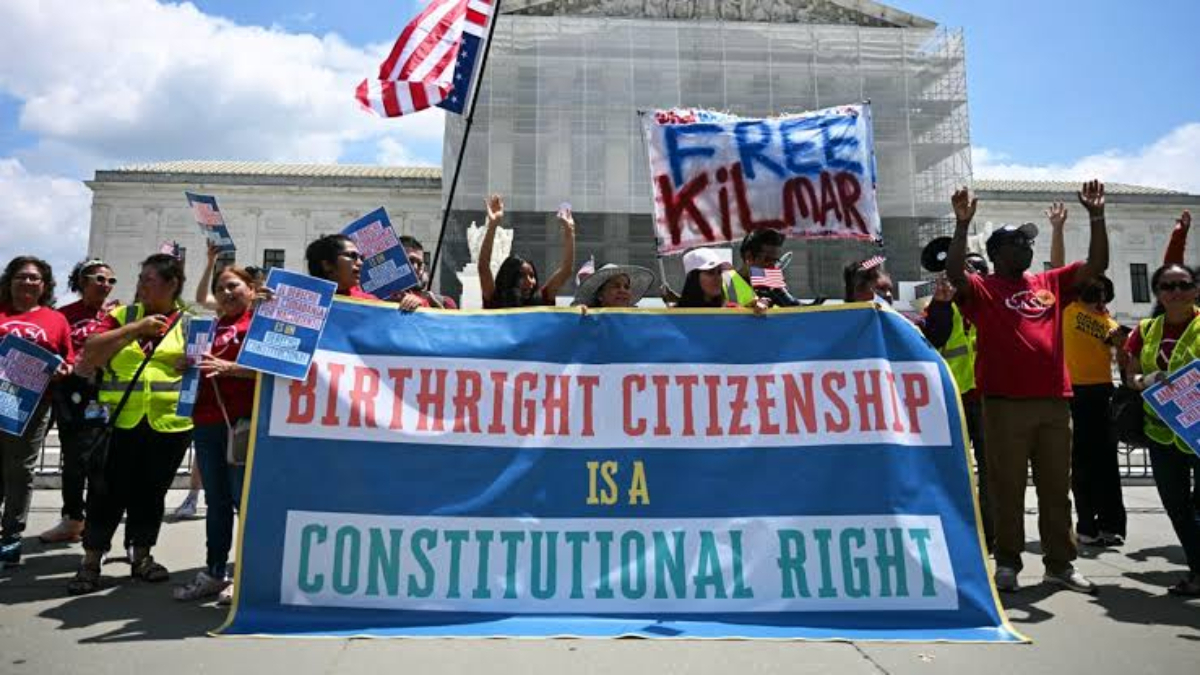
New Delhi, july 1, 2026: For thousands of Indian professionals living and working in the United States, the constant undercurrent of immigration anxiety just met its most defining legal shield. In a historic ruling, the U.S. Supreme Court struck down an executive order aimed at ending automatic birthright citizenship for children born to undocumented immigrants and temporary visa holders.
The decision represents a profound moment of relief for the Indian diaspora, particularly the massive workforce residing in the U.S. on high-skilled temporary visas like the H-1B. Had the administration’s executive order been upheld, it would have fundamentally upended the lives, family planning, and long-term security of one of America’s most economically vital immigrant communities.
The Historic Verdict: Upholding a 150-Year Promise
The Supreme Court’s decision flatly rejected the administration’s attempt to rewrite the traditional understanding of the 14th Amendment by executive fiat. The administration had argued that the phrase “subject to the jurisdiction thereof” should exclude children born to parents on temporary visas or those without legal status, asserting that these families do not hold permanent political allegiance to the United States.
The high court’s majority soundly dismissed this argument, anchoring their decision in more than a century of legal precedent dating back to the landmark 1898 United States v. Wong Kim Ark case.
By validating the Citizenship Clause, the court protected an estimated 250,000 children per year who would have otherwise been denied American citizenship at birth.
Why This Hits Home for the Indian H-1B Community
To understand why this ruling triggered an immediate wave of celebration and relief across Indian enclaves from Silicon Valley to New Jersey, one must understand the unique gridlock gripping Indian immigrants.
The Endless Green Card Backlog
Unlike many other immigrant groups, high-skilled Indian workers face a crushing, decades-long backlog for lawful permanent residency (green cards). Because of strict per-country caps established by U.S. immigration law, an Indian professional entering the green card line today could theoretically wait up to several decades for approval.
Consequently, hundreds of thousands of Indian engineers, doctors, data scientists, and executives spend their prime adult years living in a state of perpetual temporariness. They build lives, buy homes, and raise families in the U.S., yet their legal status remains tethered to temporary work visas that must be renewed every few years.
The Threat of Generational Limbo
If the executive order had taken effect, children born to Indian parents on H-1B or L-1 visas would have been denied U.S. passports. This would have forced parents into an impossible logistical and emotional nightmare:
- The Threat of Statelessness: Parents would have had to hastily register their children for Indian citizenship through local consulates.
- The Bureaucratic Trap: These U.S.-born children would then require dependent visas (like the H-4) just to live in the country where they were born.
- The Aging-Out Cliff: If the parents lost their jobs or were forced to return to India due to visa max-out limits, the children would have no independent right to stay in the U.S.
The ruling successfully dismantles this terrifying scenario, ensuring that while the parents navigate the volatile waves of corporate visa sponsorships, their children remain safely anchored to the legal protections of American citizenship.
Comparing the Stakes: What the Order Tried to Do vs. What the Court Affirmed
To put the magnitude of this decision into perspective, the following table outlines the drastic shift the executive order attempted to enforce compared to the reality preserved by the Supreme Court.
The Cultural and Practical Reality of “Split-Status” Families
While the Supreme Court’s decision provides massive structural relief, it does not rewrite standard U.S. immigration law regarding the parents themselves. A child’s status as an American citizen does not automatically grant permanent residency or legal immigration benefits to their foreign-born parents. Under current law, a U.S. citizen child cannot sponsor their parents for a green card until they reach the age of 21.
Furthermore, India does not permit full dual citizenship. When an infant is born in the U.S. to Indian nationals, they automatically become an American citizen. Because they cannot hold an Indian passport simultaneously, Indian parents rely heavily on the Overseas Citizen of India (OCI) card.
The OCI card acts as a lifelong, multi-purpose visa that allows U.S.-born children to travel to India freely, live there indefinitely, and study or work without special permits. The high court’s ruling guarantees that families can continue utilizing this seamless, globally mobile structure without the fear of their children falling into a stateless void.
A Triumph of Stability Over Uncertainty
For the 5.4 million people of Indian origin living in the United States, this ruling is far more than a dry breakdown of constitutional law; it is validation of their deep stakes in the American fabric. High-skilled Indian immigrants represent a foundational pillar of America’s technological and economic dominance, contributing heavily to tax bases and corporate innovation while patiently waiting their turn in broken legislative lines.
By securing the future of their children, the Supreme Court has stripped away a layer of acute vulnerability. While the broader fight over comprehensive immigration reform and green card backlogs will undoubtedly stretch on in Congress, Indian families can sleep a bit easier knowing that the ground beneath their children’s feet remains unshakeable.
For a broader breakdown of how the Justices arrived at this decision on the final day of their term, you can view this Supreme Court Upholds Birthright Citizenship Coverage, which details the legal arguments presented by both sides during this historic session.