
, chaired by Defence Minister Rajnath Singh)
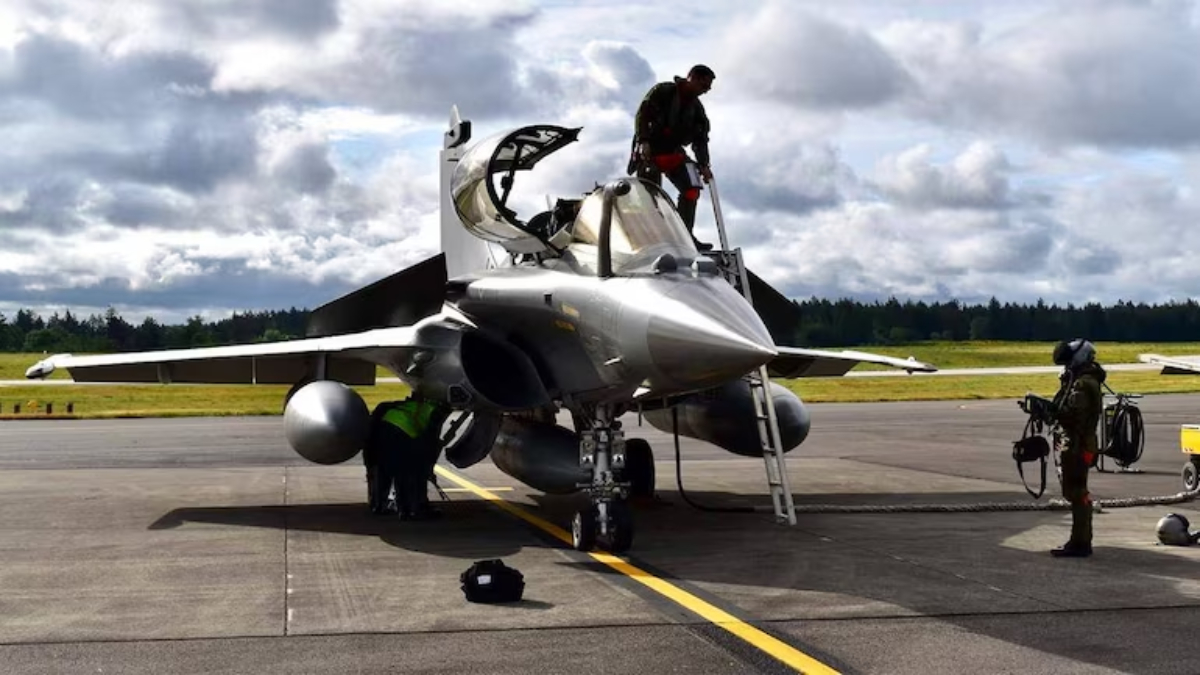
New Delhi, February 12, 2026: In a landmark move for India’s military modernization, the Defence Acquisition Council (DAC), chaired by Defence Minister Rajnath Singh, met today to deliberate on high-stakes procurement deals. Topping the agenda is the multi-billion dollar acquisition of 114 Rafale multi-role fighter jets and the pioneering induction of High-Altitude Pseudo Satellites (HAPS).
These decisions come at a strategic juncture, just days before French President Emmanuel Macron’s scheduled visit to India, signaling a deepening of the Indo-French strategic partnership and a firm push toward self-reliance in cutting-edge surveillance technology.
1. The “Mother of All Defence Deals”: 114 Rafale Jets
The most significant item on the table is the ₹3.25 lakh crore proposal for 114 Rafale fighter aircraft. Aimed at addressing the Indian Air Force’s (IAF) dwindling squadron strength, this deal is being hailed as one of the largest in global aviation history.
Key Highlights of the Proposal:
- The “Make in India” Component: Unlike the previous procurement of 36 jets in fly-away condition, the current plan envisions a massive domestic manufacturing push. Out of 114 jets, 18 are expected to be procured off-the-shelf, while the remaining 96 will be manufactured in India through a partnership between Dassault Aviation and an Indian production partner.
- Squadron Boost: The IAF currently operates roughly 30–31 fighter squadrons against a sanctioned strength of 42. This acquisition would add approximately six to seven squadrons, significantly bridging the gap.
- Advanced Weaponry: The jets are expected to be equipped with state-of-the-art weaponry, including Meteor beyond-visual-range missiles and SCALP cruise missiles, further enhancing India’s air superiority.
2. High-Altitude Pseudo Satellites (HAPS): The New Frontier
In a move to revolutionize persistent surveillance, the DAC is set to grant the Acceptance of Necessity (AoN) for High-Altitude Pseudo Satellites. These represent a “missing link” between conventional drones and space-based satellites.
Why HAPS Matters:
- Endurance & Altitude: These solar-powered unmanned platforms operate in the stratosphere—about 20 km above the Earth—well above commercial air traffic. They can stay airborne for months, providing constant monitoring without the need for orbital launches.
- Border & Maritime Security: For a country with vast and rugged borders, HAPS offers a cost-effective solution for round-the-clock surveillance. Unlike satellites that pass over a location at intervals, HAPS can “stare” at a specific region indefinitely.
- Indigenous Innovation: This project aligns with the Atmanirbhar Bharat initiative, with organizations like the National Aerospace Laboratories (NAL) and private startups leading the development of these solar-powered “atmospheric satellites.”
3. Strengthening the Navy: P-8I Poseidon Aircraft
The council is also expected to clear the procurement of six additional P-8I Poseidon maritime patrol aircraft. Developed by Boeing, these aircraft are the “eyes of the Navy” in the Indian Ocean Region, specialized in anti-submarine warfare (ASW) and long-range maritime reconnaissance. With increasing naval activity in the Indo-Pacific, expanding this fleet is seen as a critical necessity for maritime domain awareness.
4. Strategic Implications
The timing of this DAC meeting is no coincidence. As President Macron arrives next week for the AI Summit, the progress on the Rafale deal underscores France’s role as a primary defense ally. Moreover, by focusing on HAPS and domestic manufacturing of fighter jets, India is sending a clear message: while it continues to modernize with global technology, the future of its defense infrastructure is rooted in indigenous production and high-tech innovation.
What’s Next?
Once the DAC grants the Acceptance of Necessity (AoN), the proposals will undergo commercial negotiations before moving to the Cabinet Committee on Security (CCS) for final financial approval.