

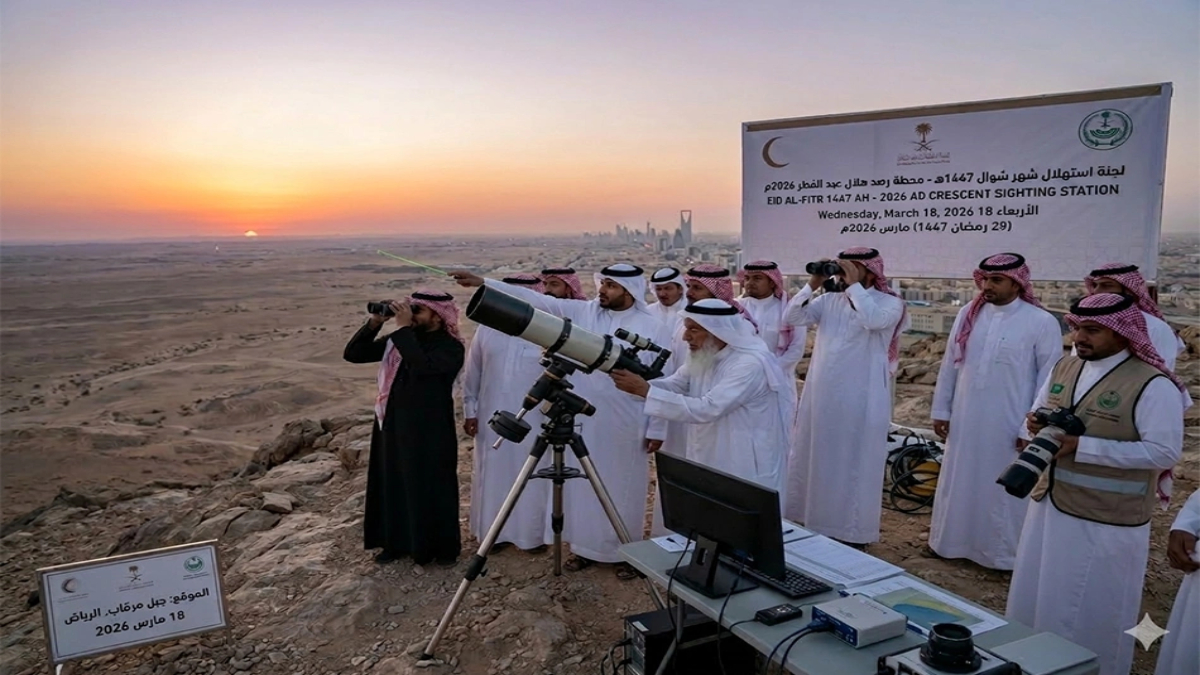
New Delhi, March 17, 2026 — As the holy month of Ramadan 1447 AH draws to a close, the Supreme Court of Saudi Arabia has officially called upon all Muslims throughout the Kingdom to sight the crescent moon of the month of Shawwal on the evening of Wednesday, March 18, 2026.
The sighting of the Shawwal crescent is a pivotal moment in the Islamic calendar, as it marks the end of the month-long dawn-to-sunset fasting and signals the commencement of Eid ul Fitr, the “Festival of Breaking the Fast.”
The Official Sighting Announcement
In a statement issued by the Royal Court, the Supreme Court urged citizens and residents to keep a lookout for the new moon. According to the Umm Al-Qura calendar, Wednesday, March 18, corresponds to the 29th day of Ramadan.
The court has requested that anyone who sights the crescent—whether with the naked eye or through binoculars—report their testimony to the nearest court or registration center. This collective effort ensures that the religious declaration is backed by verified eyewitness accounts from various regions across the Kingdom.
When is Eid ul Fitr 2026 in KSA?
The exact date of the celebration depends entirely on the moon’s visibility:
- Scenario A: If the crescent is sighted on Wednesday evening (March 18), then Ramadan will consist of 29 days. In this case, Eid ul Fitr will be celebrated on Thursday, March 19, 2026.
- Scenario B: If the moon is not visible on Wednesday, Ramadan will complete a 30-day cycle. Consequently, Eid ul Fitr will fall on Friday, March 20, 2026.
Holiday Dates and Preparations
The Saudi Ministry of Human Resources and Social Development has already outlined the holiday schedule for the public and private sectors. For most employees, the Eid break is expected to begin at the end of the workday on Wednesday, March 18, allowing families to gather and prepare for the festivities.
Across the Kingdom, from the bustling streets of Riyadh to the holy cities of Makkah and Madinah, preparations are in full swing.
- Shopping: Markets are witnessing a surge in “Chand Raat” (the night of the moon) shoppers buying new clothes, gifts, and ingredients for traditional feasts.
- Zakat Al Fitr: Authorities have reminded the faithful to pay Zakat Al Fitr (charity) before the Eid prayer, ensuring that the less fortunate can also participate in the celebrations.
- Eid Prayers: Large squares and mosques are being prepared to accommodate millions of worshippers for the special congregational prayers held shortly after sunrise on the first day of Shawwal.
Global Significance
The announcement from Saudi Arabia is watched closely by Muslim communities worldwide. While many countries, particularly in South Asia like India and Pakistan, rely on their own local sightings (often celebrating a day later), the Kingdom’s declaration often guides the start of Eid for many Western nations and Gulf neighbors like the UAE, Qatar, and Kuwait.