

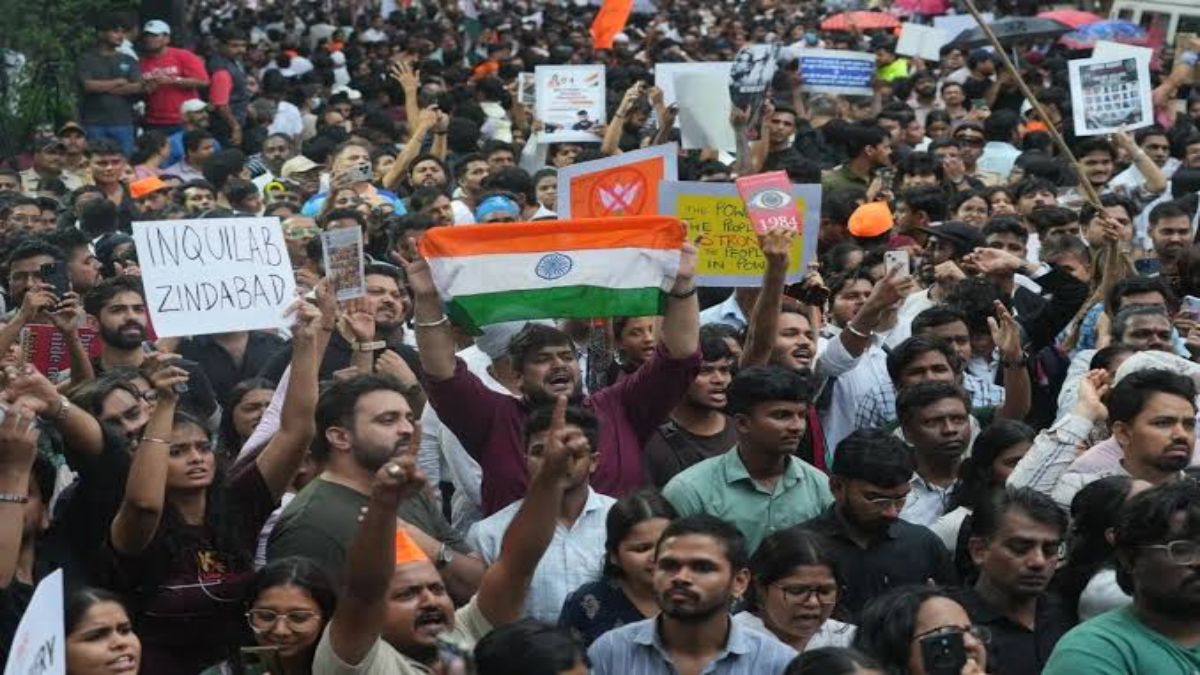
NEW DELHI — Tensions reached a boiling point in the heart of India’s capital as thousands of student activists, young job-seekers, and civil rights groups gathered at Jantar Mantar to attempt a high-stakes march toward Parliament. Defying explicit police bans, the crowd—rallying under the banner of the youth-led Cockroach Janta Party (CJP)—demanded the immediate resignation of Union Education Minister Dharmendra Pradhan over widespread examination paper leaks and corruption in national competitive tests.
The demonstration, dubbed the “Chalo Sansad” (March to Parliament) rally, coincides with the opening day of Parliament’s Monsoon Session. With Delhi Police erecting multi-layered steel barricades, deploying heavy security contingents, and imposing strict prohibitory orders under Section 163 of the Bharatiya Nagarik Suraksha Sanhita (BNSS), the capital braced for a tense standoff between state authorities and one of the largest youth mobilizations the country has seen in years.
From Judicial Insult to National Movement
The origin of the “Cockroach” label traces back to May 2026, when a Supreme Court judge made a passing remark comparing unemployed young job applicants to “cockroaches” during an unrelated hearing. Rather than taking offense, frustrated students embraced the term self-deprecatingly, asking a simple question online: “What happens if all the cockroaches come together?”
Founded by digital activist Abhijeet Dipke, the Cockroach Janta Party quickly transformed from an internet movement into a political force. Within days, the movement amassed over 22 million followers on social media, uniting students across the country who felt demoralized by chronic delays, high-profile leaks in national entrance tests (such as NEET), and double-digit urban youth unemployment.
What started as online satire morphed into a physical sit-in at New Delhi’s Jantar Mantar. For weeks, students camped in the sweltering heat, demanding structural overhaul in India’s examination administration, compensation for families of students who tragically died by suicide following leaked exams, and legal accountability for systemic corruption.
Escalation: The Detaining of Sonam Wangchuk
The movement gained explosive momentum following the forced hospitalization of renowned education reformer and climate activist Sonam Wangchuk. Wangchuk, who had joined the Jantar Mantar sit-in and was on the 21st day of an indefinite hunger strike, was forcibly moved by Delhi Police to Safdarjung Hospital due to deteriorating vital parameters and critically low potassium levels.
Wangchuk’s removal sparked widespread indignation across the country, drawing additional student unions, opposition figures, and farmers’ organizations to the protest camp overnight. In a handwritten note shared from his hospital bed, Wangchuk described the planned July 20 march as India’s “Second Freedom Movement”—calling for “freedom from injustice” regarding paper leaks and “freedom from fear” against state crackdowns.
With Wangchuk hospitalized, Angmo stepped up to lead the march alongside CJP founder Abhijeet Dipke, promising that the movement would maintain absolute non-violence despite government pressure.
Security Gridlock in New Delhi
Ahead of the planned march, Delhi Police issued clear public notices warning that no authorization had been sought or granted for a procession to Parliament.
Authorities sealed major entry points into the New Delhi district, performing thorough vehicle checks and deploying anti-riot units, water cannons, and paramilitary forces along the routes connecting Jantar Mantar to the Parliament complex. Loudspeakers placed around the protest perimeter continuously warned demonstrators that assembling or marching beyond designated boundaries would result in immediate legal action and detention under Section 223 of the Bharatiya Nyaya Sanhita (BNS).
Despite these warnings, thousands of young demonstrators—carrying backpacks filled with water, snacks, and mobile power banks—camped overnight at Jantar Mantar, singing patriotic songs and chanting slogans including “#DharmendraPradhanMustResign” and “Quit Corruption!”
Voices from the Ground
For many participating in the demonstration, the rally is less about political affiliation and more about securing a fair future.
- Adi Nathan (21), student from Meerut: “We spend years preparing for competitive exams, sacrificing our sleep and our families’ hard-earned money, only to find out the question paper was sold hours before the exam. We are here because we want this cycle of paper leaks to end once and for all.”
- Mohammed Tabrez (22), competitive exam candidate from Uttar Pradesh: “All we are asking for is basic fairness. When exams are canceled or leaked, years of our life are wiped out. The system has failed us, and nobody is held accountable.”
Economists and policy analysts point out that the Cockroach movement highlights underlying economic tensions. While India’s broader economy continues to grow, youth unemployment among urban youth aged 15–29 remains elevated at around 13.6%. With millions competing for a handful of government jobs and university seats, examination integrity has become a sensitive trigger for public anger.
Key Demands of the Cockroach Movement
The Cockroach Janta Party’s core demands center around six structural reforms:
- Ministerial Accountability: The immediate resignation of Union Education Minister Dharmendra Pradhan over exam management failures.
- Central Examination Law: Implementation of stringent, non-bailable criminal penalties for leak kingpins and corrupt testing agencies.
- Independent Oversight: Establishment of a national, autonomous student grievance committee to audit testing procedures.
- Compensation & Fee Waivers: Financial compensation for affected families and free re-examinations for students impacted by leaked paper cancellations.
- Fast-Track Courts: Creation of special courts dedicated to prosecuting paper leak cases within 90 days.
- Whistleblower Protections: Secure systems for students and teachers to report test leaks or irregularities without fear of retaliation.
What Lies Ahead
As Parliament opens its session, lawmakers inside face an intense political showdown over the youth movement’s demands, with opposition parties signaling their intent to halt parliamentary proceedings until the education crisis is formally debated.
Outside, the standoff between thousands of young protesters and heavily armored security forces presents one of the most visible public challenges to the government in recent years. Whether the movement succeeds in breaching police barricades or forces legislative action from within the house, the “Cockroach” uprising marks a major shift in how India’s youth organize and demand accountability in the digital era.