

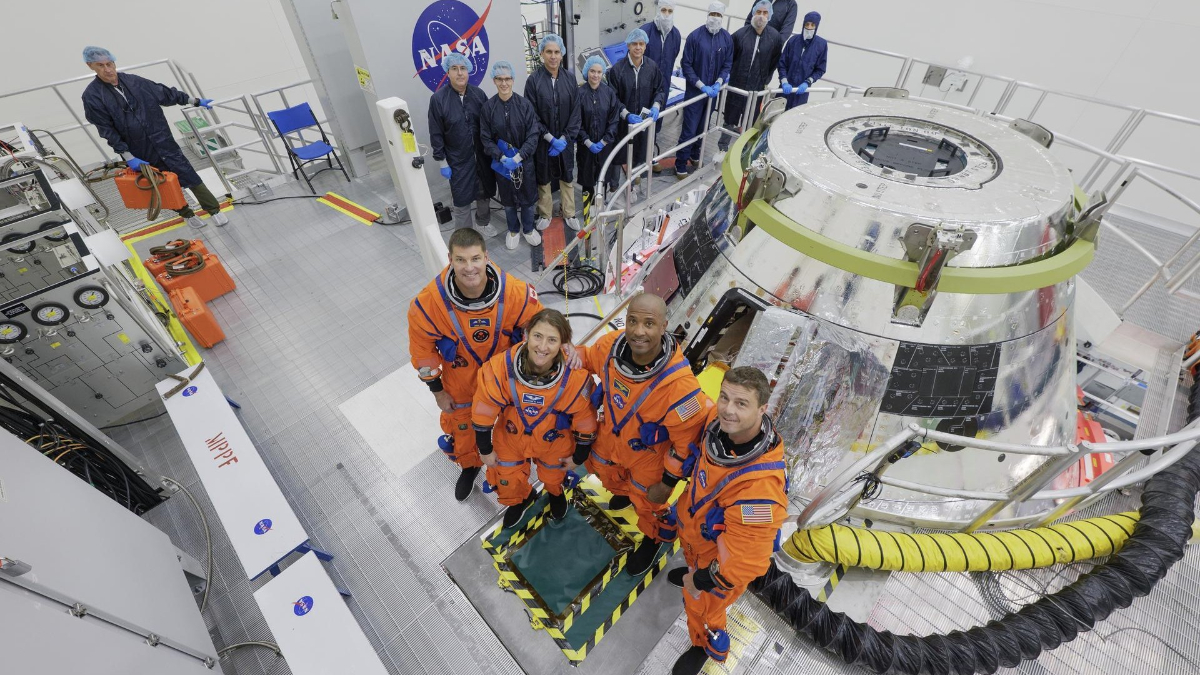
New Delhi, April 29, 2026 — The Orion spacecraft that carried four astronauts on a historic journey around the Moon has finally returned home. On Tuesday, April 28, 2026, the capsule—proudly dubbed Integrity by its crew—arrived back at NASA’s Kennedy Space Center in Florida, marking the final homecoming of a mission that has captivated the world.
The return to the launch site comes nearly a month after the Artemis II mission roared to life on April 1, 2026, sending humanity on its first lunar flyby in more than half a century.
A Record-Setting Voyage
The Artemis II mission was more than just a flight; it was a demonstration of the next generation of human space exploration. The crew—Commander Reid Wiseman, Pilot Victor Glover, and Mission Specialists Christina Koch (NASA) and Jeremy Hansen (Canadian Space Agency)—spent ten days in deep space, pushing the boundaries of what has been achieved since the Apollo era.
During their nearly 10-day journey, the crew reached a distance of 252,756 miles (406,771 kilometers) from Earth, surpassing the distance record previously held by the Apollo 13 mission in 1970. The mission provided the world with breathtaking, real-time documentation of the Moon’s far side, captured through high-quality photos, video footage, and firsthand observations that have reignited global interest in lunar exploration.
“A Perfect Mission”
Following a successful splashdown in the Pacific Ocean on April 10, 2026, the Orion capsule was recovered by U.S. Navy and NASA teams before being transported via truck from San Diego to the Kennedy Space Center.
NASA officials have characterized the mission as a resounding success. Despite a minor, humorous hiccup with the spacecraft’s onboard toilet system, the vehicle performed exceptionally well under the harsh conditions of deep space.
“The systems designed for deep space travel have proven they are working as planned,” said a NASA spokesperson. For the crew, the mission was a profound experience. Commander Reid Wiseman, reflecting on the experience via social media after returning to Earth, shared a sentiment of peace and perspective, noting that his focus is now on processing the monumental nature of the journey.
What’s Next for Artemis?
The arrival of the capsule back at Kennedy Space Center is not the end, but rather a new beginning for the engineering teams.
Engineers are now beginning a meticulous inspection of the Integrity capsule. Key areas of focus include:
- The Heat Shield: A detailed analysis of the heat shield’s performance during the high-speed re-entry into Earth’s atmosphere.
- Systems Recycling: The removal and examination of electronic components and research equipment for potential reuse or data analysis.
- Data Gathering: Using the flight data to refine safety protocols and systems for future human missions.
This data is vital for the upcoming Artemis III mission. While Artemis II proved that humans can safely navigate the path to and around the Moon, the next phase will focus on complexity. Artemis III will feature a new crew and a different capsule, with plans to practice critical docking maneuvers in Earth’s orbit alongside lunar landers currently in development by private aerospace partners.
As NASA sets its sights on the next decade, the successful return of the Artemis II capsule stands as a testament to international collaboration and technological resilience. The path to a sustained human presence on the Moon—and eventually, missions to Mars—is officially well underway.