

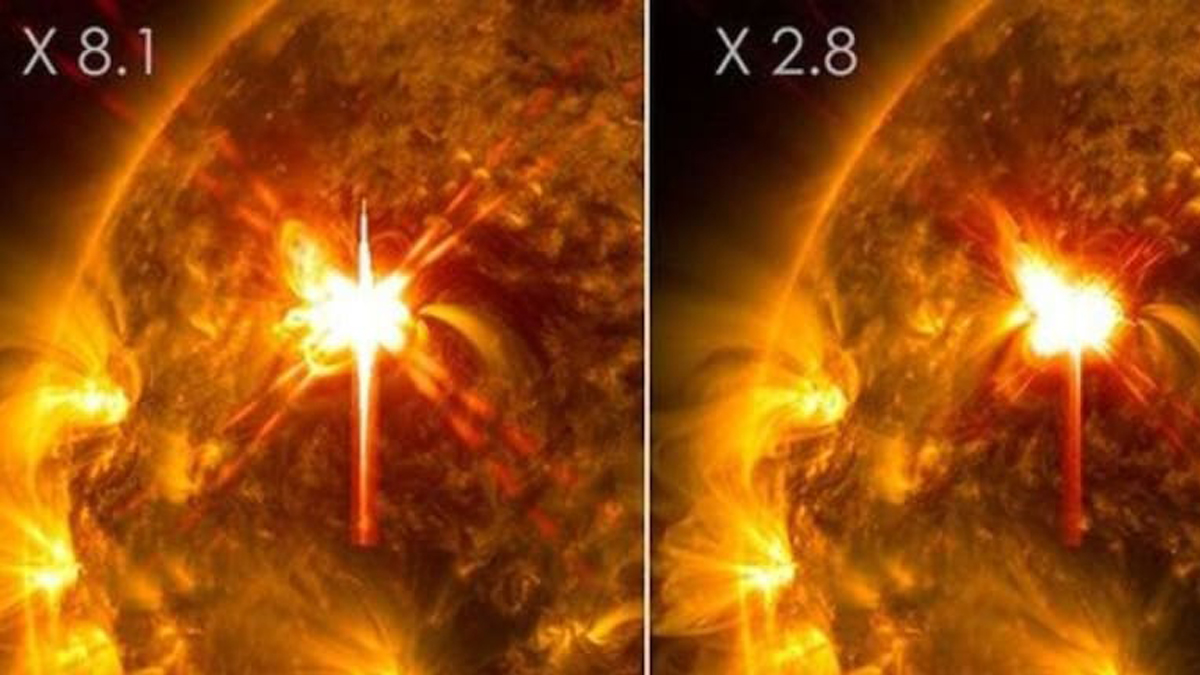
New Delhi, February 5, 2026: The Sun has entered a period of extreme volatility, firing off a series of massive solar flares this week that have already triggered radio blackouts on Earth and sparked alerts for a looming geomagnetic storm. a rapidly growing sunspot designated Region 4366—now nicknamed the “Solar Flare Factory”—erupted with more than 20 significant flares. Among these were four “X-class” events, which represent the most intense category of solar explosions.
The Record-Breaking Blast
The highlight of this solar barrage was a staggering X8.1 flare that peaked on the evening of February 1. To put that in perspective:
- It is the most powerful solar flare recorded so far in 2026.
- It ranks as the strongest eruption since late 2024.
- It is currently one of the top 20 most energetic flares observed since 1996.
This was followed closely by an X4.2 flare on February 4, confirming that the sunspot is not yet finished with its display of celestial fireworks.
Real-World Impacts: Blackouts and Auroras
While these flares occur 93 million miles away, their effects are felt almost instantly. The radiation from the X8.1 event caused R3-level (Strong) radio blackouts across the South Pacific, disrupting shortwave signals in eastern Australia and New Zealand. Pilots, mariners, and ham radio operators in those regions reported significant interference as the Sun ionized the upper layers of Earth’s atmosphere.
Beyond communication hiccups, the “main event” may still be coming. Many of these flares were accompanied by Coronal Mass Ejections (CMEs)—huge clouds of solar plasma and magnetic fields.
- The Forecast: Experts at NOAA’s Space Weather Prediction Center expect these plasma clouds to reach Earth by Thursday, February 5.
- The Reward: While CMEs can stress power grids, they also fuel the Northern and Southern Lights (Auroras). If the impact is direct, vibrant light shows could be visible much further from the poles than usual, potentially reaching mid-latitude regions.
Why Now? The Solar Cycle Status
If it feels like the Sun has been unusually hyperactive lately, you’re right. We are currently navigating the peak years of Solar Cycle 25. Although some scientists believe we may have technically passed the “solar maximum” in 2025, history shows that the years immediately following the peak often produce the most violent and erratic individual storms.
What’s Next?
NASA’s Solar Dynamics Observatory is keeping a 24/7 watch on sunspot 4366 as it rotates to face Earth more directly. With its unstable magnetic structure, there is a high probability of further X-class flares throughout the week. For now, satellite operators and power grid managers are on high alert, while skywatchers are keeping their cameras ready for a potential weekend of spectacular auroras.